Indian AI Royalty Proposal for Content Creators Data Usage
Source:The Hindu ↗
Why It Matters
The intersection of AI innovation and intellectual property rights is a crucial global debate. This Indian proposal represents a unique governance model (centralized royalty) contrasting with US and EU approaches, making it highly relevant for questions on technology regulation, fair use, and creator rights in GS3 (Science & Tech / IPR) and GS2 (Government Policies).
Summary
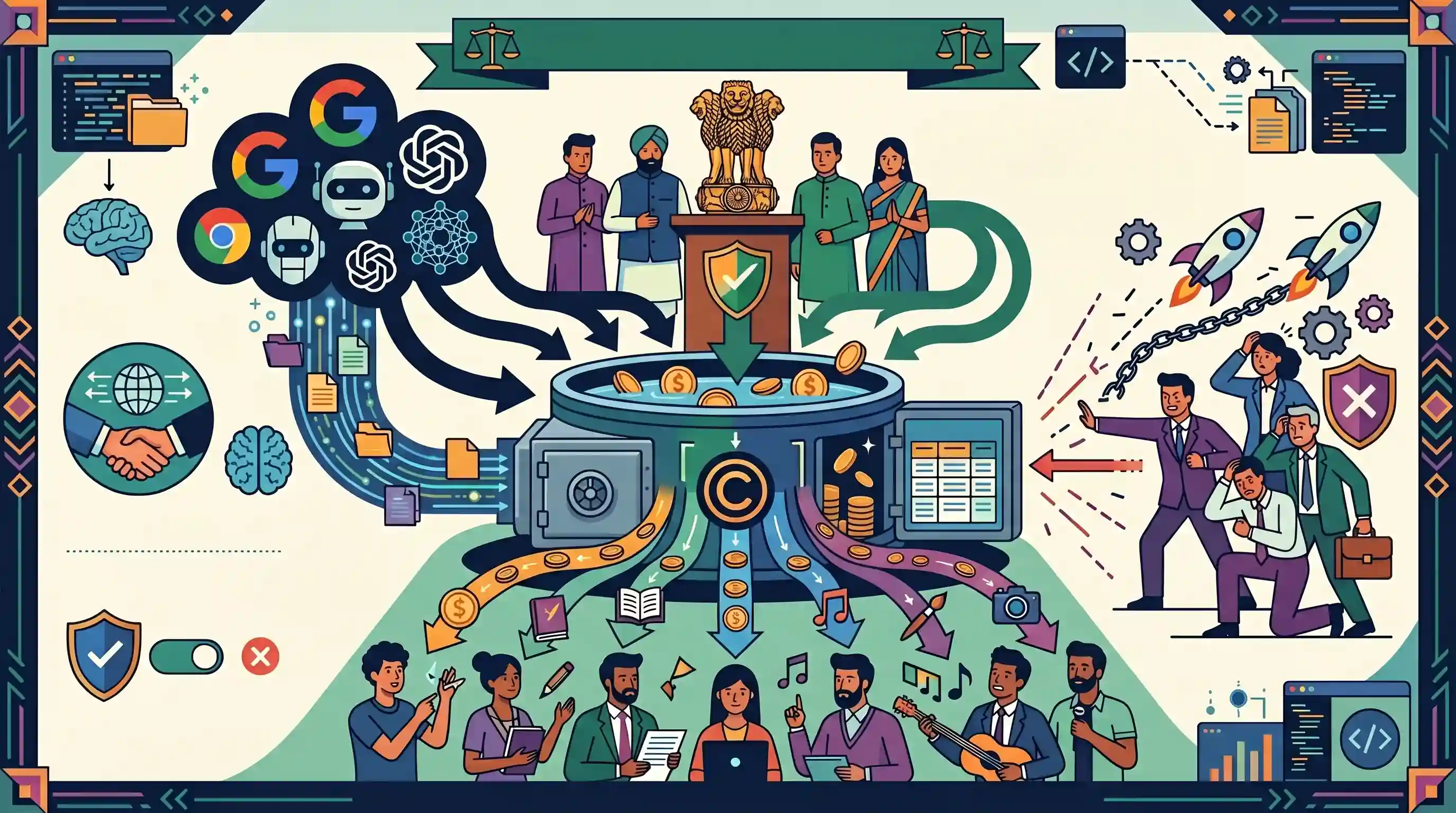
An Indian government panel has proposed a new regulatory framework requiring Artificial Intelligence companies like Google and OpenAI to pay royalties to content creators for using their data to train AI models. The panel advocates for a centralized royalty pool managed by a copyright body, contrasting sharply with the US 'fair use' approach and rejecting the EU's 'opt-out' model as ineffective for creators. The proposal, aimed at protecting intellectual property rights in the generative AI era, faces strong opposition from tech and media industry bodies like Nasscom and the Motion Picture Association, who argue it amounts to a tax on innovation.
Key Points
- An Indian government panel has proposed that AI companies pay content creators a share of revenue for using their work to train models.
- The proposal suggests a centralized body to collect and distribute royalties, avoiding the \'opt-out\' model seen in the EU which the panel deems ineffective.
- This diverges from the US stance, where AI giants claim training on publicly available data is \'fair use\'.
- Industry bodies like Nasscom and the Motion Picture Association oppose the move, calling it a \'tax on innovation\'.
Important Terms
Copyright Act, 1957

India's primary legislation (amended 2012) protecting literary and artistic works. It grants creators exclusive rights and outlines 'fair dealing' exceptions for research and education.
UPSC context
GS Paper 3: IPR. Crucial for analyzing how traditional laws adapt to disruptive technologies like Generative AI.
Doctrine of Fair Dealing
A legal doctrine under Section 52 of India's Copyright Act allowing limited use of copyrighted works without permission for specific purposes like research, criticism, or news reporting.
UPSC context
GS Paper 3: IPR. Tests the legal boundary between commercial AI training and statutory exceptions in Indian law.
Copyright Royalty Collective for AI Training (CRCAT)
The proposed centralized agency in India tasked with collecting mandatory royalties from AI companies to compensate creators whose data is used for model training.
UPSC context
GS Paper 3: Regulation. Represents India's unique 'statutory licensing' approach compared to US or EU models.
NASSCOM
The apex trade body for India's IT-BPM industry. It advocates for tech-friendly policies and recently dissented against mandatory AI royalties, calling them a 'tax on innovation.'
UPSC context
GS Paper 3: Economy/IT. A key stakeholder in the digital economy and regulatory consultations.
ANI (Asian News International)
The leading Indian news agency that filed a landmark lawsuit against OpenAI, alleging unauthorized use of its news content to train ChatGPT.
UPSC context
GS Paper 3: Science & Tech. Involved in India's first major legal precedent for AI and copyright infringement.
OpenAI
The US-based research organization and creator of ChatGPT. It argues that training AI on public data constitutes 'fair use' and questions Indian court jurisdiction.
UPSC context
GS Paper 3: Technology. A central global player whose operations challenge national data and IPR frameworks.
Generative AI
A subset of AI that produces new content (text, image, code) by analyzing patterns in vast datasets, triggering global debates over data scraping and creator rights.
UPSC context
GS Paper 3: Science & Tech. A core emerging technology topic requiring understanding of both potential and regulatory risks.
Prelims Trap
"India's proposed AI framework adopts the European Union's 'opt-out' model to protect content creators."
The DPIIT panel explicitly rejected the EU's 'opt-out' model, arguing it places an unfair burden on creators, proposing a mandatory central royalty pool instead.
Static Concepts Connected
What is 'Fair Dealing' under the Indian Copyright Act, 1957?
- Definition: An exception allowing limited use of copyrighted material without permission. It is more restrictive than the broader US 'Fair Use' doctrine.
- Permitted Uses: Includes private/personal research, criticism, review, and reporting of current events (Section 52 of the Act).
- Commercial AI Gap: Mass data scraping for commercial AI training currently falls outside these traditional exceptions, necessitating new regulatory frameworks.
How do generative AI models utilize Text and Data Mining (TDM)?
- Data Scraping: AI developers use automated bots to scrape massive volumes of publicly available internet data, including text, images, and code.
- Model Training: TDM processes this unstructured data, feeding it into neural networks to train the model on patterns, syntax, and semantics.
- The IPR Conflict: Because the ingested datasets inevitably contain copyrighted material, outputting derivative content raises massive copyright infringement and compensation concerns globally.
Cross-Topic Patterns
Data Sovereignty to AI Data Royalties
Just as the DPDP Act focused on data localization and privacy, the new IPR regime shifts the focus to monetizing Indian intellectual capital against exploitation by foreign Big Tech algorithms.
Divergent Global Tech Regulation Models
India relies on central state-backed entities (like the proposed CRCAT), the EU focuses on rigid citizen rights (opt-out), and the US favors corporate 'fair use' to drive innovation.

Expect a GS3 Mains question in 2026 comparing India's proposed AI royalty framework with the US 'fair use' and EU's opt-out approaches.
Linked PYQs · 5
Linked PYQs · 5
- 2023MainsGS3
Introduce the concept of Artificial Intelligence (AI). How does Al help clinical diagnosis? Do you perceive any threat to privacy of the individual in the use of Al in healthcare?
- 2014MainsGS3
In a globalized world, Intellectual Property Rights assume significance and are a source of litigation. Broadly distinguish between the terms-Copyrights, Patents and Trade Secrets.
- 2020PrelimsGS1
With the present state of development, Artificial Intelligence can effectively do which of the following? 1. Bring down electricity consumption in industrial units 2. Create meaningful short stories and songs 3. Disease diagnosis 4. Text-to-Speech Conversion 5. Wireless transmission of electrical energy Select the correct answer using the code given below:
- 2002PrelimsGS1
Consider the following statements: 1. The World Intellectual Property Organisation (WIPO) is a specialised agency of United Nations System of Organisations 2. WIPO has its headquarters at Rome 3. The Trade Related Aspects of Intellectual Property Rights (TRIPS) Agreement is binding on all WTO members 4. Least developed country members of WTO are not required to apply the provisions of TRIPS Agreements for a period of 20 years from the general date of application of the Agreement Which of these statements are correct?
- 2023PrelimsGS1
Consider the investments in the following assets: 1. Brand recognition 2. Inventory 3. Intellectual property 4. Mailing list of clients How many of the above are considered intangible investments?
