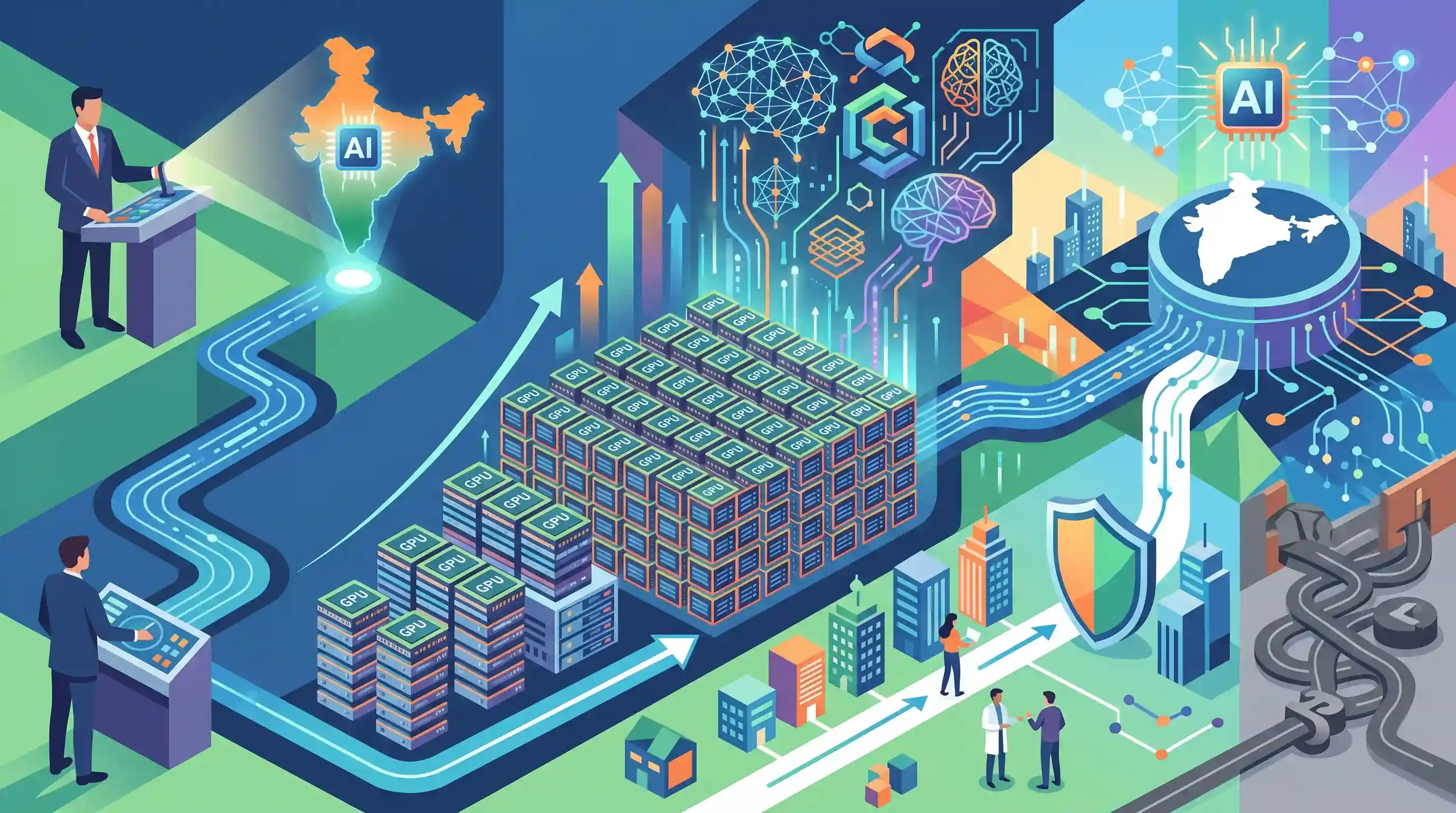
India aims to triple domestic GPU compute capacity by 2026
Source:Indian Express ↗
Why It Matters
Artificial Intelligence is a transformative emerging technology with vast socio-economic implications. Compute infrastructure (like GPUs) is the primary bottleneck globally for AI development. Understanding India's strategy to build domestic computing capacity under the IndiaAI Mission is highly relevant for GS-3 questions regarding technological self-reliance, digital economy, and AI applications.
Summary
The CEO of the IndiaAI Mission has stated that India's Graphics Processing Unit (GPU) compute capacity is projected to triple, reaching 100,000 units by the end of 2026. This substantial infrastructure upgrade is being driven by the IndiaAI Mission to foster an indigenous artificial intelligence ecosystem. Since GPUs are essential for training complex AI systems and Large Language Models (LLMs), building domestic compute capacity aims to provide affordable infrastructure to Indian startups and researchers. The initiative is a strategic move toward technological sovereignty, aiming to reduce India's reliance on foreign tech giants and position the country as a leader in AI innovation and digital public infrastructure.
Key Points
- India aims to triple its domestic Graphics Processing Unit (GPU) capacity to approximately 100,000 by the end of 2026, according to the IndiaAI Mission CEO.
- GPUs are the fundamental hardware infrastructure required for running complex machine learning algorithms, deep learning, and training Large Language Models (LLMs).
- The scale-up is a core component of the IndiaAI Mission, which seeks to provide subsidized compute capacity to domestic startups, researchers, and academic institutions.
- Expanding indigenous AI compute infrastructure is critical for reducing dependence on foreign cloud providers, ensuring data sovereignty, and advancing India's technological self-reliance.
- Beyond compute infrastructure, the IndiaAI Mission focuses on building indigenous datasets, fostering AI talent, and deploying AI solutions in governance, healthcare, and agriculture.
Important Terms
IndiaAI Mission

A national program under MeitY with a ₹10,371 crore outlay to build a self-reliant AI ecosystem through seven pillars, including compute capacity and startup financing.
UPSC context
GS-III: Science and Technology. Important for questions on national technology missions and AI governance in India.
Graphics Processing Unit (GPU)
Specialized electronic circuits designed to accelerate image processing and complex parallel computations, now critical for training and running large-scale Artificial Intelligence models.
UPSC context
GS-III: IT and Computers. Relevant for technical components of digital infrastructure and emerging technologies.
Large Language Models (LLMs)
AI systems trained on massive datasets to understand and generate human-like text, forming the foundation for tools like ChatGPT and indigenous projects like BharatGen.
UPSC context
GS-III: S&T. Tests knowledge of generative AI and India's efforts to build sovereign foundation models.
Technological Sovereignty
A state's ability to control its digital destiny, including hardware, data, and software, reducing reliance on foreign entities for critical technological needs.
UPSC context
GS-II: International Relations/Governance. Central to debates on data protection, strategic autonomy, and high-tech self-reliance.
Digital Public Infrastructure (DPI)
Open-source digital blocks like Aadhaar, UPI, and Bhashini that provide essential services to citizens at scale, now being integrated with AI for social impact.
UPSC context
GS-II & III: Governance and Economy. A signature Indian model for digital inclusion and economic growth.
Indigenization of Technology
The process of developing and manufacturing technology within the country to achieve self-reliance (Atmanirbhar Bharat) and reduce import dependence in strategic sectors.
UPSC context
GS-III: S&T. Key theme for defense, semiconductor, and AI policy questions.
Prelims Trap
The IndiaAI Mission aims to indigenously manufacture 100,000 GPU chips by the end of 2026.
The mission focuses on building GPU compute capacity (infrastructure and cloud access) for startups, not fabricating the actual GPU semiconductor chips domestically.
Static Concepts Connected
What is the fundamental difference between CPUs and GPUs?
- Architecture: CPUs have a few powerful cores optimized for sequential processing; GPUs have thousands of smaller cores designed for highly parallel processing.
- AI Suitability: Training Large Language Models (LLMs) requires massive simultaneous matrix multiplications, making the parallel architecture of GPUs essential compared to CPUs.
- Core Function: CPUs handle complex logic and operating system tasks, while GPUs accelerate rendering, deep learning, and data-heavy workloads.
What are the core pillars of the IndiaAI Mission?
- Compute Capacity: Providing subsidized and accessible GPU infrastructure to domestic startups, researchers, and academic institutions.
- AI Datasets: Creating an indigenous datasets platform (AIKosh) to provide diverse, localized data for training culturally relevant AI models.
- Sectoral Application: Deploying AI-driven technological interventions in critical socio-economic sectors like healthcare, agriculture, and governance.
Cross-Topic Patterns
Evolution of DPI: From Identity to Compute
India is expanding its Digital Public Infrastructure (DPI) model from software layers (Aadhaar, UPI, ONDC) to hardware, treating AI compute capacity as an affordable public good for startups.
Synergy: Semiconductor Mission & IndiaAI
While the India Semiconductor Mission builds chip-fabrication capabilities and self-reliance, the IndiaAI Mission creates the domestic demand and ecosystem for advanced processing hardware.

Expect a multi-statement Prelims question contrasting CPU vs GPU architectures, combined with IndiaAI Mission's compute capacity targets.
Linked PYQs · 3
Linked PYQs · 3
- 2023MainsGS3
Introduce the concept of Artificial Intelligence (AI). How does Al help clinical diagnosis? Do you perceive any threat to privacy of the individual in the use of Al in healthcare?
- 2024PrelimsGS1
Consider the following statements: I. It is expected that Majorana 1 chip will enable quantum computing. II. Majorana 1 chip has been introduced by Amazon Web Services (AWS). III. Deep learning is a subset of machine learning. Which of the statements given above are correct?
- 2023MainsGS3
What is the status of digitalization in the Indian economy? Examine the problems faced in this regard and suggest improvements.
