India National Security Doctrine and Cross Border Terror
Source:The Hindu ↗
Why It Matters
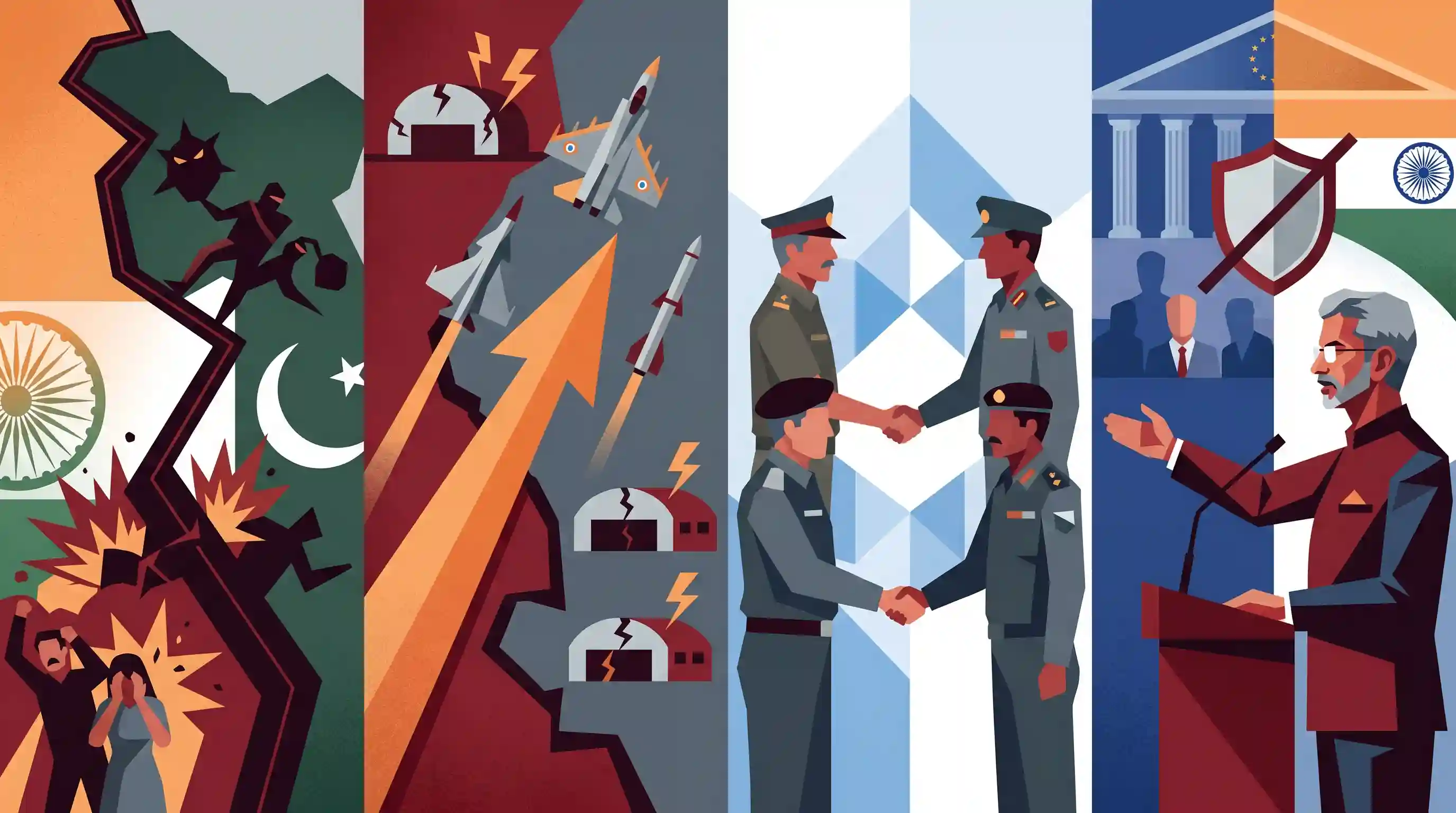
This highlights India's evolving national security doctrine, demonstrating a shift toward proactive military retaliation (Operation Sindoor) against state-sponsored cross-border terrorism while pairing kinetic action with intense diplomatic pressure.
Summary
External Affairs Minister S. Jaishankar issued a strong warning that India will retaliate deep inside Pakistani territory if provoked by further cross-border terrorist attacks. The statements followed India's recent military action, 'Operation Sindoor', launched in response to the Pahalgam terror attack in April 2025 that killed 26 people. India's precision strikes targeted terror infrastructure and severely disabled key Pakistani airfields, leading to a ceasefire agreement between the DGMOs on May 10. Reaffirming India's zero-tolerance policy against terrorism, Jaishankar criticized Pakistan for treating terrorism as an instrument of state policy and conveyed this uncompromising stance during his diplomatic engagements in Europe.
Key Points
- India executed 'Operation Sindoor', conducting precision strikes deep into Pakistan and PoK on May 7 in retaliation for the deadly Pahalgam terror attack on April 22.
- The military hostilities ceased on May 10 following talks between DGMOs, after Indian forces reportedly disabled eight major Pakistani airfields using systems like the Rafale.
- External Affairs Minister S. Jaishankar firmly warned of retribution targeting terrorist groups and their leadership directly in Pakistani territory if further provoked.
- Jaishankar emphasized that Pakistan remains heavily dependent on cross-border terrorism as an instrument of state policy, keeping regional tensions high.
- The statements were made as India engages diplomatically with European nations (including France and Belgium) to assert its zero-tolerance policy toward terrorism.
Important Terms
Operation Sindoor

India's May 2025 military response to the Pahalgam terror attack, involving precision air and missile strikes against terrorist infrastructure and military assets deep within Pakistani territory.
UPSC context
GS Paper III (Internal Security); tests knowledge of India's evolving 'proactive' counter-terrorism doctrine and strategic shifts.
Cross-border Terrorism
Terrorism involving perpetrators or sponsors based in one country launching attacks in another; it is a primary challenge in India-Pakistan bilateral relations.
UPSC context
GS Paper III (Security); fundamental for understanding regional instability and the role of non-state actors.
State-sponsored Terrorism
The active support, funding, or provision of sanctuary to terrorist groups by a sovereign government to achieve strategic foreign policy objectives against another nation.
UPSC context
GS Paper II (International Relations); critical for discussing India's diplomatic efforts to internationally isolate terror-exporting regimes.
Precision Strikes
Highly accurate military attacks—using drones or missiles—designed to neutralize specific enemy targets (like terror camps) while minimizing unintended civilian or non-combatant casualties.
UPSC context
GS Paper III (Defense); relevant for modern warfare tactics and technology-driven security responses.
Zero-tolerance Policy
The Indian government's uncompromising administrative stance that mandates immediate and punitive action against all terrorist activities and their support structures.
UPSC context
GS Paper III (Internal Security/Policy); reflects the core national security strategy and political resolve in counter-terrorism.
DGMO (Director General of Military Operations)
A senior military official in charge of directing tactical operations; the DGMO is the primary channel for military communication between India and Pakistan during crises.
UPSC context
GS Paper III (Defense/Crisis Management); essential for understanding de-escalation mechanisms and military-level diplomacy.
Prelims Trap
"The UN Comprehensive Convention on International Terrorism (CCIT) is an enforced global treaty defining terrorism."
The CCIT is a 1996 Indian proposal that remains a draft. It has NOT been adopted globally due to disagreements over the definition of terrorism.
Static Concepts Connected
What characterizes India's evolving doctrine against cross-border terrorism?
- Strategic Restraint: Earlier policy focused purely on defensive border-hardening and diplomatic isolation without direct military retaliation inside PoK or Pakistan.
- Offensive Defense: Current doctrine relies on deterrence by punishment, using pre-emptive or retaliatory precision strikes to neutralize terror infrastructure across the LoC.
- Proactive Diplomacy: Simultaneously coupling hard-power military actions with immediate global outreach to secure diplomatic backing and isolate the adversary.
What is the role of the DGMO in India-Pakistan border management?
- Military Hotline: Operates as a direct hotline between the Director Generals of Military Operations of both nations to manage real-time crises and prevent unintended escalation.
- Ceasefire Mechanisms: Negotiates, implements, and monitors ground-level ceasefires (e.g., the 2003 LoC ceasefire, the 2021 reaffirmation, and recent pacts) to stabilize the border.
Cross-Topic Patterns
FATF mechanisms + state-sponsored terror
India leverages military strikes alongside global financial frameworks (like FATF) to pressure Pakistan's terror financing networks, integrating hard military power with economic diplomacy.
Standoff weapons + escalation control
Operations utilizing Rafales and SCALP missiles demonstrate how advanced imported standoff tech alters the escalation matrix, allowing India to strike deep without physically crossing hostile airspace.

Expect a GS-3 Mains question evaluating India's 'Offensive Defense' doctrine, linking standoff tech (Rafale) with DGMO de-escalation.
Linked PYQs · 3
Linked PYQs · 3
- 2020MainsGS3
Analyze internal security threats and transborder crimes along Myanmar, Bangladesh and Pakistan borders including Line of Control (LoC). Also discuss the role played by various security forces in this regard.
- 2016MainsGS2
Increasing cross-border terrorist attacks in India and growing interference in the internal affairs of several member-states by Pakistan are not conducive for the future of SAARC (South Asian Association for Regional Cooperation)." Explain with suitable examples.
- 2015MainsGS2
Terrorist activities and mutual distrust have clouded India-Pakistan relations. To what extent the use of soft power like sports and cultural exchanges could help generate goodwill between the two countries? Discuss with suitable examples.
