Bilateral Trade Agreement Prospects Between India and United States
Source:The Hindu ↗
Why It Matters
This article is crucial for understanding the current trajectory of India-US relations and the impact of the Trump administration's protectionist trade policies (such as baseline tariffs) on the global economy. It illustrates how India is navigating bilateral negotiations to safeguard its economic and strategic interests amid rising protectionism and US-China trade tensions.
Summary
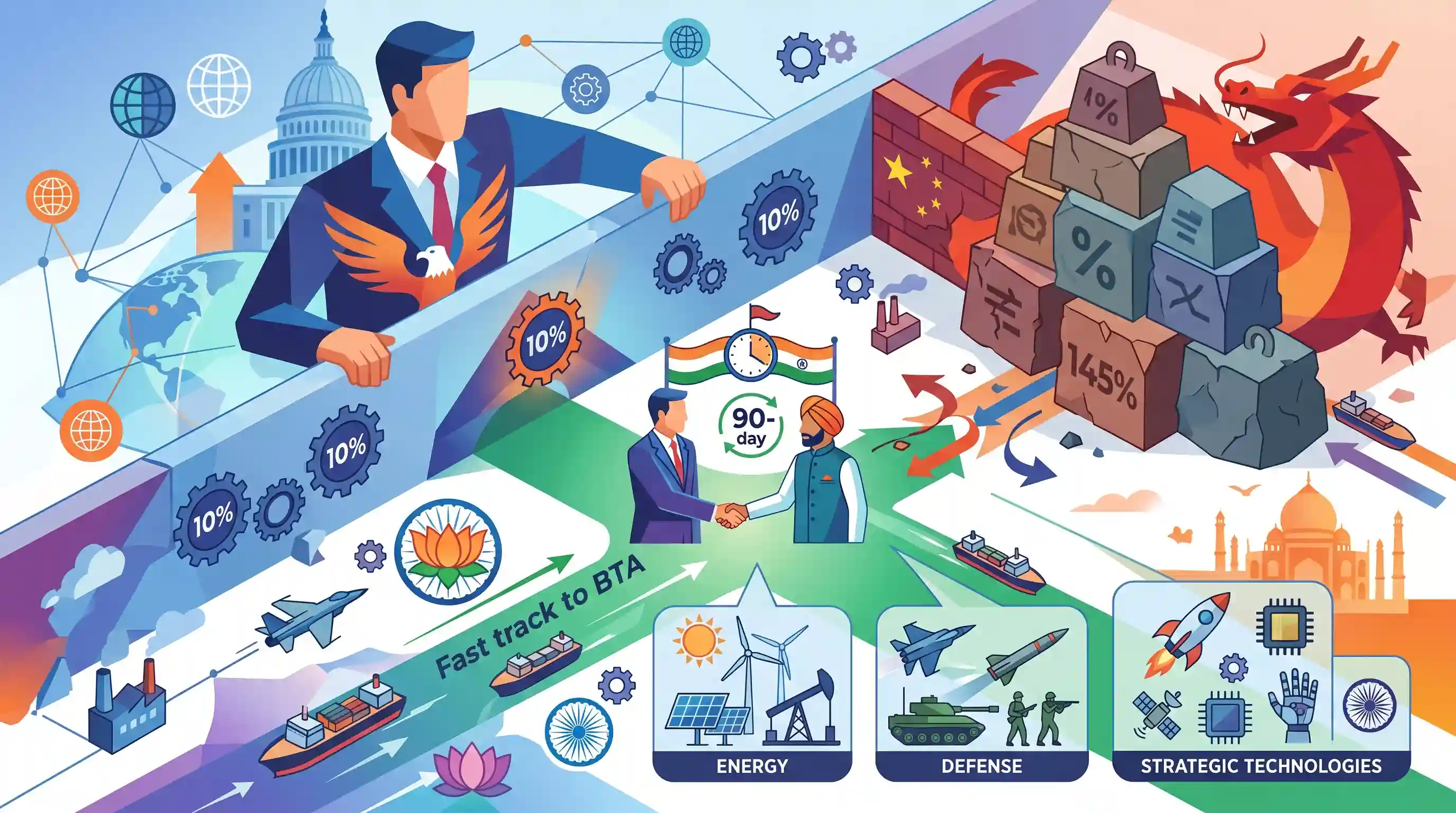
U.S. Treasury Secretary Scott Bessent has indicated that India will likely be among the first nations to finalize a bilateral trade agreement (BTA) with the United States. This development comes as the Trump administration implements a baseline 10% global tariff while temporarily suspending more aggressive reciprocal tariffs for 90 days to facilitate negotiations. Vice President JD Vance's recent visit to India highlighted substantial progress toward a broad-based partnership encompassing energy, defence, and strategic technologies. This diplomatic progress contrasts sharply with the U.S. stance on China, which faces steep tariffs of up to 145%.
Key Points
- U.S. Treasury Secretary Scott Bessent stated that India is poised to be one of the first countries to finalize a bilateral trade deal with the United States.
- The U.S. administration has implemented an across-the-board 10% tariff but temporarily suspended individual reciprocal tariffs for 90 days to allow for negotiations.
- Bilateral talks are progressing positively with Asian partners, with U.S. Vice President JD Vance reporting substantial progress after a recent visit to India.
- The prospective India-U.S. Bilateral Trade Agreement (BTA) is expected to cover diverse sectors including energy cooperation, defence, and strategic technologies.
- Meanwhile, the U.S. maintains exceptionally high tariffs (up to 145%) on China, placing the onus on Beijing to de-escalate trade tensions.
Important Terms
Bilateral Trade Agreement (BTA)

A formal pact between two nations to reduce trade barriers, eliminate tariffs, and ease market access for goods and services to boost mutual economic exchange.
UPSC context
GS Paper II/III; tests knowledge of bilateral groupings and their impact on India’s 'Mission 500' trade target.
U.S. Treasury Department
The American executive department responsible for federal finances, currency production, economic policy, and implementing international financial sanctions or trade-related fiscal measures.
UPSC context
GS Paper II/III; relevant for global financial stability and the impact of U.S. fiscal policies on India’s economy.
Reciprocal Tariffs
Import duties imposed by one country matching the rates levied on its own exports by a trading partner to ensure a level playing field.
UPSC context
GS Paper III; tests understanding of trade wars, protectionism, and the 'effect of policies of developed countries' on India's interests.
Trade Protectionism
Economic policies like high tariffs, quotas, and subsidies designed to shield domestic industries from foreign competition by restricting international trade.
UPSC context
GS Paper III; vital for analyzing macroeconomic stability, export competitiveness, and challenges to the rules-based global trade order.
Strategic Trade Authorization (STA-1)
A U.S. regulatory status allowing trusted partners license-free access to sensitive dual-use technologies for defense and high-tech sectors.
UPSC context
GS Paper II; signifies India’s status as a 'Major Defense Partner' and its responsible role in global export control regimes.
Prelims Trap
India currently has a comprehensive Free Trade Agreement (FTA) with the United States.
India and the US currently do not have a comprehensive FTA. They are negotiating a new Bilateral Trade Agreement (BTA) to bypass new tariffs.
Static Concepts Connected
How do reciprocal tariffs interact with WTO's Most-Favoured-Nation (MFN) principle?
- MFN Principle: The core WTO rule requiring members to apply the same baseline tariff rate to all trading partners, preventing arbitrary discrimination.
- Reciprocal Tariffs: Levying matching tariffs on a specific country violates basic MFN rules unless justified under specific WTO-allowed exceptions.
- Article XXIV Exception: Under WTO Article XXIV, countries can bypass MFN to offer lower/zero tariffs if they form a formal Free Trade Agreement or Customs Union.
What are the core tenets of Friendshoring and the China Plus One strategy?
- China Plus One: A supply chain strategy where multinational companies diversify their manufacturing and sourcing outside of China to mitigate over-dependence and geopolitical risks.
- Friendshoring: Rerouting supply chains specifically to countries perceived as politically, economically, or militarily allied, reducing the risk of trade weaponization.
Cross-Topic Patterns
Strategic Tech (iCET) driving trade pacts
The proposed BTA explicitly includes strategic technologies, demonstrating how diplomatic frameworks like the India-US iCET (Initiative on Critical and Emerging Technology) are maturing into formal, binding trade chapters.
Protectionism and Currency Watchlists
Aggressive US tariff policies often run parallel to the US Treasury's "Currency Manipulator" watchlist, a lever historically deployed to pressure Asian emerging economies during bilateral negotiations.

A 2026 Prelims multi-statement question will likely mix WTO MFN exceptions with US 'reciprocal tariffs' and India's current BTA status.
Linked PYQs · 3
Linked PYQs · 3
- 2019MainsGS2
‘What introduces friction into the ties between India and the United States is that Washington is still unable to find for India a position in its global strategy, which would satisfy India's national self-esteem and ambitions.’ Explain with suitable examples.
- 2025MainsGS3
What are the challenges before the Indian economy when the world is moving away from free trade and multilateralism to protectionism and bilateralism? How can these challenges be met?
- 2018MainsGS3
How would the recent phenomena of protectionism and currency manipulations in world trade affect macroeconomic stability of India?
