Formulation of Comprehensive National Military Space Doctrine
Source:The Hindu ↗
Why It Matters
The weaponisation of space and the inclusion of space as a domain of warfare reflect a shift in global and national security paradigms. This is highly relevant for GS-3 discussions regarding external state threats, defence modernisations, and the synergy between defence forces and the private sector in space technology.
Summary
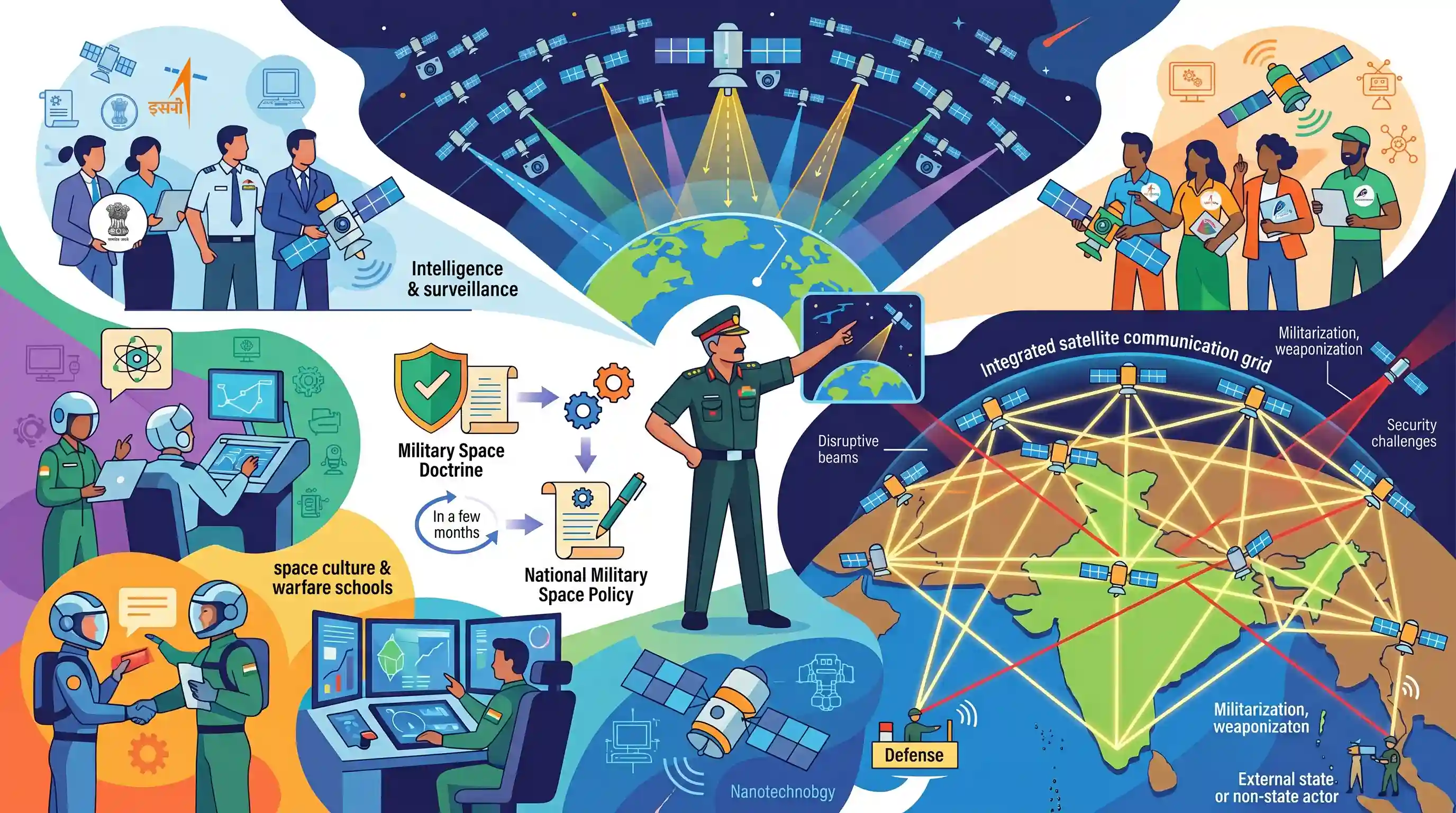
Chief of Defence Staff General Anil Chauhan announced that India is working on a military space doctrine and a national military space policy, expected to be ready in two to three months. Speaking at the Indian DefSpace Symposium, he highlighted space as a newly emerging domain of warfare, necessitating a dedicated 'space culture' and warfare schools. To bolster defence capabilities, the government has approved a 52-satellite constellation for intelligence and surveillance, leaning on a collaborative approach between ISRO and private players. Furthermore, the Defence Space Agency is developing an integrated satellite communication grid to mitigate vulnerabilities amid the growing militarisation and weaponisation of space.
Key Points
- India is developing a 'military space doctrine' and a 'national military space policy' expected to be released within a few months, according to Chief of Defence Staff General Anil Chauhan.
- Recognizing space as a new domain of warfare, the CDS emphasized the need to develop a 'space culture' including doctrines, research, and warfare schools.
- The government approved a 52-satellite constellation for defence (intelligence, surveillance, and reconnaissance), 31 of which will be built by the private sector in partnership with ISRO.
- The Defence Space Agency is working on an integrated satellite communication grid to counter potential threats from the ongoing militarisation and weaponisation of space.
Important Terms
Military Space Doctrine

A strategic framework defining how India's armed forces will operate in the space domain, focusing on deterrence, protecting space-based assets, and integrating satellite capabilities into terrestrial combat operations.
UPSC context
GS Paper III (Internal Security/Science & Tech); essential for understanding space as the fifth domain of warfare and modern military strategy.
National Military Space Policy
A high-level government framework currently under development to outline India's strategic vision for space-based national security, complementing the civil-oriented Indian Space Policy 2023 with specific military objectives.
UPSC context
GS Paper III; relevant for national security architecture and the evolution of India's space governance from civil to dual-use.
Defence Space Agency (DSA)
A tri-services agency established in 2019 to command India's space warfare assets and manage satellite-based intelligence, surveillance, and reconnaissance (ISR) for the Army, Navy, and Air Force.
UPSC context
GS Paper III; tests knowledge of tri-service commands and institutional reforms aimed at achieving military synergy across operational domains.
Militarisation vs. Weaponisation of Space
Militarisation involves using space for support roles (surveillance/GPS); weaponisation refers to placing destructive weapons in orbit or developing systems (like ASATs) to destroy or disable celestial assets.
UPSC context
GS Paper II (IR) & III; tests conceptual clarity on international treaties (e.g., Outer Space Treaty) and the global arms race.
Space-Based Surveillance (SBS) Phase-III
A ₹26,968 crore project to launch 52 satellites (21 by ISRO, 31 by private firms) by 2029 to provide persistent, real-time surveillance over India's land borders and maritime regions.
UPSC context
GS Paper III; critical for questions on border management, indigenous technology, and the role of private players in Indian defence.
Indian Space Research Organisation (ISRO)
India's primary space agency, increasingly acting as a key strategic partner for the military by developing dedicated defence satellites and transferring launch technologies like SSLV to private industry.
UPSC context
GS Paper III; relevant for indigenization of technology and the shift from pure scientific research to supporting national security.
Prelims Trap
"The Outer Space Treaty (1967) prohibits both the militarisation and weaponisation of outer space, including conventional weapons."
The treaty bans WMDs in space, but it does NOT explicitly prohibit conventional weapons in orbit or the broader use of space assets for military support (militarisation).
Static Concepts Connected
What are the key prohibitions and allowances under the Outer Space Treaty (1967)?
- WMD Ban: Strictly prohibits placing nuclear weapons or any other weapons of mass destruction (WMDs) in orbit or on celestial bodies.
- Peaceful Celestial Bodies: Celestial bodies must be used exclusively for peaceful purposes. Establishing military bases or testing weapons on them is forbidden.
- Conventional Weapons Permitted: The treaty does not ban placing conventional weapons in orbit, nor does it ban using satellites for military communication and reconnaissance.
What is the institutional architecture for India's military space operations?
- Defence Space Agency (DSA): A tri-service agency established in 2019 to command India's space warfare assets and counter space-based threats.
- Defence Space Research Organisation: Provides scientific and technological research support directly to the Defence Space Agency to develop military space capabilities.
- Mission DefSpace: An initiative launched to leverage the private sector and startups for developing innovative space-defence solutions.
Cross-Topic Patterns
Private sector in sovereign space defense
The allocation of 31 defence ISR satellites to private players marks a shift from ISRO monopoly to a civil-military-private fusion, strictly aligning with the Indian Space Policy 2023.
Cyber-Space-EW theaterisation overlap
The DSA's integrated satcom grid connects to India's push for theaterisation. It forces a doctrinal overlap between space assets, the Defence Cyber Agency, and electronic warfare commands.

Expect a 2026 GS-3 question evaluating India’s shift from passive space security to active space deterrence (DSA, ASAT, DefSpace).
Linked PYQs · 4
Linked PYQs · 4
- 2016MainsGS3
Discuss India's achievements in the field of Space Science and Technology. How the application of this technology has helped India in its socio-economic development?
- 2019MainsGS3
What is India's plan to have its own space station and how will it benefit our space programme?
- 2023MainsGS3
The use of unmanned aerial vehicles (UAVs) by our adversaries across the borders to ferry arms/ammunitions, drugs, etc., is a serious threat to the internal security. Comment on the measures being taken to tackle this threat.
- 2023MainsGS3
What are the internal security challenges being faced by India? Give out the role of Central Intelligence and Investigative Agencies tasked to counter such threats.
