India Withdraws Bid to Host COP33 Climate Summit
Source:The Hindu ↗
Why It Matters
Understanding the dynamics of international climate diplomacy, including summit hosting rotations and India's updated NDC targets, is crucial for answering questions on India's environmental commitments and global climate change negotiations.
Summary
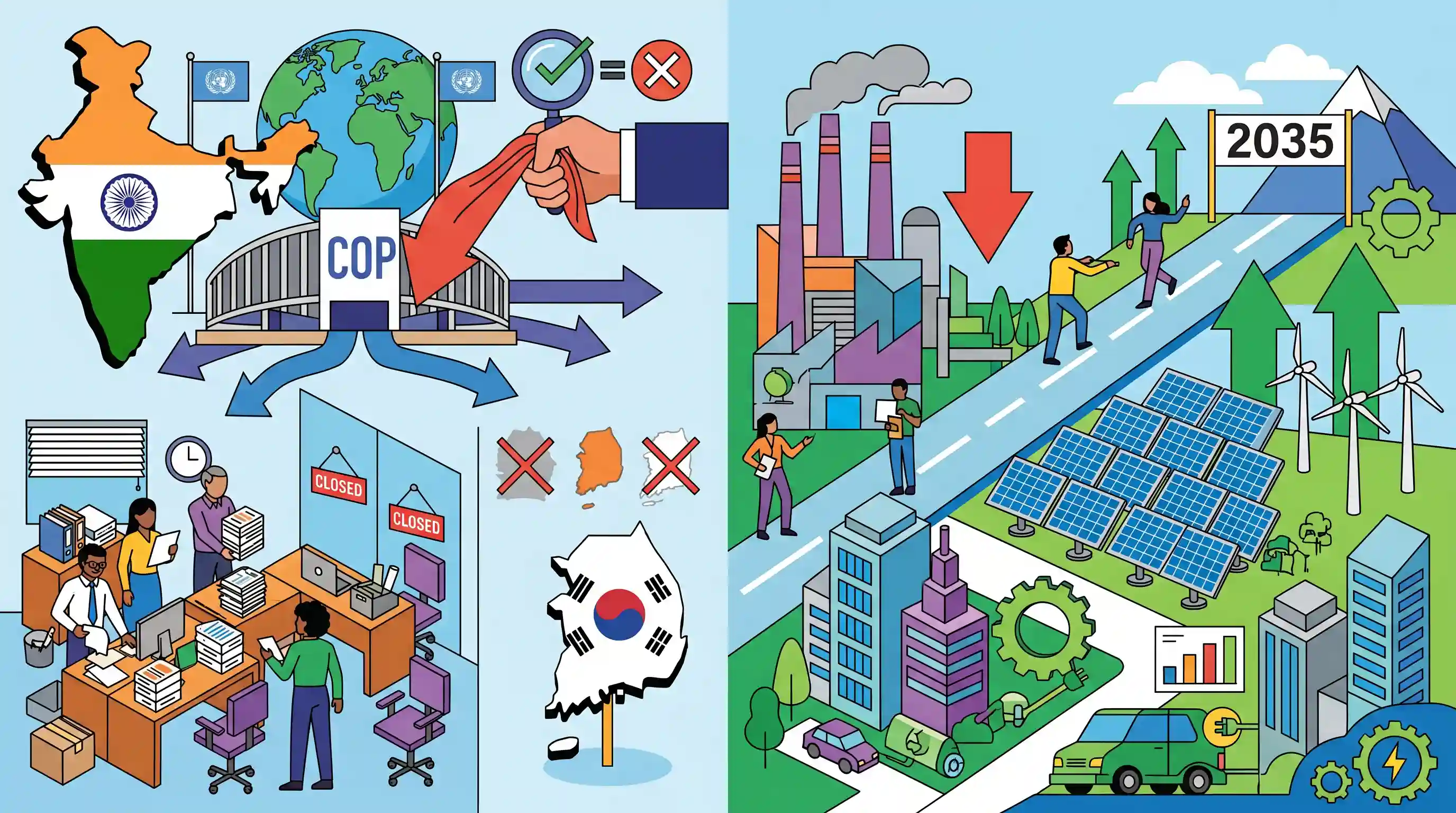
India has decided to withdraw its bid to host the 33rd United Nations Climate Change Conference (COP 33) scheduled for 2028. The proposal, initially announced by Prime Minister Narendra Modi at COP 28 in Dubai, was retracted following a review of India's commitments. The Ministry of Environment, Forest and Climate Change has disbanded the cell created to prepare for the summit. South Korea is now the lone contender from the Asia-Pacific group to host the event. Despite the withdrawal from hosting, India continues its climate action efforts, having recently updated its Nationally Determined Contributions (NDCs) with ambitious targets for 2035, including significant reductions in emissions intensity and increasing non-fossil fuel energy capacity.
Key Points
- India has formally withdrawn its proposal to host the UNFCCC COP 33 climate summit in 2028 after a review of its commitments.
- The initial proposal to host the major climate summit was announced by Prime Minister Narendra Modi during COP 28 in Dubai.
- Following the withdrawal, South Korea remains the only country from the Asia-Pacific group that has expressed interest in hosting COP 33.
- Simultaneously, India updated its Nationally Determined Contributions (NDCs) for 2035, aiming to reduce emissions intensity by 47% and achieve 60% electric power capacity from non-fossil sources.
Important Terms
COP 33

The 33rd United Nations Climate Change Conference scheduled for 2028. Hosting rotates among five regional groups; India recently withdrew its bid, leaving South Korea as the sole Asia-Pacific contender.
UPSC context
GS Paper III: Environmental Conservation. Tests knowledge of India's climate diplomacy, regional leadership, and shifts in international commitments.
Nationally Determined Contributions (NDCs)
Periodic, non-binding climate action plans submitted by countries under the Paris Agreement. They outline specific mitigation and adaptation targets tailored to a nation's developmental and environmental circumstances.
UPSC context
GS Paper III: Environmental Pollution. Key for testing India's climate targets, Paris Agreement compliance, and sustainable development pathways.
UNFCCC
The primary 1992 international treaty aimed at stabilizing greenhouse gas concentrations. It provides the legal framework for global climate negotiations and summits like the COP.
UPSC context
GS Paper III: International Treaties. Foundational for understanding global climate governance, its evolution, and India's role in multilateral frameworks.
MoEFCC
India's nodal ministry for planning and coordinating environmental, forest, and wildlife policies. it leads the nation's international climate negotiations and implements domestic environmental laws.
UPSC context
GS Paper II: Government Policies. Tests understanding of institutional roles in environmental governance and international policy representation.
Emissions Intensity
The volume of greenhouse gas emissions produced per unit of a country's Gross Domestic Product (GDP). Reducing this indicates economic growth is decoupling from carbon output.
UPSC context
GS Paper III: Environmental Impact Assessment. Crucial metric for evaluating the efficiency of India's green growth and transition.
COP 28
The 2023 UN Climate Change Conference held in Dubai. It featured the first 'Global Stocktake' and was where India initially proposed hosting COP 33.
UPSC context
GS Paper III: International Summits. Significant for understanding global stocktakes and the origin of India’s hosting proposals.
Prelims Trap
India's updated NDCs aim to reduce GDP emissions intensity by 45% and achieve 50% non-fossil capacity by 2035.
Aspirants easily confuse the timelines. The 45% intensity cut and 50% non-fossil targets apply to 2030. The newly updated 2035 targets are 47% and 60%.
Static Concepts Connected
How is the host country for the annual UNFCCC COP selected?
- Regional rotation: The COP presidency rotates among five UN-designated regional groups: Africa, Asia-Pacific, Eastern Europe, Latin America and the Caribbean, and Western European and Others.
- Group consensus: Countries within the designated regional group for that year must consult among themselves and reach a consensus to nominate a host nation.
- Default venue: If no country steps forward or a regional group cannot agree, the summit defaults to the UNFCCC Secretariat headquarters in Bonn, Germany.
What is the legal framework for NDCs under the Paris Agreement?
- Article 4 mandate: Article 4 of the Paris Agreement requires all parties to prepare, communicate, and maintain successive NDCs that they intend to achieve.
- Ratchet mechanism: Countries must update their NDCs every five years, with each submission representing a progression (ratcheting up) beyond the country's current pledge.
- Non-binding targets: While the regular submission and updating of NDCs is a legally binding obligation, the actual achievement of the quantified targets remains non-binding internationally.
Cross-Topic Patterns
Diplomacy vs. Domestic Climate Finance
Withdrawing from expensive mega-event hosting duties signals a pragmatic shift, allowing India to redirect state capacity and fiscal resources toward executing its ambitious 60% non-fossil energy targets.
Panchamrit to Net Zero 2070 trajectory
The newly minted 2035 NDCs serve as the critical medium-term bridge policy, translating India's immediate 2030 Panchamrit commitments into a viable long-term decarbonization trajectory for 2070.

A multi-statement question distinguishing India's 2030 Panchamrit goals from the newly updated 2035 NDC targets is highly likely in 2026.
Linked PYQs · 4
Linked PYQs · 4
- 2021MainsGS3
Describe the major outcomes of the 26th session of the Conference of the Parties (COP) to the United Nations Framework Convention on Climate Change (UNFCCC). What are the commitments made by India in this conference?
- 2025MainsGS3
Write a review on India's climate commitments under the Paris Agreement (2015) and mention how these have been further strengthened in COP26 (2021). In this direction, how has the first Nationally Determined Contribution intended by India been updated in 2022?
- 2025PrelimsGS1
Consider the following statements : I. Carbon dioxide (CO2) emissions in India are less than 0.5 t CO2/ capita. II. In terms of CO2 emissions from fuel combustion, India ranks second in Asia-Pacific region. III. Electricity and heat producers are the largest sources of CO2 emissions in India. Which of the statements given above is/are correct?
- 2022PrelimsGS1
"Climate Action Tracker" which monitors the emission reduction pledges of different countries is a :
