India receives international recognition for social security expansion
Source:The Hindu ↗
Why It Matters
Highlights tangible success and metrics of India's digital governance interventions (e-Shram, NCS) in the unorganised sector. It provides strong data points (coverage jumping from 19% to 64%) for Mains answers on social security, inclusive growth, and welfare administration.
Summary
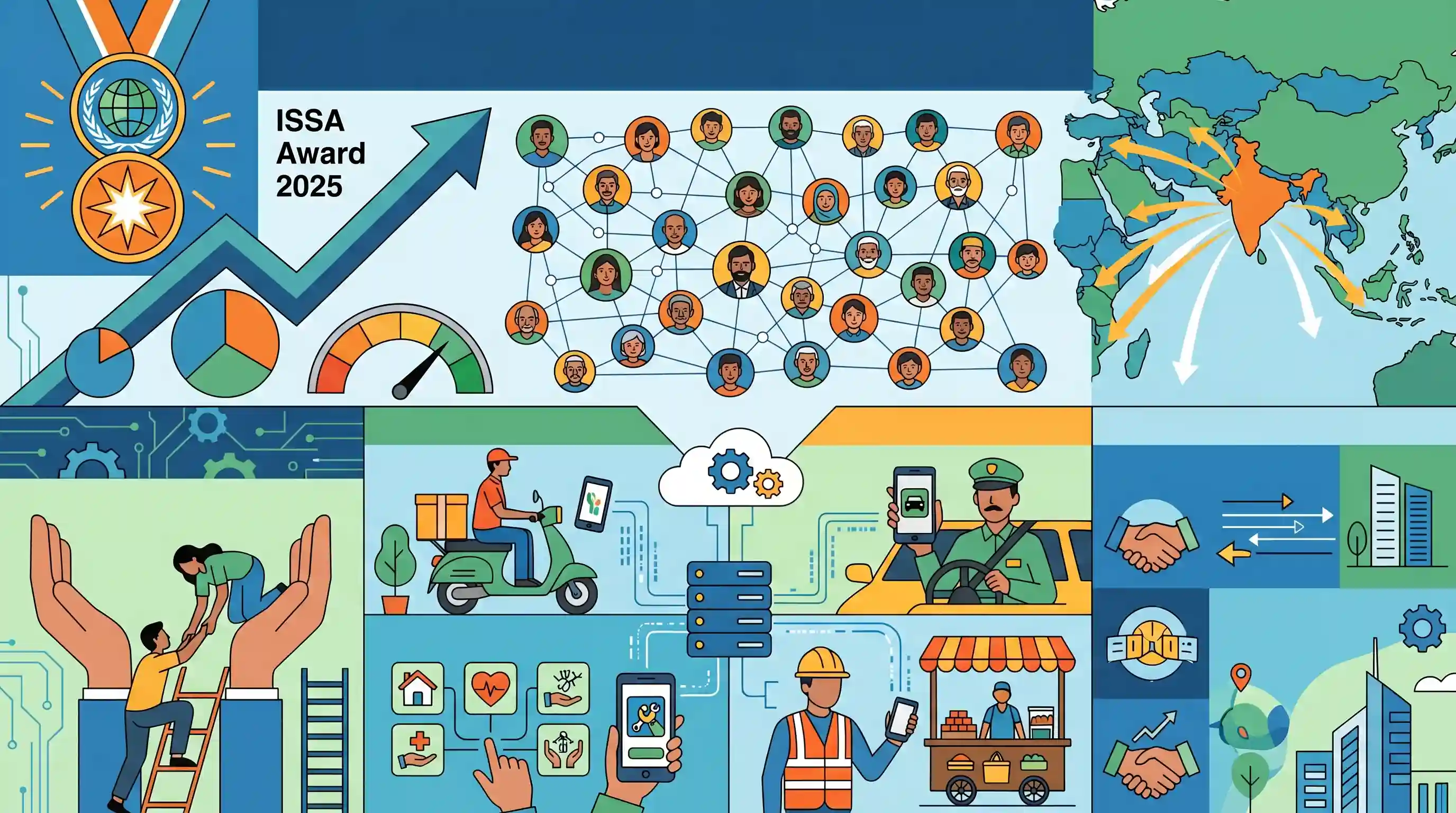
India has been conferred the prestigious ISSA Award 2025 by the International Social Security Association for its remarkable expansion of social security coverage from 19% in 2015 to over 64% today, encompassing over 940 million citizens. Union Labour Minister Mansukh Mandaviya credited this success to the 'Antyodaya' principle and robust digital infrastructure like the e-Shram portal and National Career Service. The achievement highlights India's proactive efforts in extending social protection to the unorganised sector, including gig and platform workers, positioning the country as a leader among the Global South in formulating modern welfare frameworks.
Key Points
- India received the ISSA Award 2025 for 'Outstanding Achievement in Social Security' at a ceremony in Kuala Lumpur.
- Social protection coverage in India expanded significantly from 19% in 2015 to over 64% in 2025, reaching more than 940 million citizens.
- The success was driven by a digital-first approach through platforms like e-Shram and the National Career Service (NCS), integrating unorganised workers into the formal welfare net.
- India is leading the Global South in developing model definitions and social security frameworks for gig and platform workers.
- Bilateral discussions were held with countries like Uganda and Malaysia to explore cooperation in social security administration and IT systems.
Important Terms
International Social Security Association (ISSA)

International body for social security agencies and govt departments, founded in 1927 under the ILO auspices to promote excellence in social security administration.
UPSC context
GS II: International Institutions. Tests knowledge of global governance frameworks and international standards for social welfare.
e-Shram Portal
A centralized national database for unorganised workers seeded with Aadhaar, launched in 2021 to facilitate the delivery of social security benefits and portability.
UPSC context
GS II: Welfare Schemes for Vulnerable Sections. Core for questions on informal sector formalization and digital public infrastructure.
Antyodaya
A core governance philosophy meaning 'uplifting the last person,' driving India's targeted welfare and poverty alleviation strategies for inclusive growth.
UPSC context
GS II: Governance/Social Justice. Tests understanding of the ethical and philosophical foundations behind Indian public policy.
National Career Service (NCS)
A digital platform providing a wide range of employment-related services, including job matching, career counseling, and vocational guidance, integrated with the e-Shram portal.
UPSC context
GS III: Employment & Economy. Relevant for labor market reforms and the role of technology in bridging the skill gap.
Employees' Provident Fund Organisation (EPFO)
A statutory body under the Ministry of Labour & Employment that manages the world's largest social security schemes, including provident funds and pensions.
UPSC context
GS III: Indian Economy. Essential for topics on social security, savings, and the formalization of the labor force.
Employees' State Insurance Corporation (ESIC)
A statutory social security and health insurance body that provides medical and cash benefits to workers in the organized sector.
UPSC context
GS II: Social Justice. Important for understanding occupational health and social protection mechanisms in India.
PERKESO
The Social Security Organisation of Malaysia (Pertubuhan Keselamatan Sosial), a key international partner for India in developing bilateral social security and skill-recognition frameworks.
UPSC context
GS II: International Relations. Relevant for bilateral agreements, labor mobility, and social protection collaboration within the Global South.
Prelims Trap
"Gig workers are legally granted traditional employee status under the Code on Social Security, 2020."
The Code explicitly defines a 'gig worker' as an individual who earns from activities strictly *outside* of a traditional employer-employee relationship.
Static Concepts Connected
How does the Code on Social Security, 2020 classify new-age workers?
- Gig Workers: Individuals who participate in work arrangements and earn from activities outside of traditional employer-employee relationships.
- Platform Workers: Workers who use online platforms to access organizations or individuals to provide specific services or solve specific problems.
- Funding Mechanism: Mandates a dedicated social security fund for gig and platform workers, financed by aggregators contributing 1-2% of their annual turnover.
What is the functional scope of the e-Shram portal?
- Database Creation: Builds a comprehensive National Database of Unorganized Workers (NDUW), capturing details of migrant, domestic, and agricultural labourers.
- UAN Issuance: Registered workers receive a 12-digit Universal Account Number (UAN) seeded with Aadhaar, ensuring nationwide portability of benefits.
- Welfare Integration: Acts as a foundational registry to deliver targeted social security benefits like the Pradhan Mantri Shram Yogi Maan-dhan (PM-SYM) pension scheme.
Cross-Topic Patterns
DPI shaping Global South diplomacy
India is leveraging its Digital Public Infrastructure (e-Shram, Aadhaar) as a diplomatic tool for South-South cooperation, directly tying domestic welfare technology to its foreign policy objectives and leadership of the Global South.
Gig economy vs. SDG 8 (Decent Work)
The expansion of platform-based work addresses unemployment but risks violating SDG 8 (Decent Work) unless backed by statutory social protection frameworks like the Code on Social Security.

Multi-statement Prelims 2026 question likely blending e-Shram capabilities with Code on Social Security 2020 definitions for gig workers.
Linked PYQs · 3
Linked PYQs · 3
- 2019MainsGS2
Performance of welfare schemes that are implemented for vulnerable sections is not so effective due to absence of their awareness and active involvement at all stages of policy process. Discuss.
- 2022MainsGS2
Besides the welfare schemes, India needs deft management of inflation and unemployment to serve the poor and the underprivileged sections of the society. Discuss.
- 2024PrelimsGS1
With reference to the Pradhan Mantri Shram Yogi Maan-dhan (PM-SYM) Yojana, consider the following statements : 1. The entry age group for enrolment in the scheme is 21 to 40 years. 2. Age specific contribution shall be made by the beneficiary. 3. Each subscriber under the scheme shall receive a minimum pension of ₹ 3,000 per month after attaining the age of 60 years. 4. Family pension is applicable to the spouse and unmarried daughters. Which of the statements given above is/are correct?
