India aims for self reliance to stop fruit and vegetable imports
Source:The Hindu ↗
Why It Matters
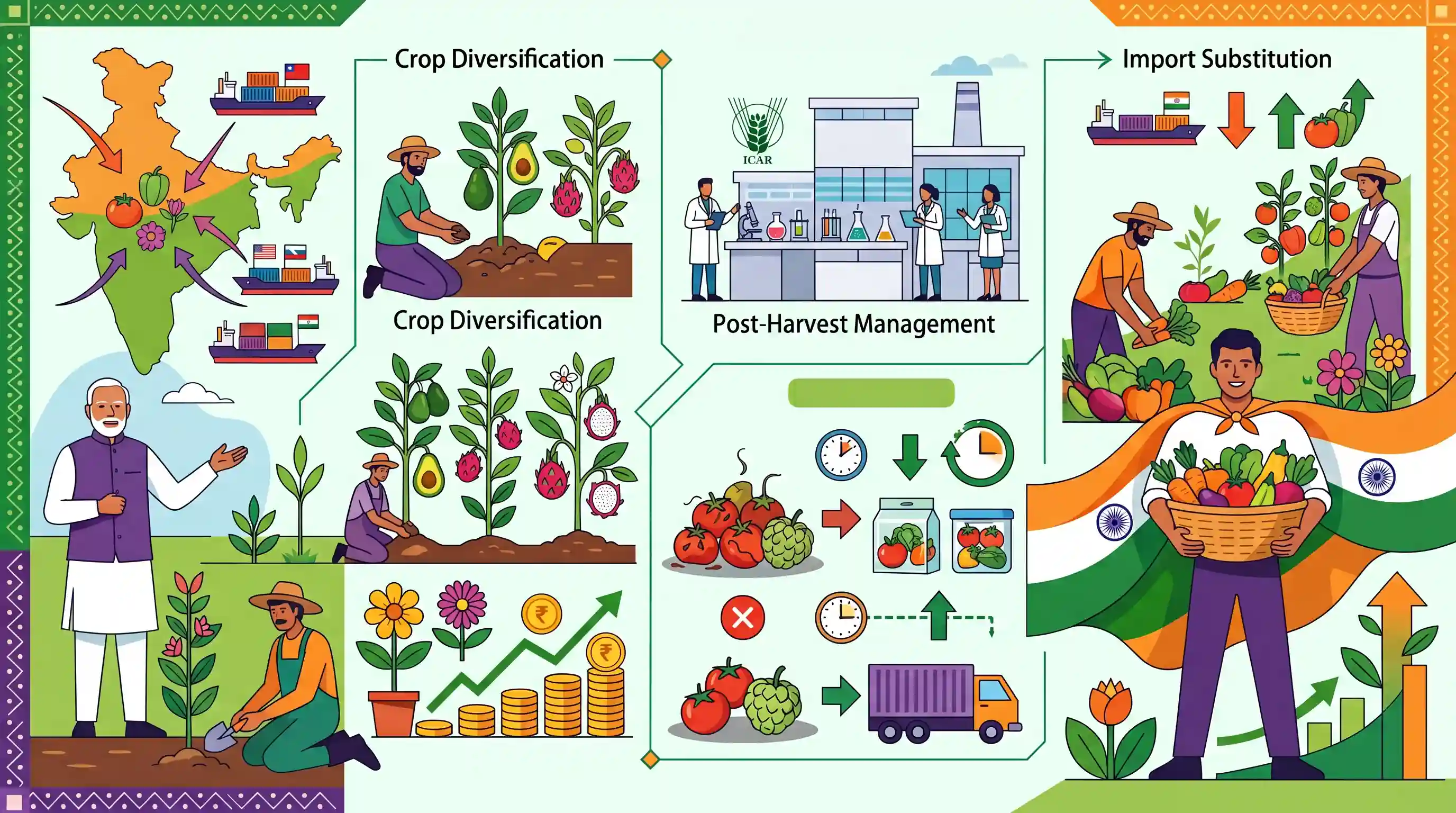
The strategic shift towards import substitution in high-value horticulture crops addresses the need for crop diversification away from traditional cereals and aims to boost farm incomes. Emphasizing post-harvest management (like increasing shelf life) is crucial for reducing supply chain losses and stabilizing prices. This aligns with the national goal of Aatmanirbhar Bharat (self-reliance) in agriculture.
Summary
Union Agriculture Minister Shivraj Singh Chouhan announced India's target to achieve self-reliance in the production of fruits, vegetables, and flowers, thereby eliminating the need for their imports. Addressing a review meeting at ICAR-IIHR, he emphasized identifying high-demand crops like avocado and dragon fruit for domestic cultivation while ensuring farm profitability. He also highlighted the urgent need for research to improve the shelf life of highly perishable crops like tomatoes and custard apples to reduce post-harvest losses, linking agricultural self-reliance to the broader goal of a self-reliant India.
Key Points
- India aims to halt the import of fruits, vegetables, and flowers by becoming completely self-reliant in their domestic production.
- The focus is shifting towards domestically cultivating emerging, high-demand crops like avocados and dragon fruits that have traditionally been imported.
- The government has directed agricultural researchers to develop farmer-friendly crop varieties, emphasizing that cultivation must be profitable to encourage adoption.
- Enhancing the shelf life of highly perishable crops, such as tomatoes and custard apples, is a major research priority to reduce post-harvest losses.
- Achieving self-reliance in the horticulture sector is framed as a critical component of the broader national vision for a self-reliant India.
Important Terms
Aatmanirbhar Bharat

A national mission launched in 2020 to make India self-reliant across sectors like agriculture and manufacturing. It focuses on reducing import dependency by strengthening domestic production and local supply chains.
UPSC context
GS Paper III (Economy/Agriculture); tests understanding of India's self-reliance strategy and economic reforms.
Indian Council of Agricultural Research (ICAR)
The apex autonomous body under the Ministry of Agriculture responsible for coordinating and managing agricultural research and education. It manages one of the largest national agricultural systems globally.
UPSC context
GS Paper III (Agriculture/S&T); tests knowledge of institutional frameworks driving agricultural productivity and food security.
Indian Institute of Horticultural Research (IIHR)
A Bengaluru-based ICAR subsidiary specializing in research on fruits, vegetables, and ornamentals. It develops high-yielding varieties and post-harvest technologies to boost the horticulture sector.
UPSC context
GS Paper III (Agriculture); focuses on specialized research institutes and their role in horticultural development.
Import Substitution
An economic strategy aimed at replacing foreign imports with domestic production. In agriculture, this involves scaling up the cultivation of imported fruits and vegetables to save foreign exchange.
UPSC context
GS Paper III (Economy/Trade); tests concepts of trade policy and agricultural self-sufficiency.
Post-Harvest Management
The stage of crop handling immediately following harvest, involving cooling, cleaning, and packaging. Effective management reduces losses in perishable crops like tomatoes and custard apples.
UPSC context
GS Paper III (Food Processing/Supply Chain); tests strategies to reduce agricultural waste and improve farmer income.
High-Value Crops
Non-traditional crops like avocado and dragon fruit that yield higher market value and profits per unit area compared to staple grains, facilitating agricultural diversification.
UPSC context
GS Paper III (Agriculture); tests crop diversification strategies and doubling farmers' income.
Prelims Trap
"India's total horticulture production is significantly lower than its foodgrain production, necessitating heavy imports."
Horticulture production (>330 million tonnes) has consistently outpaced total foodgrain production in India for over a decade. Imports address specific exotic demand, not overall volume deficits.
Static Concepts Connected
What are the core components of the Mission for Integrated Development of Horticulture (MIDH)?
- Umbrella Scheme: A Centrally Sponsored Scheme encompassing sub-schemes like the National Horticulture Mission and Horticulture Mission for North East & Himalayan States.
- Funding Pattern: The Union government contributes 60% for general states and 90% for NE and Himalayan states, focusing on end-to-end holistic development.
- Coverage Scope: Includes fruits, vegetables, root & tuber crops, mushrooms, spices, flowers, aromatic plants, coconut, cashew, cocoa, and bamboo.
How does India currently tackle post-harvest losses for perishable crops?
- Operation Greens: Expanded from TOP (Tomato, Onion, Potato) to 22 perishables (TOTAL) to build value chains, stabilize prices, and reduce wastage.
- Agri Infra Fund: A ₹1 lakh crore medium-to-long term financing facility specifically targeted at post-harvest management infrastructure and community farming assets.
- Kisan Rail: Refrigerated parcel trains (multi-commodity) introduced by Indian Railways to transport perishables seamlessly across regions, minimizing transit decay.
Cross-Topic Patterns
Exotic Crops & Agro-climatic Zoning
Scaling up Dragon Fruit (Kamalam) and Avocado requires identifying suitable semi-arid or tropical micro-climates, linking horticulture expansion directly to India's agro-climatic zone mapping and climate-resilient agriculture.
Perishables & CPI Inflation Volatility
Improving the shelf life of tomatoes directly influences macroeconomic stability. Volatile perishable prices repeatedly skew India's headline retail inflation (CPI), often prompting RBI monetary policy interventions.

Expect a multi-statement Prelims question matching exotic fruits (Dragon fruit/Avocado) with their ideal Indian agro-climatic zones & MIDH.
Linked PYQs · 4
Linked PYQs · 4
- 2021MainsGS3
What are the present challenges before crop diversification? How do emerging technologies provide an opportunity for crop diversification?
- 2025MainsGS3
Explain the factors influencing the decision of the farmers on the selection of high value crops in India.
- 2023MainsGS3
Explain the changes in cropping pattern in India in the context of changes in consumption pattern and marketing conditions.
- 2020MainsGS3
What are the challenges and opportunities of food processing sector in the country? How can income of the farmers be substantially increased by encouraging food processing?
