India plans to halt all Indus river water flow into Pakistan
Source:The Hindu ↗
Why It Matters
The suspension of the Indus Waters Treaty represents a monumental shift in India's strategic posture toward Pakistan. It links transboundary water sharing (traditionally insulated from geopolitical tensions) directly to national security and counter-terrorism. For UPSC candidates, this touches upon Geography (river systems and hydropower), International Relations (treaties and neighborhood policy), and Internal Security (border management and responses to state-sponsored terrorism).
Summary
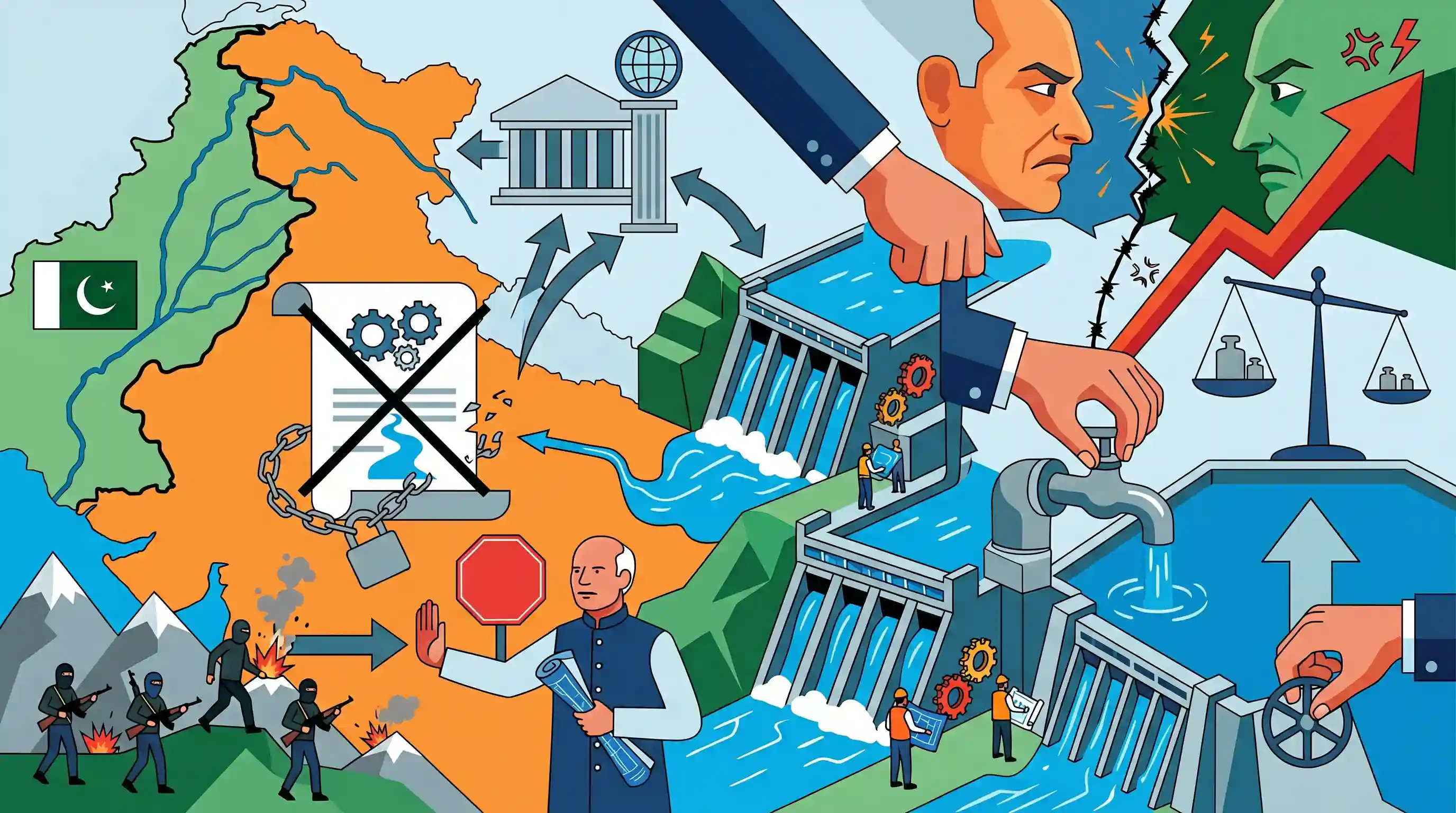
Union Minister C.R. Patil announced that India is developing comprehensive plans to ensure no water from the Indus River system flows into Pakistan. This aggressive policy shift follows India's decision to place the 1960 Indus Waters Treaty (IWT) in abeyance in retaliation for a terror attack in Pahalgam. By suspending the treaty and bypassing the World Bank's arbitration, India intends to weaponize its upper-riparian advantage against cross-border terrorism. Practically, this suspension removes restrictions on the western rivers (Indus, Jhelum, Chenab), allowing India to redesign major hydropower projects like Kishenganga and Baglihar for greater water storage, marking a massive escalation in India-Pakistan diplomatic relations.
Key Points
- India has pledged to stop all water flow from the Indus river system into Pakistan, formulating short, medium, and long-term plans to achieve this.
- The decision follows India keeping the 1960 Indus Waters Treaty (IWT) in 'abeyance' as a direct response to a terror attack in Pahalgam, linking water diplomacy to cross-border terrorism.
- India did not notify the World Bank (the treaty's arbiter), indicating a rejection of the existing dispute resolution mechanisms.
- The suspension frees India from IWT restrictions on the western rivers (Indus, Jhelum, Chenab), potentially allowing for redesigns of hydropower projects to maximize water storage.
Important Terms
Indus Waters Treaty (IWT)

A 1960 water-sharing agreement between India and Pakistan, brokered by the World Bank, dividing the Indus system's six rivers to resolve transboundary disputes.
UPSC context
GS-II (IR); core of India-Pakistan water diplomacy and transboundary resource management.
Permanent Indus Commission (PIC)
A bilateral body of officials from India and Pakistan established to oversee the implementation of the 1960 treaty through annual meetings and inspections.
UPSC context
GS-II; tests knowledge of bilateral institutional mechanisms and conflict resolution frameworks.
Western Rivers
The Indus, Jhelum, and Chenab rivers; allocated primarily to Pakistan under the IWT, with restricted Indian rights for non-consumptive uses like hydropower.
UPSC context
GS-I (Geography) and GS-II; essential for Himalayan drainage and geopolitical river-sharing questions.
Upper-riparian State
A state located upstream on a river system, possessing natural geographical control over the water flow to downstream (lower-riparian) nations.
UPSC context
GS-II; central to 'Water Hegemony' discourse and India’s strategic leverage in neighborhood relations.
Kishenganga and Baglihar Projects
Major Indian run-of-the-river hydroelectric projects on the Jhelum and Chenab rivers that have faced technical and legal challenges from Pakistan under the IWT.
UPSC context
GS-II/III; case studies for infrastructure development and international legal compliance in conflict zones.
World Bank
The international financial institution that brokered and signed the 1960 treaty, acting as a mediator for dispute resolution through specialized experts.
UPSC context
GS-II; examines the role of international organizations in mediating sovereign bilateral disputes.
Abeyance
A state of temporary suspension; specifically referring to India's policy shift to halt treaty obligations and bilateral meetings following terror attacks.
UPSC context
GS-II; relates to 'Water Weaponization' as a tool of foreign policy and counter-terrorism.
Prelims Trap
Under the 1960 IWT, India had exclusive rights to the Western Rivers (Indus, Jhelum, Chenab).
Eastern rivers (Ravi, Beas, Sutlej) were exclusively India's. Western rivers went to Pakistan, with India allowed limited run-of-the-river use. The abeyance aims to seize broader control of Western rivers.
Static Concepts Connected
What is the geographical division of rivers under the 1960 Indus Waters Treaty?
- Eastern Rivers: Ravi, Beas, and Sutlej were allocated exclusively to India for unrestricted use and water storage.
- Western Rivers: Indus, Jhelum, and Chenab were allocated to Pakistan, though India was permitted limited agricultural use and run-of-the-river hydroelectric projects.
- World Bank Role: The Bank brokered the treaty and is a signatory for specific dispute resolution functions, but it is not a formal guarantor of the treaty.
What characterizes India's recent shift in regional hydro-diplomacy?
- Upper-Riparian Advantage: India is actively leveraging its geographical position upstream to exert control over water flow into the lower-riparian state of Pakistan.
- Hydro-hegemony: The strategic weaponization of cross-border water resources and treaty suspension to deter state-sponsored terrorism, moving away from pure arbitration.
Cross-Topic Patterns
Water Diplomacy + Cross-border Terrorism
Links to the broader doctrine that "blood and water cannot flow together," echoing earlier diplomatic/trade revocations (like MFN status) to strategically squeeze Pakistan over state-sponsored terrorism.
Brahmaputra vs. Indus Riparian Dynamics
Highlights India's dual riparian reality: an assertive upper-riparian against Pakistan on the Indus, but a vulnerable lower-riparian to China on the Brahmaputra, where no formal water-sharing treaty exists.

The IWT abeyance ensures a 2026 question mapping Western Rivers to specific hydro-projects (Baglihar) and the World Bank's exact role.
Linked PYQs · 5
Linked PYQs · 5
- 2021PrelimsGS1
With reference to the Indus river system, of the following four rivers, three of them pour into one of them which joins the Indus direct. Among the following, which one is such river that joins the Indus direct?
- 2009PrelimsGS1
The Dul Hasti Power Station is based on which one of the following rivers?
- 2024MainsGS3
India has a long and troubled border with China and Pakistan fraught with contentious issues. Examine the conflicting issues and security challenges along the border. Also give out the development being undertaken in these areas under the Border Area Development Programme (BADP) and Border Infrastructure and Management (BIM) Scheme.
- 2020MainsGS3
Analyze internal security threats and transborder crimes along Myanmar, Bangladesh and Pakistan borders including Line of Control (LoC). Also discuss the role played by various security forces in this regard.
- 2015MainsGS2
Terrorist activities and mutual distrust have clouded India-Pakistan relations. To what extent the use of soft power like sports and cultural exchanges could help generate goodwill between the two countries? Discuss with suitable examples.
