India Foreign Policy and G7 Multilateral Realities
Source:Indian Express ↗
Why It Matters
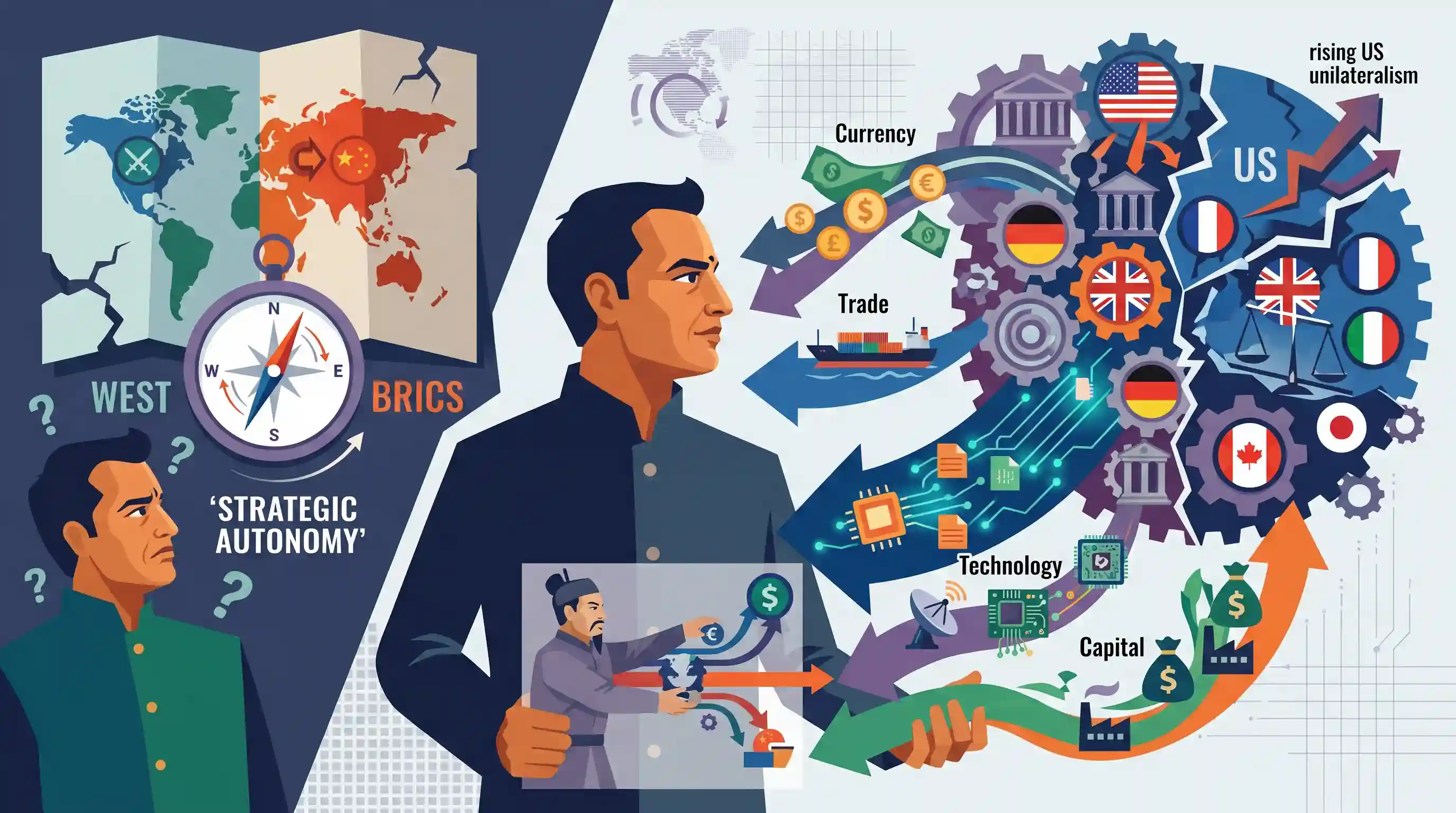
It shifts the analytical paradigm of Indian foreign policy from a simple 'West vs Global South' view to a nuanced understanding of internal G7 dynamics, US tech-capitalism supremacy, and the necessity of pragmatic economic diplomacy over traditional non-alignment rhetoric.
Summary
The article argues that India's foreign policy discourse must evolve past the outdated "West vs. BRICS" binary to navigate the complex internal dynamics of the G7. Acknowledging the West as India's primary source of trade, technology, and capital, New Delhi must embrace pragmatic "cold realism." Rather than being perpetually anxious about strategic autonomy or engaging in moralizing rhetoric, the author suggests India emulate China's historical strategy: ruthlessly leveraging Western partnerships for national economic and technological transformation, while skillfully managing structural contradictions like rising US unilateralism and a shifting transatlantic balance of power.
Key Points
- India must move beyond the "West vs. BRICS" binary in its foreign policy discourse and recognize that its primary reliance for trade, capital, technology, and diaspora relations is on the G7 nations.
- The global economic balance within the West is shifting, with the US heavily outperforming Europe and Japan, propelled largely by "American tech capitalism" (e.g., SpaceX, AI).
- The resurgence of US unilateralism under Donald Trump's "America First" policy creates deepening transatlantic and transpacific divisions within the G7, which India must navigate strategically rather than treating the West as a monolith.
- Instead of being anxious about preserving strategic autonomy, India should adopt China's historical "cold realism"—deeply engaging the West to build national economic and technological capabilities despite underlying political and strategic contradictions.
Important Terms
G7 (Group of Seven)

Informal grouping of seven advanced industrial democracies (USA, UK, France, Germany, Italy, Japan, Canada) that coordinates global economic, security, and energy policies.
UPSC context
GS Paper II: Global groupings involving India. Tests understanding of India’s strategic engagement with the developed West.
BRICS
An association of major emerging economies—Brazil, Russia, India, China, and South Africa—focused on fostering multipolarity and reforming Western-dominated global governance institutions.
UPSC context
GS Paper II: Bilateral and regional groupings. Critical for analyzing India's balancing act between Western and non-Western blocs.
Global South
Collective term for developing and emerging nations in Asia, Africa, and Latin America, often sharing colonial histories and advocating for equitable global development.
UPSC context
GS Paper II: Effect of policies of developed/developing countries. Tests India’s leadership role as the 'Voice of the Global South.'
Strategic Autonomy
The ability of a state to pursue its national interests and make sovereign foreign policy decisions without being constrained by external pressures or alliance obligations.
UPSC context
GS Paper II: India’s Foreign Policy. A cornerstone concept for Mains questions on India’s independent stance in global conflicts.
Realpolitik
A pragmatic approach to foreign policy based on power dynamics and national interests rather than moral or ideological considerations; referred to in the article as 'cold realism.'
UPSC context
GS Paper II: IR Theories. Relevant for understanding India's shift from ideological non-alignment to interest-based 'multi-alignment.'
Multi-alignment
A diplomatic strategy of maintaining active, interest-based relationships with multiple competing power centers simultaneously to maximize strategic options and economic gains.
UPSC context
GS Paper II: India’s Foreign Policy. Captures the modern evolution of Non-Alignment into a more proactive, pragmatic engagement strategy.
Prelims Trap
India's 'Global South' leadership means its primary technological and capital reliance has shifted from the G7 to BRICS nations.
Despite geopolitical advocacy for the Global South and BRICS, India fundamentally relies on the G7 and Western alliances for FDI, deep-tech transfers, and primary export markets.
Static Concepts Connected
How does 'Strategic Autonomy' differ from traditional 'Non-Alignment'?
- Non-Alignment:: Cold War era policy of maintaining equal distance from rival military blocs (US/USSR) to avoid entanglement in foreign conflicts.
- Strategic Autonomy:: Modern policy of issue-based multi-alignment; partnering simultaneously with opposing blocs (e.g., Quad and SCO/BRICS) strictly based on national interest.
- Economic Pragmatism:: Prioritizes securing capital, critical minerals, and technology over purely ideological or moral posturing on the global stage.
What are the core structural differences between the G7 and BRICS?
- G7 (Advanced):: Informal bloc of advanced, industrialized democracies wielding massive historical influence over the global financial architecture (IMF/World Bank).
- BRICS (Emerging):: Developing economy coalition aimed at reforming multilateralism, increasing Global South representation, and creating alternative institutional financing (e.g., New Development Bank).
Cross-Topic Patterns
Geopolitics vs GS3 FDI realities
India champions the Global South politically (GS2), but its economic survival, FDI inflows, and Atmanirbhar Bharat ambitions rely fundamentally on Western capital and tech transfers (GS3).
Tech sovereignty and internal G7 divides
US dominance in AI/SpaceX versus Europe's regulatory stance forces India to navigate competing digital and trade regimes to secure critical technologies and build its own digital sovereignty.

GS2 2026 is highly likely to test the paradox of India's 'Global South' political leadership versus its structural reliance on G7 tech.
Linked PYQs · 3
Linked PYQs · 3
- 2024MainsGS2
‘The West is fostering India as an alternative to reduce dependence on China's supply chain and as a strategic ally to counter China's political and economic dominance.’ Explain this statement with examples.
- 2019MainsGS2
‘What introduces friction into the ties between India and the United States is that Washington is still unable to find for India a position in its global strategy, which would satisfy India's national self-esteem and ambitions.’ Explain with suitable examples.
- 2019MainsGS2
‘The long-sustained image of India as a leader of the oppressed and marginalised nations has disappeared on account of its new found role in the emerging global order.’ Elaborate.
