UN Peacekeeping and West Asia Diplomatic Stance
Source:The Hindu ↗
Why It Matters
Highlights India's diplomatic balancing act in the Middle East and its vested security interests due to the deployment of Indian troops in UN Peacekeeping missions. The Mediterranean region and its borders are highly recurring themes in Prelims mapping.
Summary
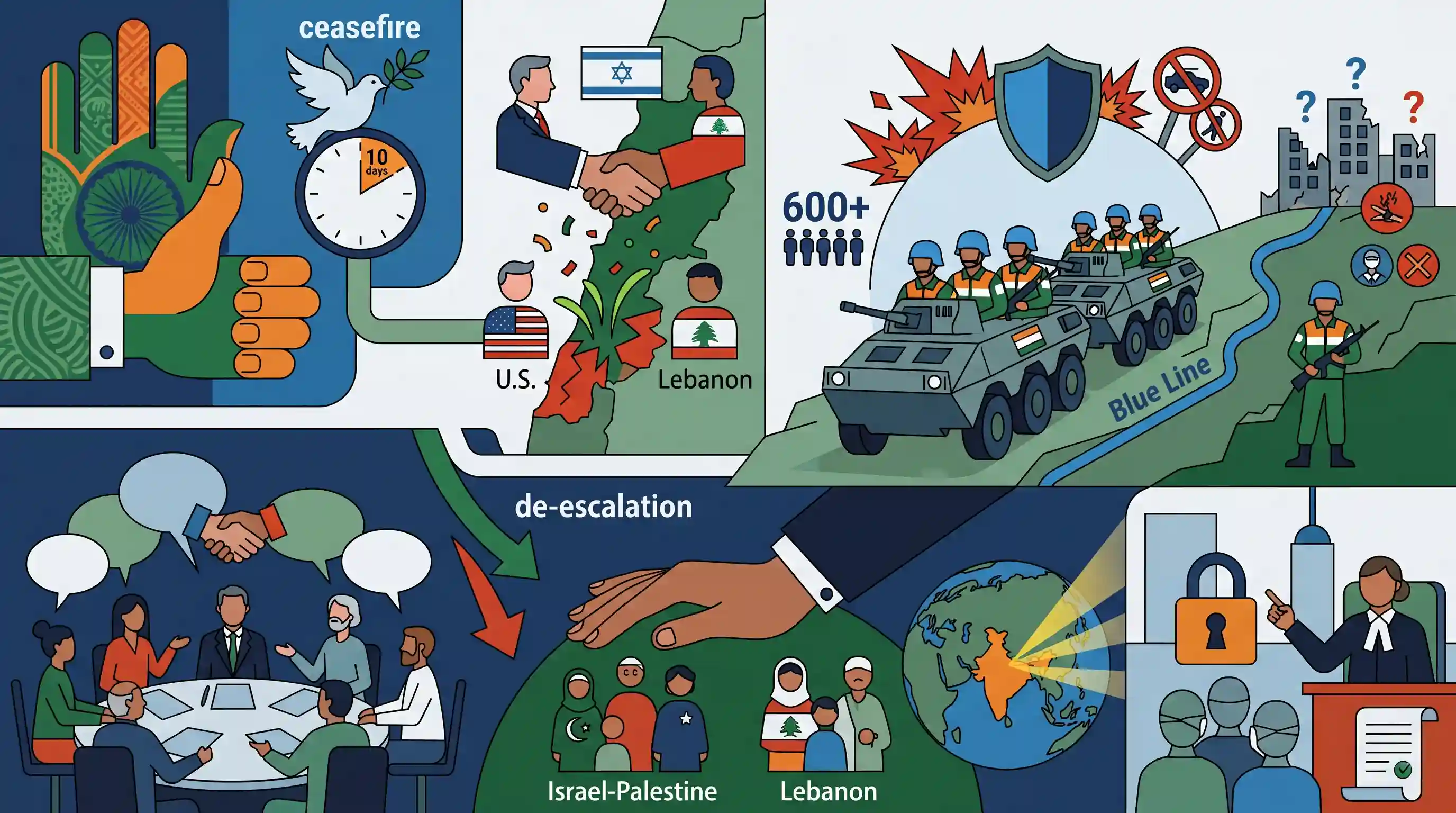
India has formally welcomed the U.S.-brokered 10-day ceasefire between Israel and Lebanon, emphasizing its commitment to regional stability in West Asia. The ongoing hostilities had directly impacted the roughly 600 Indian soldiers stationed in South Lebanon as part of the UNIFIL peacekeeping force, where personnel movement was restricted and casualties were sustained among other participating nations. The Ministry of External Affairs reaffirmed India's stance advocating for dialogue, de-escalation, and the protection of civilians across the Israel-Palestine and Lebanon conflicts, while also clarifying its domestic protocol regarding the banning of foreign entities like Hamas.
Key Points
- India welcomed the U.S.-brokered 10-day ceasefire between Israel and Hezbollah in Lebanon, emphasizing its support for any step that ends hostilities in West Asia.
- Around 600 Indian troops are currently deployed as part of the UNIFIL peacekeeping mission in South Lebanon and have faced significant risks during the crossfire.
- The conflict heavily affected UNIFIL operations, leading to movement halts and casualties among peacekeepers from other nations like Indonesia.
- The MEA clarified that India has established domestic legal processes to address the potential banning of organizations like Hamas, resisting immediate international pressure to declare it a terror group.
Important Terms
UNIFIL

A 1978-established UN peacekeeping mission monitoring the Israel-Lebanon border (Blue Line). India is a major troop contributor, with approximately 600-900 personnel ensuring regional stability and protecting civilians.
UPSC context
GS Paper II: International Relations. Tests knowledge of India's role in UN peacekeeping and strategic interests in West Asia.
Hezbollah
A Shia militant group and political party in Lebanon. It is a primary party in the conflict with Israel, and its activities significantly impact the security of Indian peacekeepers in South Lebanon.
UPSC context
GS Paper II: International Relations/Regional Groups. Relevant for understanding non-state actors and West Asian geopolitics.
Unlawful Activities (Prevention) Act (UAPA)
The primary legislative framework used by the Indian government to designate individuals and organizations as 'terrorist'. It governs the domestic protocol for banning foreign entities like Hamas or Hezbollah.
UPSC context
GS Paper III: Internal Security. Crucial for understanding India's legal mechanisms against terrorism and foreign policy alignment.
Ministry of External Affairs (MEA)
The nodal government agency responsible for India’s foreign relations. It articulates India's stance on global conflicts, emphasizing 'de-escalation, restraint, and return to dialogue' in the Israel-Lebanon context.
UPSC context
GS Paper II: Indian Constitution/Polity. Tests understanding of the executive’s role in conducting foreign policy.
Israel-Lebanon ceasefire
A U.S.-brokered temporary halt in hostilities (notably the 10-day truce in April 2026) aimed at stabilizing the border and facilitating the withdrawal of forces to prevent wider regional escalation.
UPSC context
GS Paper II: International Relations. Current affairs focus on West Asia's stability and diplomatic mediation.
Hamas
A Palestinian militant group governing the Gaza Strip. While Israel seeks its designation as a terrorist group by India, New Delhi maintains a process-driven approach under domestic law.
UPSC context
GS Paper II: International Relations. Important for the 'Israel-Palestine' conflict and India's 'balancing act' diplomacy.
IDF (Israel Defense Forces)
The unified military force of Israel. Its operations in South Lebanon against Hezbollah directly influence the safety and operational movement of Indian UNIFIL personnel.
UPSC context
GS Paper II: International Relations. Relevant for studying conflict dynamics and bilateral defense ties.
Prelims Trap
"The 'Blue Line' is the legally recognized international border demarcating Israel and Lebanon."
It is not a recognized international boundary, but rather a temporary 'withdrawal line' identified by the UN in 2000 to confirm Israeli troop withdrawal.
Static Concepts Connected
How are UN Peacekeeping operations mandated and funded?
- UNSC Mandate: Missions like UNIFIL are established and periodically renewed exclusively via UN Security Council resolutions, such as UNSC Resolution 1701.
- Assessed Funding: Financing is compulsory for all UN members based on an assessed scale of assessments, which is separate from the regular UN budget.
- Voluntary Troops: Troop deployment is strictly voluntary. India remains one of the largest historical contributors of personnel to 'Blue Helmet' missions globally.
How does India legally designate an entity as a terrorist organization?
- UAPA Framework: The Central Government designates organizations as terrorist entities by invoking provisions of the Unlawful Activities (Prevention) Act (UAPA), 1967.
- First Schedule: Banned groups are officially added to the First Schedule of the UAPA via a gazette notification issued by the Ministry of Home Affairs.
- Tribunal Review: Such declarations are subject to judicial scrutiny by a specialized UAPA Tribunal, ensuring that due process and statutory requirements are met.
Cross-Topic Patterns
Levant Mapping + UN Border Lines
UPSC routinely tests Mediterranean geography. The Israel-Lebanon theater spotlights mapping markers like the Blue Line, Golan Heights, and the broader Levant region against ongoing geopolitical events.
UAPA Protocols + Diplomatic Stances
India’s refusal to arbitrarily ban foreign entities like Hamas demonstrates the intersection of foreign policy independence and strict domestic statutory procedures under the UAPA framework.

Expect a paired Prelims question linking West Asian geographic markers (Blue Line, Levant) with specific UN peacekeeping mandates (UNIFIL).
Linked PYQs · 4
Linked PYQs · 4
- 2017PrelimsGS1
Mediterranean Sea is a border of which of the following countries? 1. Jordan 2. Iraq 3. Lebanon 4. Syria Select the correct answer using the code given below:
- 2022PrelimsGS1
The term "Levant" often heard in the news roughly corresponds to which of the following regions?
- 2015PrelimsGS1
The area known as 'Golan Heights' sometimes appears in the news in the context of the events related to
- 2023PrelimsGS1
Consider the following statements: Statement-I: Israel has established diplomatic relations with some Arab States. Statement-II: The 'Arab Peace Initiative' mediated by Saudi Arabia was signed by Israel and Arab League. Which one of the following is correct in respect of the above statements?
