Food safety regulator drops front of pack warning labels
Source:The Hindu ↗
Why It Matters
This case study is highly relevant for GS2 (Governance and Health) and GS4 (Ethics). It illustrates the conflict between public health imperatives and corporate profit motives, the influence of industry lobbying on statutory bodies like FSSAI, and the ethical issues surrounding MNC double standards in developing countries.
Summary
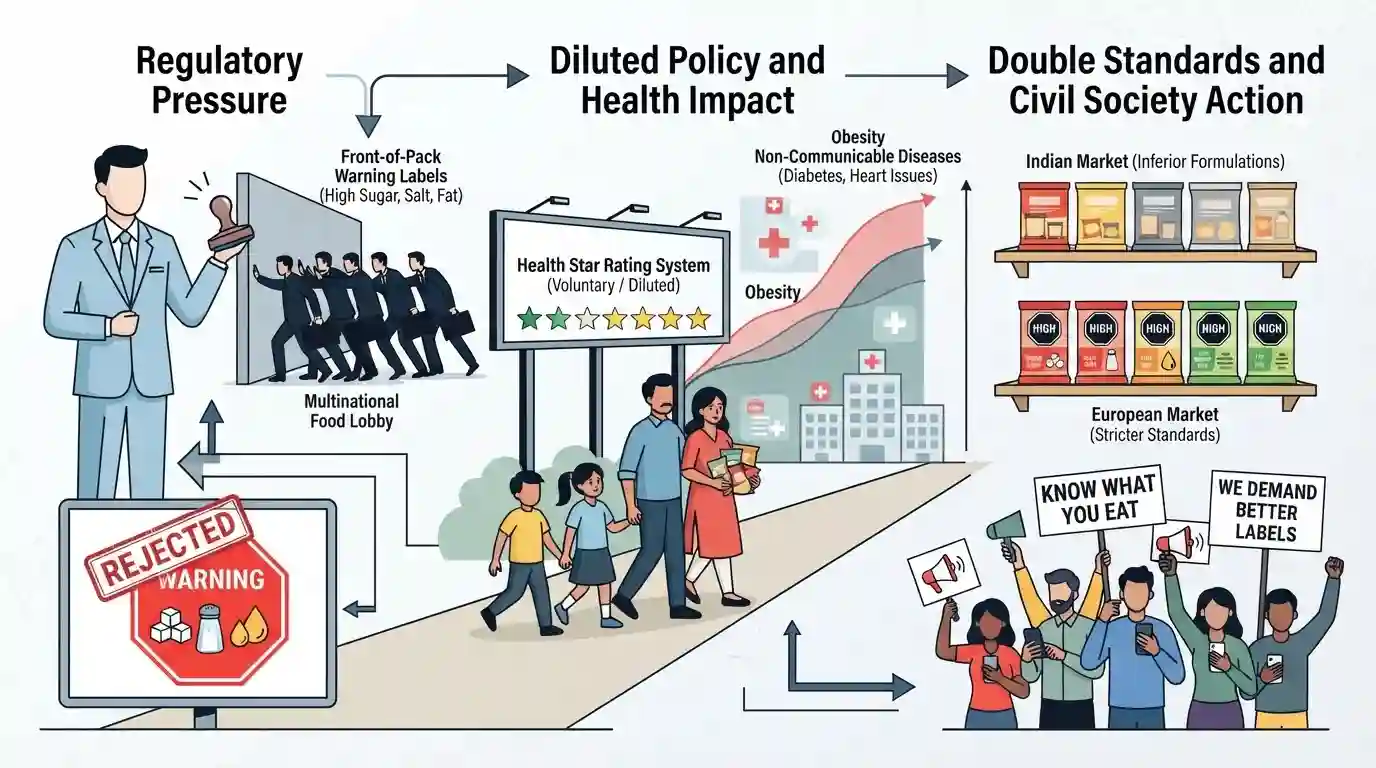
The article examines how India's food safety regulator, FSSAI, bowed to industry pressure and abandoned plans to introduce front-of-pack red warning labels on foods high in sugar, salt, and fat. Despite a rising epidemic of obesity and non-communicable diseases in the country, successful lobbying by "Big Food" multinationals resulted in a diluted 'Health Star Rating' system. The issue also highlights the ethical double standards of multinational corporations that sell high-sugar, inferior formulations in developing nations like India while adhering to stricter nutritional standards in European markets. In the absence of strong state regulation, civil society and social media activists have taken up the mantle of consumer awareness.
Key Points
- The Food Safety and Standards Authority of India (FSSAI) initially proposed strict front-of-pack red warning labels for unhealthy processed foods, similar to models used in Latin America.
- Facing intense lobbying and resistance from "Big Food" corporations, FSSAI abandoned the warning labels in favor of a weaker 'Health Star Rating' system.
- Public health experts criticize the star rating system because it allows companies to mask high sugar or fat content by adding small amounts of "positive" nutrients like fruit or nuts.
- Multinational companies employ a double standard, often selling products (like baby food and health drinks) with significantly higher added sugar in developing countries like India compared to their European markets.
- The regulatory failure comes at a critical time as India faces a severe epidemic of obesity and non-communicable diseases (NCDs) driven by ultra-processed food consumption.
- Independent activists and civil society actors have stepped in via social media to educate consumers and expose misleading marketing claims in the absence of robust state regulation.
Important Terms
Food Safety and Standards Authority of India (FSSAI)

An autonomous statutory body established under the Food Safety and Standards Act, 2006, responsible for protecting public health through the regulation and supervision of food safety in India.
UPSC context
GS Paper 2 (Statutory bodies). Crucial for understanding regulatory frameworks governing public health and consumer protection.
Food Safety and Standards Act, 2006
A consolidated statute regulating the manufacture, storage, distribution, sale, and import of food, aiming to ensure safe and wholesome food for human consumption across India.
UPSC context
GS Paper 2 (Statutory laws). Forms the legal foundation for state interventions in food safety and public health policies.
Food Safety and Standards (Packaging and Labelling) Regulations
Rules governing how nutritional facts, ingredients, and warnings are displayed on food packaging. Current debates focus on introducing stringent front-of-pack warning labels for high-sugar and high-salt foods.
UPSC context
GS Paper 2 (Health). Tests understanding of regulatory measures for combating non-communicable diseases and corporate pushback.
Health Star Rating (HSR) system
A proposed front-of-pack labelling format for India that assigns packaged foods a rating between 0.5 to 5 stars based on their salt, sugar, and fat content to guide healthier consumer choices.
UPSC context
GS Paper 2 (Health). Tests knowledge of public health initiatives, behavioural consumer nudges, and policy effectiveness.
Food and Beverage Alliance of India (FBAI)
An industry association representing major multinational FMCG corporations in India. It functions as a pressure group, frequently lobbying against stringent food safety regulations and interpretive front-of-pack warning labels.
UPSC context
GS Paper 2 (Pressure groups). Highlights the influence of corporate associations and lobbying on public policy and regulatory dilution.
Prelims Trap
The Health Star Rating (HSR) system is a mandatory food labeling standard formulated and globally recommended by the WHO.
The HSR system was developed by Australia and New Zealand, not the WHO. WHO actually advocates for clearer front-of-pack warning labels.
Static Concepts Connected
What is the statutory origin and administrative structure of FSSAI?
- Statutory Origin: Established under the Food Safety and Standards Act, 2006, consolidating eight legacy food safety laws into a single window.
- Administrative Ministry: Operates strictly under the Ministry of Health and Family Welfare, not the Ministry of Food Processing Industries.
- Composition Mandate: Comprises a Chairperson and 22 members, of whom one-third must be women, representing diverse sectors including food industries and consumer bodies.
How does the WTO's SPS Agreement interface with domestic food safety standards?
- SPS Agreement: The Sanitary and Phytosanitary Measures Agreement regulates how member states can set food safety and biosecurity rules to prevent trade protectionism.
- Codex Benchmarking: Recognizes standards set by the Codex Alimentarius Commission (FAO/WHO joint body) as the default international benchmark.
- National Sovereignty: Allows countries to enforce stricter standards than international baselines, provided there is scientific justification under national health priorities.
Cross-Topic Patterns
Corporate Lobbying vs. Article 47
Examines how commercial lobbying forces the state to compromise on Article 47 of the DPSP, which mandates raising the level of nutrition and public health.
Asymmetric Standards in North-South Trade
Highlights the ethical disparity where MNCs maintain strict formulation standards in the EU while distributing lower-grade, high-sugar variants in the Global South.

MNC double standards and regulatory capture of FSSAI are ripe for GS2 governance and GS4 corporate ethics questions.
Linked PYQs · 4
Linked PYQs · 4
- 2016PrelimsGS1
With reference to pre-packaged items in India, it is mandatory to the manufacturer to put which of the following information on the main label, as per the Food Safety and Standards (Packaging and Labelling) Regulations, 2011? 1. List of ingredients including additives 2. Nutrition information 3. Recommendations, if any, made by the medical profession about the possibility of any allergic reactions 4. Vegetarian/non-vegetarian Select the correct answer using the code given below.
- 2018PrelimsGS1
Consider the following statements: 1. The Food Safety and Standards Act, 2006 replaced the Prevention of Food Adulteration Act, 1954. 2. The Food Safety and Standards Authority of India (FSSAI) is under the charge of Director General of Health Services in the Union Ministry of Health and Family Welfare. Which of the statements given above is/are correct?
- 2024MainsGS2
In a crucial domain like the public healthcare system the Indian State should play a vital role to contain the adverse impact of marketisation of the system. Suggest some measures through which the State can enhance the reach of public healthcare at the grassroots level.
- 2018MainsGS2
“Policy contradictions among various competing sectors and stakeholders have resulted in inadequate 'protection and prevention of degradation' to environment.” Comment with relevant illustrations.
