India supports UNGA resolution urging end to US embargo on Cuba
Source:The Hindu ↗
हे का महत्त्वाचे आहे
This development highlights India's independent foreign policy posture, its stance against unilateral economic sanctions, and its diplomatic balancing act within multilateral institutions like the UN.
सारांश
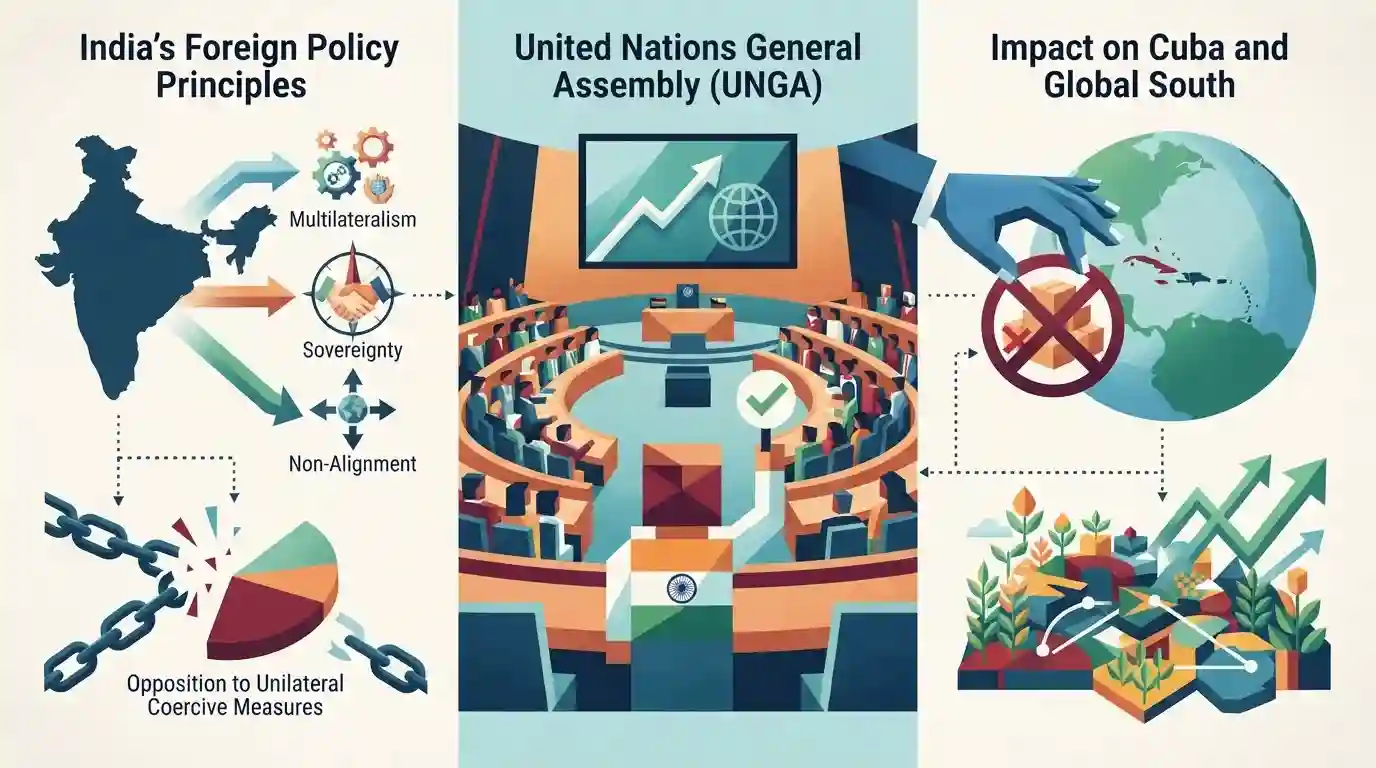
India voted at the United Nations General Assembly (UNGA) in favor of a resolution urging the United States to lift its decades-long economic embargo on Cuba, reflecting India's traditional foreign policy principles of opposing unilateral coercive measures and supporting multilateralism.
मुख्य मुद्दे
- India voted in favour of a UNGA resolution calling for an end to the long-standing U.S. economic, commercial, and financial embargo against Cuba.
- India's vote underscores its consistent foreign policy stance against unilateral economic sanctions and its solidarity with developing nations and the Global South.
- The resolution highlights international consensus against the U.S. embargo, which has faced overwhelming annual support at the United Nations for decades.
महत्त्वाच्या संज्ञा
United Nations General Assembly (UNGA)

The principal deliberative, policymaking, and representative organ of the United Nations comprising all 193 member states, where resolutions carry significant moral weight despite not being legally binding.
UPSC context
Important for GS Paper II (International Relations, UN and Multilateral Bodies). Tests knowledge of global governance structures and voting dynamics.
US embargo on Cuba
Sanctions imposed by the United States against Cuba, including commercial, economic, and financial restrictions that have faced widespread global opposition at the United Nations.
UPSC context
Important for GS Paper II (International Relations). Tests understanding of bilateral disputes, unilateral coercive measures, and international law.
Unilateral coercive measures and extraterritorial laws
Measures and laws enacted by a single country that attempt to exert legal jurisdiction over entities or activities outside its borders, conflicting with national sovereignty.
UPSC context
Important for GS Paper II (International Relations, India's Foreign Policy). Tests India's stance on sovereignty, multilateralism, and global south solidarity.
पूर्वपरीक्षा सापळा
UNGA resolutions calling for an end to the US embargo on Cuba are legally binding directives enforceable by the UN Security Council.
UNGA resolutions are recommendations and lack legal enforceability, unlike UNSC resolutions under Chapter VII. Aspirants often confuse UNGA declarations with binding international law.
संबंधित स्थिर संकल्पना
What is the legal status and jurisdiction of UNGA resolutions compared to UNSC resolutions?
- General Assembly: Non-binding nature: UNGA resolutions are recommendations to member states and carry moral and political weight, unlike Chapter VII UNSC resolutions.
- Security Council: Binding decisions: Security Council resolutions under Chapter VII can create legally binding obligations for all UN member states on matters of international peace and security.
- Charter Basis: Charter provisions: Article 10 and Article 11 of the UN Charter outline the discussion and recommendation powers of the General Assembly.
आंतर-विषय नमुने
UNGA Voting Patterns & NAM Legacy
India's consistent anti-sanctions vote aligns with its historical Bandung and Non-Aligned Movement (NAM) roots, balanced today with multi-alignment across Western and Global South platforms.
Unilateral Sanctions vs. Multilateral Norms
While India opposes unilateral US sanctions on Cuba, it simultaneously navigates Western-led export controls and secondary sanctions frameworks in technology and defense.

UNGA resolution voting behavior combined with India's traditional opposition to unilateral coercive measures is a high-yield IR theme.
संबंधित PYQ · 3
संबंधित PYQ · 3
- 2025MainsGS2
"The reform process in the United Nations remains unresolved, because of the delicate imbalance of East and West and entanglement of the USA vs. Russo-Chinese alliance.” Examine and critically evaluate the East-West policy confrontations in this regard.
- 2019MainsGS2
‘What introduces friction into the ties between India and the United States is that Washington is still unable to find for India a position in its global strategy, which would satisfy India's national self-esteem and ambitions.’ Explain with suitable examples.
- 2015MainsGS2
Discuss the impediments India is facing in its pursuit of a permanent seat in UN Security Council.
