India UN Resolution Stance on Two State Solution
Source:Indian Express ↗
Why It Matters
The article highlights India's nuanced diplomatic balancing act in the Middle East. While maintaining strong strategic ties with Israel, India continues to support the Palestinian cause and the two-state solution at international forums. It also illustrates the broader global diplomatic divide, where resolutions backed by the majority of the UN face opposition from the US-Israel bloc.
Summary
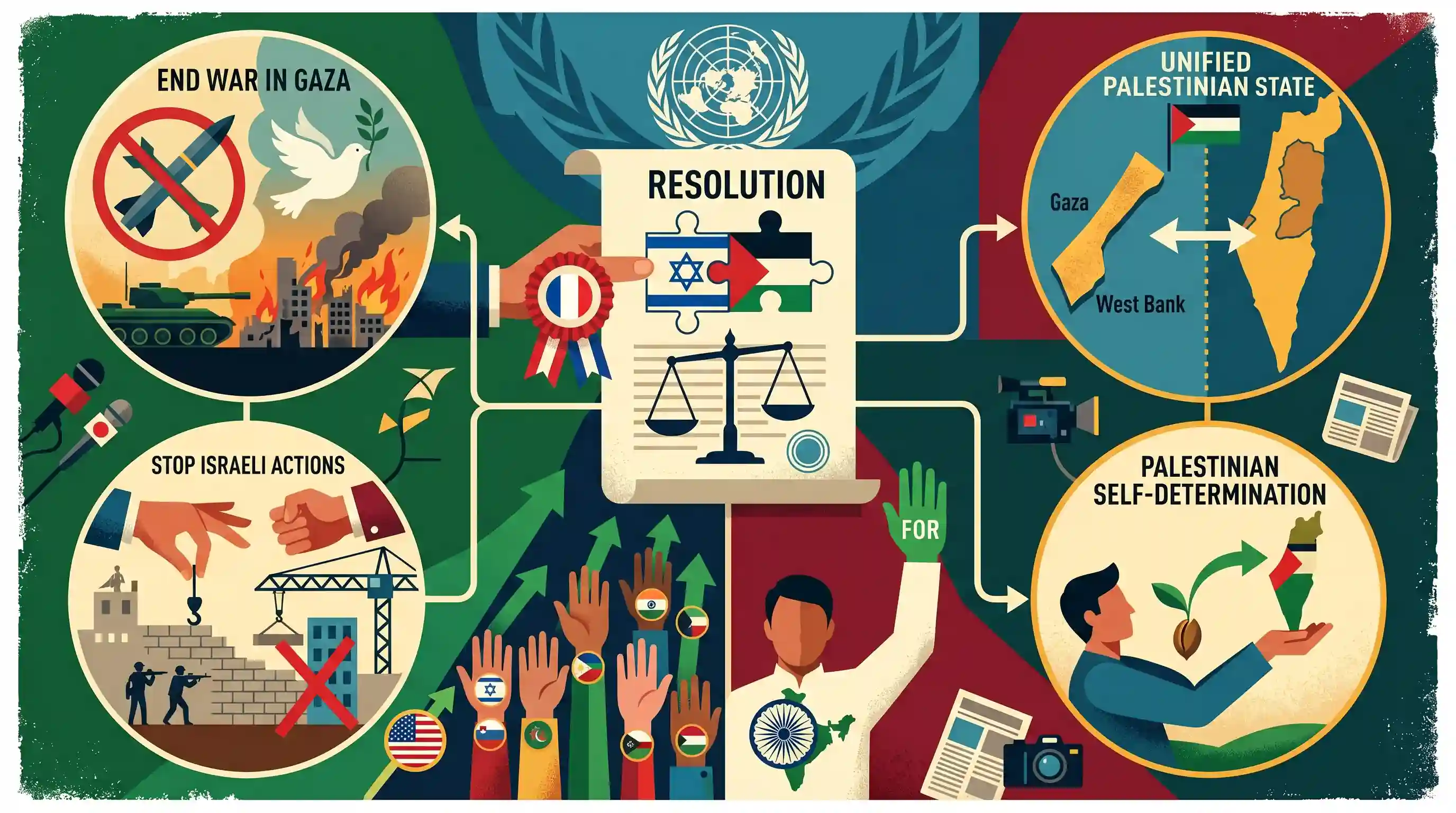
India recently voted in favor of a UN General Assembly resolution that backs the 'New York Declaration' advocating for a two-state solution to the Israel-Palestine conflict. The France-introduced resolution received widespread international backing, despite opposition from Israel and the US. It urgently calls for an end to the ongoing war in Gaza, demanding that Israel halt settlement expansions, land annexations, and settler violence in the Occupied Palestinian Territory, including East Jerusalem. Crucially, the declaration reaffirms the Palestinian right to self-determination and insists that Gaza and the West Bank must be unified under a single Palestinian state, reflecting India's continued diplomatic stance on resolving the Middle East crisis.
Key Points
- India voted in favour of a UN General Assembly resolution calling for a peaceful settlement of the Palestine issue and endorsing a two-state solution.
- The France-introduced resolution backs the 'New York Declaration', which was initially adopted at a conference co-chaired by France and Saudi Arabia in July 2025.
- The declaration demands Israeli leadership commit to the two-state framework and cease all settlement activities, land grabs, and settler violence in the Occupied Palestinian Territory, including East Jerusalem.
- It reaffirms the Palestinian right to self-determination, insisting that Gaza is an integral part of a future Palestinian state and must be unified with the West Bank.
Important Terms
New York Declaration

A 2025 UN-endorsed roadmap proposing a 15-month plan for a sovereign, demilitarized Palestinian state, immediate ceasefire in Gaza, and Hamas disarmament under international supervision.
UPSC context
GS II (International Relations); significant for India's shift from recent abstentions to active support for specific Middle East peace roadmaps.
two-state solution
The proposed framework for resolving the Israeli–Palestinian conflict by establishing two independent, sovereign states living side-by-side in peace within secure, recognized borders.
UPSC context
GS II (International Relations); a long-standing cornerstone of Indian foreign policy and a central theme in West Asian geopolitics.
UN General Assembly (UNGA)
The main deliberative, policymaking, and representative organ of the UN, where all 193 member states have equal representation and voting rights on international issues.
UPSC context
GS II (International Organizations); tests knowledge of global governance mechanisms and the political weight of non-binding international resolutions.
Self-determination
A fundamental international law principle granting a people the right to freely determine their political status and pursue their economic, social, and cultural development.
UPSC context
GS II (International Relations/Polity); key concept in human rights and the legal basis for Palestinian statehood claims.
Occupied Palestinian Territory (OPT)
Territories comprising the West Bank, East Jerusalem, and Gaza Strip, which have been under Israeli control since the 1967 Six-Day War.
UPSC context
GS II (International Relations/Geography); crucial for understanding territorial disputes and the legal definitions of occupation in international law.
Prelims Trap
The 2025 'New York Declaration' is a legally binding UN treaty regarding the protection of refugees and migrants.
Aspirants confuse this with the 2016 NY Declaration for Refugees, or assume UNGA resolutions are binding. It is a non-binding resolution on Palestine.
Static Concepts Connected
What is India's historical stance on Palestine?
- 1974 PLO Recognition: India was the first non-Arab State to recognize the Palestine Liberation Organization (PLO) as the sole representative of Palestinians in 1974.
- De-hyphenation Policy: Under this diplomatic approach, India treats its relations with Israel and Palestine as independent and mutually exclusive, avoiding zero-sum diplomacy.
How do UN General Assembly (UNGA) resolutions differ from UNSC resolutions?
- Legal Enforceability: UNGA resolutions are considered recommendatory and non-binding, unlike UNSC resolutions issued under Chapter VII, which are legally binding on all member states.
- Voting Mechanism: The UNGA operates on a one-member-one-vote principle without vetoes, whereas the UNSC allows its five permanent (P5) members absolute veto power.
Cross-Topic Patterns
De-hyphenation & West Asia Strategy
India's affirmative vote illustrates its de-hyphenation policy, balancing deep defense ties with Israel against traditional multilateral support for Palestinian self-determination and the two-state solution.
Confusing 'Declarations in News'
UPSC frequently tests international declarations. The 2025 'New York Declaration' on Palestine must be carefully distinguished from older, similarly named declarations on Forests (2014) and Refugees (2016).

The 'New York Declaration' is highly likely to appear in a 'Pairs in News' Prelims question in 2026, matched to the two-state solution.
Linked PYQs · 3
Linked PYQs · 3
- 2018MainsGS2
“India’s relations with Israel have, of late, acquired a depth and diversity, which cannot be rolled back.” Discuss.
- 2022MainsGS2
How will I2U2 (India, Israel, UAE and USA) grouping transform India's position in global politics?
- 2023PrelimsGS1
Consider the following statements: Statement-I: Israel has established diplomatic relations with some Arab States. Statement-II: The 'Arab Peace Initiative' mediated by Saudi Arabia was signed by Israel and Arab League. Which one of the following is correct in respect of the above statements?
