Swami Vivekananda and India's Vishwa Guru Vision
Source:Indian Express ↗
Why It Matters
Swami Vivekananda is a recurrent figure in the UPSC GS4 (Ethics) paper, where candidates are frequently asked to interpret his quotations in a contemporary context. Furthermore, understanding his philosophy is crucial for GS1 (Modern History/Culture) and for analyzing India's soft power strategy and 'Vishwa Guru' narrative in GS2 (International Relations).
Summary
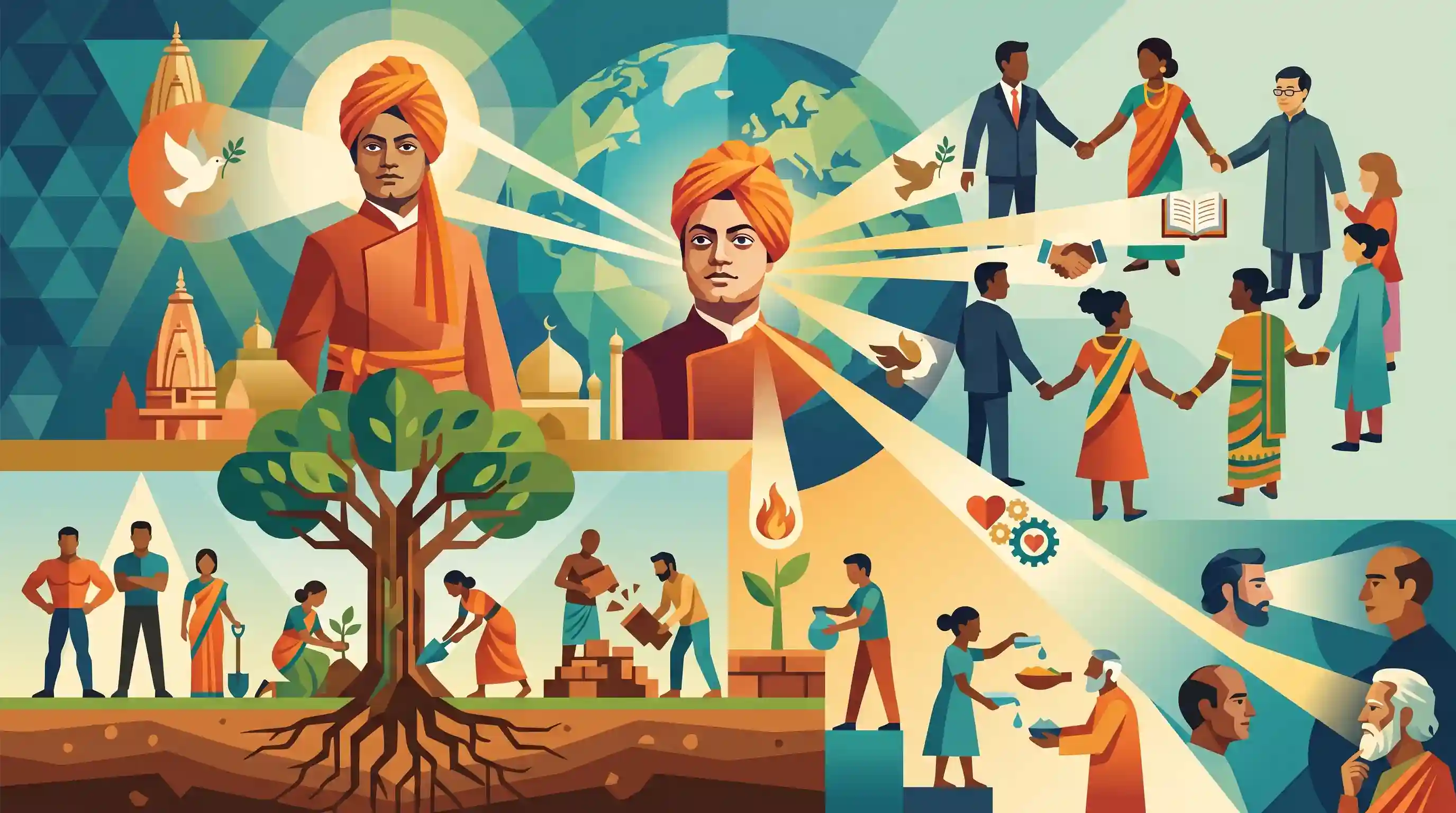
The article explores Swami Vivekananda's profound vision for India's role as a 'Vishwa Guru' (global teacher) on the world stage. It highlights how his teachings on universal brotherhood, neo-Vedanta, and humanism offer timeless solutions to modern global challenges. By emphasizing character-building, moral integrity, and the assimilation of diverse thoughts, Vivekananda imagined an India that leads through its spiritual and cultural soft power. Embracing these foundational ideals is framed as essential for India to authentically assume the mantle of global leadership, projecting an ethos of tolerance, service, and ethical strength.
Key Points
- Swami Vivekananda envisioned India's resurgence driven by spiritual awakening, moral strength, and cultural ethos rather than mere material wealth or military might.
- His historic address at the 1893 Parliament of the World's Religions emphasized universal tolerance, acceptance, and the harmonious synthesis of different religious paths.
- The contemporary concept of India as a 'Vishwa Guru' (global teacher) is deeply rooted in this vision, relying on soft power to promote global harmony, peace, and spiritual well-being.
- Vivekananda championed 'man-making' education, focusing on character-building, fearlessness, and moral courage, viewing the youth as the primary catalysts for national transformation.
- His philosophy of Practical Vedanta encourages seeing the divine in all human beings, thereby framing social service and uplifting the marginalized (Daridra Narayan) as a form of spiritual practice.
Important Terms
Vishwa Guru

Literally "global teacher," it refers to India's aspiration to lead the world through its spiritual, cultural, and intellectual heritage, emphasizing moral leadership and ancient wisdom.
UPSC context
GS Paper 2 (Soft Power) and GS Paper 4 (Ethical Leadership).
Neo-Vedanta
Vivekananda’s reinterpretation of Advaita Vedanta, shifting focus from individual salvation (moksha) through renunciation to social responsibility and active service to humanity as a form of worship.
UPSC context
GS Paper 1 (Social Reform) and GS Paper 4 (Philosophers).
Parliament of the World's Religions
The 1893 Chicago forum where Swami Vivekananda introduced Hinduism to the West, famously calling for religious universalism and the end of sectarianism and bigotry.
UPSC context
GS Paper 1 (Modern Indian History/Personalities).
Ramakrishna Mission
A philanthropic organization founded by Swami Vivekananda in 1897 to propagate the ideals of Advaita Vedanta through humanitarian service, education, and disaster relief.
UPSC context
GS Paper 1 (Socio-religious movements) and GS Paper 4 (Ethics).
Universal Brotherhood
Vivekananda's ethical vision that all beings are spiritually one, requiring a shift from mere religious "tolerance" to "acceptance" of all paths as valid and divine.
UPSC context
GS Paper 4 (Human Values and Ethics).
Practical Vedanta
The application of spiritual truths to mundane life, asserting that the highest form of religion is the selfless service of "Daridra Narayana" (God in the poor).
UPSC context
GS Paper 4 (Lessons from Great Leaders).
Prelims Trap
Swami Vivekananda advocated for strict asceticism and complete rejection of the material world to achieve true spiritual salvation.
Vivekananda championed 'Practical Vedanta', arguing against isolated asceticism. He believed spiritual liberation is achieved through Karma Yoga and active social service, famously viewing the poor as 'Daridra Narayan'.
Static Concepts Connected
What are the core tenets of Swami Vivekananda's Practical Vedanta?
- Divinity in all: It sees the divine in every human being, shifting the focus of religion from temple rituals to human welfare.
- Daridra Narayan: Serving the poor and marginalized is equated to serving the Divine itself, making social service the highest worship.
- Action over asceticism: It emphasizes active participation in society to uplift the masses, blending spiritual pursuit with material and social progress.
How does cultural diplomacy manifest in India's modern foreign policy?
- Vishwa Guru framing: Projecting India as a civilizational state offering spiritual and ethical leadership, rather than just hard military power.
- Institutional soft power: Using institutions like ICCR, diaspora networks, and initiatives like the International Day of Yoga to build cultural capital.
- Vasudhaiva Kutumbakam: Framing global engagement through the lens of 'the world is one family' (e.g., vaccine maitri, G20 presidency).
Cross-Topic Patterns
Soft Power via Moral Thinkers
Vivekananda's 'Vishwa Guru' concept often connects to GS2 Soft Power, demonstrating how 19th-century philosophical tenets like Vasudhaiva Kutumbakam translate into modern cultural diplomacy and foreign policy.
NEP 2020 & Man-making Education
Vivekananda's critique of rote learning and advocacy for character-building directly parallels the philosophical underpinnings of NEP 2020's focus on holistic, value-based student development.

Expect a GS4 question linking Vivekananda’s Practical Vedanta to the ethical duties of civil servants towards marginalized communities.
Linked PYQs · 5
Linked PYQs · 5
- 2025MainsGS4
Given below are three quotations of great thinkers. What do each of these quotations convey to you in the present context? 3.(a) "Those who in trouble untroubled are, Will trouble trouble itself." – Thiruvalluvar 3.(b) "The greatest discovery of my generation is that a human being can alter his life by altering his attitudes.” – William James 3.(c) "The strength of a society is not in its laws, but in the morality of its people." – Swami Vivekananda
- 2024MainsGS4
Given below are three quotations of great thinkers. What do each of these quotations convey to you in the present context? (a) “Learn everything that is good from others, but bring it in, and in your own way absorb it, do not become others.” — Swami Vivekananda
- 2023MainsGS4
Given below are three quotations of great thinkers. What do each of these quotations convey to you in the present context ? "Do not hate anybody, because that hatred that comes out from you must, in the long run, come back to you. If you love, that love will come back to you, completing the circle." – Swami Vivekananda
- 2020MainsGS4
Discuss the role of ethics and values in enhancing the following three major components of Comprehensive National Power (CNP) viz. human capital, soft power (culture and policies) and social harmony.
- 2021MainsGS1
Trace the rise and growth of socio-religious reform movements with special reference to Young Bengal and Brahmo Samaj.
