India Vietnam Defence Cooperation and Indo Pacific Maritime Security
Source:The Hindu ↗
Why It Matters
Vietnam is a critical pillar of India's Act East Policy and its broader strategic vision for the Indo-Pacific. Enhancing defence ties with Vietnam, particularly concerning emerging technologies (AI, Quantum) and maritime security, directly counters strategic imbalances in the region, protects freedom of navigation, and builds mutual defence capabilities against shared challenges.
Summary
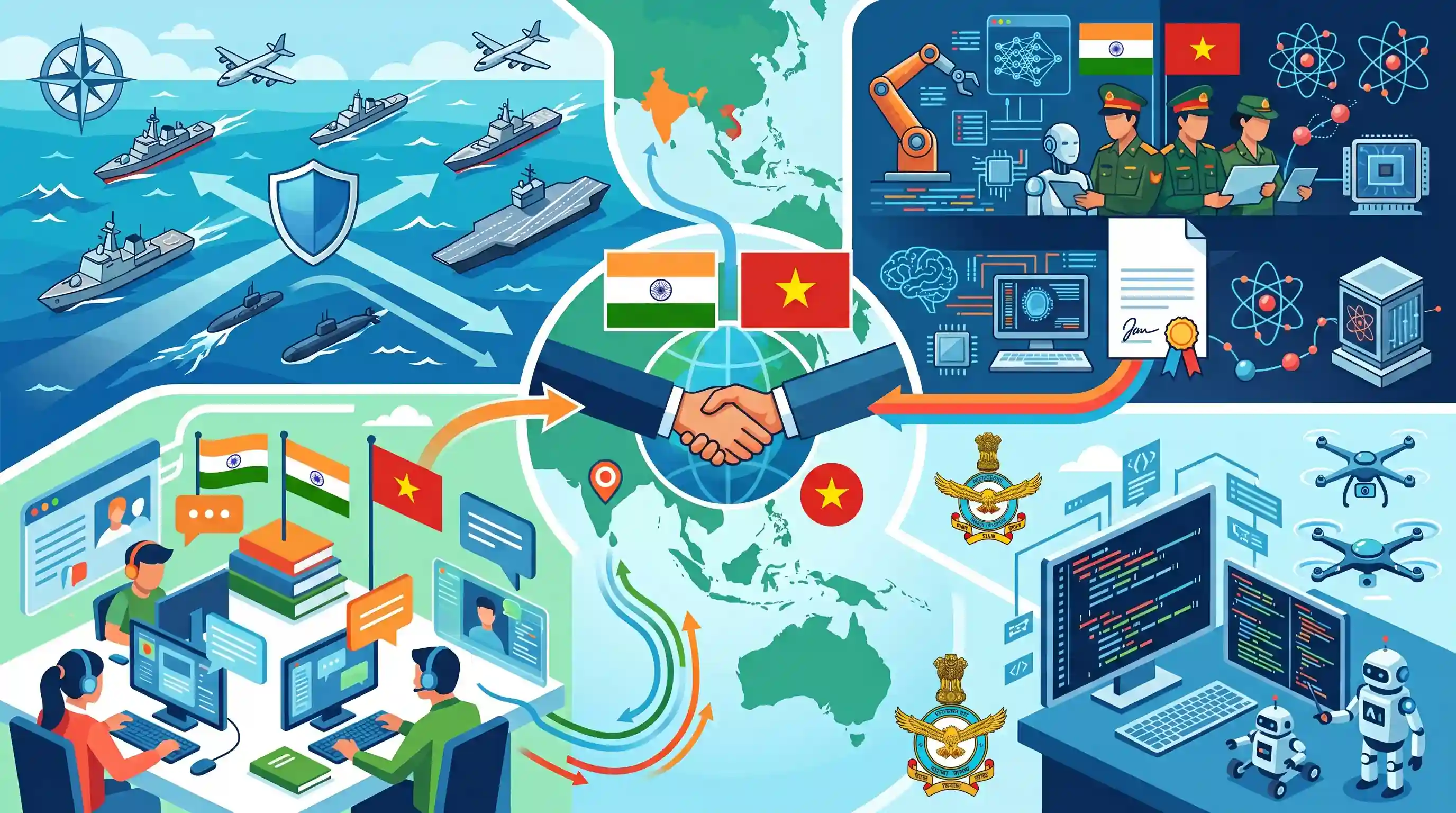
India and Vietnam have agreed to deepen their defence cooperation, focusing significantly on maritime security and regional stability in the Indo-Pacific. During talks in Hanoi, India's Defence Minister Rajnath Singh and his Vietnamese counterpart highlighted mutual convergence on issues such as freedom of navigation and a rules-based order. The countries are enhancing bilateral ties through initiatives involving advanced technology; an MoU was signed for collaboration in Artificial Intelligence (AI) and Quantum Technology between Indian and Vietnamese military institutions. Furthermore, a language lab was inaugurated at Vietnam's Air Force Officers' College, and an AI lab at the Telecommunications University is set to further capacity-building efforts. The engagement reinforces the Comprehensive Strategic Partnership between the two nations against the backdrop of strategic developments in the Indo-Pacific.
Key Points
- India and Vietnam are significantly expanding their defence cooperation, with a core focus on maritime security, freedom of navigation, and maintaining a rules-based order in the Indo-Pacific region.
- Bilateral discussions between Defence Minister Rajnath Singh and Vietnam's General Phan Van Giang underscored a mutual convergence on strategic issues and regional stability.
- A Memorandum of Understanding (MoU) was signed between India’s Military College of Telecommunications Engineering and Vietnam’s Telecommunications University to cooperate in Artificial Intelligence (AI) and Quantum Technology.
- Capacity-building initiatives include the inauguration of a language lab at the Air Force Officers' College in Nha Trang and the announcement of a forthcoming AI lab at the Telecommunications University.
- The deepening defence and technological ties reinforce the Comprehensive Strategic Partnership between the two nations, which is a vital component of India's Act East Policy.
Important Terms
Enhanced Comprehensive Strategic Partnership

The highest level of bilateral ties between India and Vietnam, elevated in 2026. It emphasizes deep strategic trust, defense co-production, and cooperation in emerging technologies like AI and Quantum.
UPSC context
GS Paper-II: International Relations. Critical for understanding evolving bilateral hierarchies and strategic autonomy in the Indo-Pacific.
Act East Policy
India's primary diplomatic strategy to deepen engagement with Southeast Asian nations. Vietnam is a central pillar, acting as a bridge for India’s economic integration and security presence in ASEAN.
UPSC context
GS Paper-II: Indian Foreign Policy. Tests India’s regional outreach and the strategic importance of Southeast Asian partners.
Maritime Security
Joint efforts to ensure freedom of navigation and a rules-based order in the Indo-Pacific. It is a key area of convergence between India and Vietnam against South China Sea tensions.
UPSC context
GS Paper-II & III: IR and Internal Security. Tests knowledge of maritime laws (UNCLOS) and regional stability.
Military College of Telecommunications Engineering (MCTE)
The Indian Army’s premier technical training institute in Mhow. It leads high-tech defense research and international collaborations in AI, cyber security, and quantum communications.
UPSC context
GS Paper-III: Security and S&T. Relevant for defense indigenization and technology-led military diplomacy.
MoU on Artificial Intelligence and Quantum Technology
A 2026 agreement between MCTE (India) and TCU (Vietnam) to collaborate on dual-use frontier technologies, enhancing defense innovation and secure communication capabilities.
UPSC context
GS Paper-III: Science & Technology. Focuses on the strategic role of emerging technologies in modern warfare.
Telecommunications University (Vietnam)
A military education institution in Nha Trang, Vietnam, where India is assisting in technical capacity building through the establishment of an Artificial Intelligence laboratory.
UPSC context
GS Paper-II: IR. Tests India's soft power and technical assistance to strategic partners.
Air Force Officers' College (Vietnam)
A Vietnamese defense training institution where India established a Language Lab to improve technical communication and interoperability between the two nations' air forces.
UPSC context
GS Paper-II: Bilateral Relations. Important for military-to-military cooperation and skill-development initiatives.
Prelims Trap
India recently exported the BrahMos anti-ship missile system to Vietnam to counter aggression.
India exported the BrahMos system to the Philippines. To Vietnam, India gifted the indigenously built active missile corvette, INS Kirpan, in 2023.
Static Concepts Connected
What distinguishes India's 'Act East' from the previous 'Look East' policy?
- Strategic Shift: Moved from predominantly economic engagement (Look East) to robust security, defense, and strategic cooperation (Act East).
- Geographic Expansion: Extended focus beyond ASEAN nations to include the broader Indo-Pacific architecture, encompassing Japan, South Korea, and Pacific Island countries.
- Institutional Links: Elevated bilateral relations with key ASEAN states, like Vietnam, to Comprehensive Strategic Partnerships.
What are the key maritime zones under UNCLOS relevant to freedom of navigation?
- Territorial Sea: Extends 12 nautical miles from the baseline; the coastal state exercises full sovereignty over the air space, water, and seabed.
- Exclusive Economic Zone: Extends 200 nautical miles; the state has sovereign rights solely for exploring and exploiting marine resources, not total sovereignty.
- Innocent Passage: Foreign vessels enjoy the right of "innocent passage" through territorial seas and full freedom of navigation in EEZs.
Cross-Topic Patterns
Emerging Tech in Military Diplomacy
Shifting from traditional hardware, India now uses capacity-building in disruptive technologies (AI, Quantum) as strategic geopolitical tools to deepen its Act East Policy partnerships.
Net Security Provider in ASEAN
Vietnam is central to India's transformation from an Indian Ocean actor to a proactive "Net Security Provider" in the broader Indo-Pacific, complementing the SAGAR vision.

Expect a 2026 GS2 question linking Act East, Indo-Pacific maritime security, and emerging tech (AI/Quantum) as diplomatic tools.
Linked PYQs · 3
Linked PYQs · 3
- 2014MainsGS2
With respect to the South China sea, maritime territorial disputes and rising tension affirm the need for safeguarding maritime security to ensure freedom of navigation and over flight throughout the region. In this context, discuss the bilateral issues between India and China.
- 2023MainsGS3
Introduce the concept of Artificial Intelligence (AI). How does Al help clinical diagnosis? Do you perceive any threat to privacy of the individual in the use of Al in healthcare?
- 2021MainsGS3
Keeping in view India's internal security, analyse the impact of cross-border cyber attacks. Also discuss defensive measures against these sophisticated attacks.
