Canal-top solar power infrastructure deployment across India
Source:The Hindu ↗
આ શા માટે મહત્વનું છે
It addresses critical intersectional themes for UPSC GS3: renewable energy expansion targets, mitigation of land-use conflicts, and efficient water management through innovative technological integration.
સારાંશ
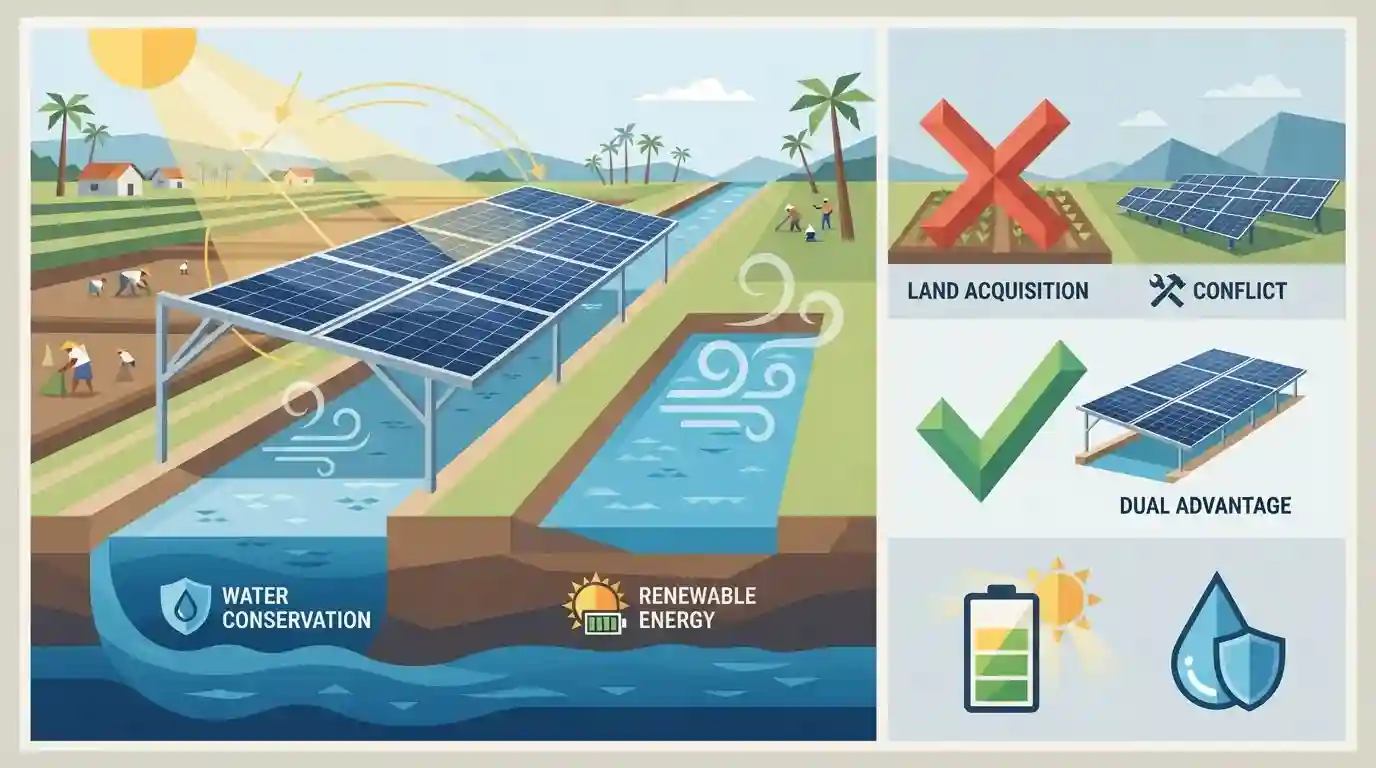
The article explores how India's vast canal networks can be leveraged for installing solar panels, providing a land-free, dual-advantage solution that generates renewable energy while mitigating water evaporation in canals.
મુખ્ય મુદ્દા
- India's extensive canal networks offer a unique, land-free pathway for deploying solar photovoltaic infrastructure.
- Canal-top solar installations help reduce water evaporation from canals while generating clean electricity, addressing land scarcity challenges.
- The dual-use model minimizes land acquisition hurdles and environmental conflicts associated with large-scale ground-mounted solar farms.
- Challenges include high initial capital costs, structural engineering constraints, operation and maintenance complexities over water bodies, and siltation.
મહત્વપૂર્ણ શબ્દો
Canal-top photovoltaics (CTPV)

An innovative renewable energy approach where solar photovoltaic panels are installed on elevated structures above irrigation or water canals, generating electricity while bypassing major land acquisition bottlenecks.
UPSC context
UPSC GS Paper III (Infrastructure, Energy & Environment): Tests understanding of innovative clean energy solutions, land conservation, and dual-use infrastructure.
Land Acquisition
The process of acquiring private or community land for public infrastructure or industrial projects, often hindered by high costs, rehabilitation challenges, and prolonged legal delays.
UPSC context
UPSC GS Paper III (Economy & Infrastructure): Important for questions on infrastructure bottlenecks, industrial growth hurdles, and agricultural land protection.
Water Resources Management
The strategic conservation, development, and optimal utilization of water resources, including mitigating evaporation losses in surface water networks like canals and reservoirs.
UPSC context
UPSC GS Paper III (Environment & Water Resources): Tests strategies for mitigating water scarcity, agricultural water security, and climate adaptation.
પ્રિલિમ્સ ટ્રેપ
Canal-top solar installations completely eliminate the financial and operational challenges associated with conventional ground-mounted solar farms in India.
While canal-top solar reduces land acquisition issues, it faces severe financial and structural hurdles (elevated steel costs, wind loads) that prevent it from being a universal substitute for ground-mounted solar.
સંલગ્ન સ્થિર ખ્યાલો
What are the key advantages and challenges of Canal-Top Photovoltaic (CTPV) systems in India?
- Land Conservation: Saves agricultural land from being diverted for solar parks, addressing intense land scarcity.
- Water Security: Lowers water loss through evaporation in arid irrigation canals while suppressing algal blooms.
- Panel Efficiency: Cooling effect from flowing water enhances photovoltaic conversion efficiency compared to hot ground arrays.
- High Capex & O&M: Involves high capital costs for elevated structures, complex maintenance over water, and severe wind-load engineering challenges.
આંતર-વિષય પેટર્ન
Renewable Energy Meets Water Conservation Infrastructure
Canal-top solar links renewable energy expansion (SDG 7) with water conservation and climate resilience in agriculture (SDG 6 & 13).
Land Acquisition Exemption in Infrastructure Projects
Utilizing canal corridors bypasses traditional land acquisition bottlenecks governed by the Right to Fair Compensation and Transparency in Land Acquisition, Rehabilitation and Resettlement Act, 2013.

Canal-top solar benefits (evaporation reduction, panel cooling efficiency) vs capital costs will be tested in a multi-statement prelims question.
સંલગ્ન PYQ · 2
સંલગ્ન PYQ · 2
- 2018MainsGS3
“Access to affordable, reliable, sustainable and modern energy is the sine qua non to achieve Sustainable Development Goals (SDGs).” Comment on the progress made in India in this regard.
- 2024PrelimsGS1
Recently, the term "pumped-storage hydropower" is actually and appropriately discussed in the context of which one of the following?
