India US Sign Decade Long Defence Framework Agreement
Source:The Hindu ↗
Why It Matters
Understanding the trajectory of India-US defense ties is crucial for the GS-2 International Relations syllabus. It illustrates how strategic and security imperatives in the Indo-Pacific are driving the 'Major Defence Partnership' forward, even as the two countries navigate economic disagreements such as tariffs.
Summary
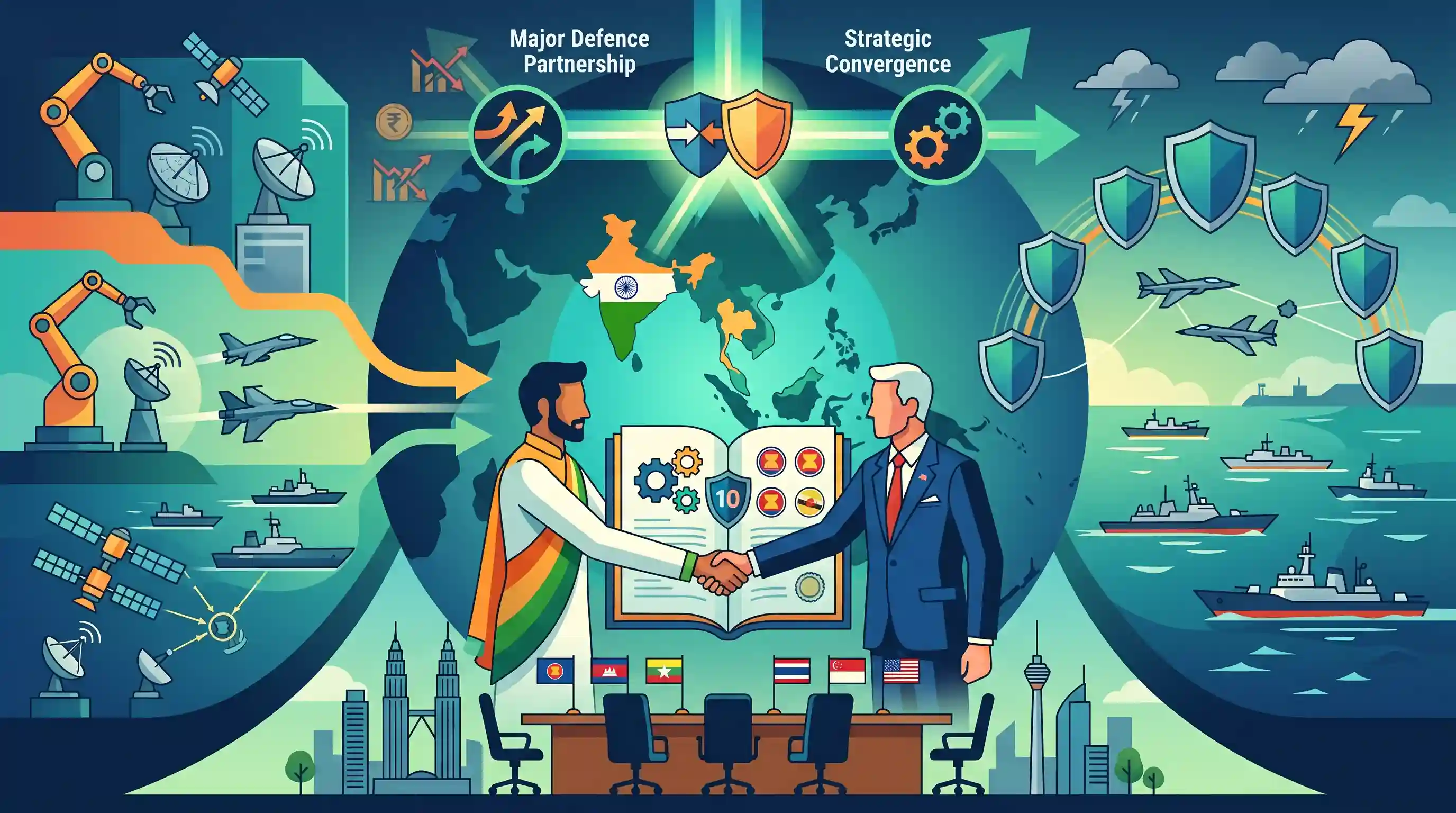
India and the United States have signed a 10-year defense framework agreement to advance their "Major Defence Partnership". The pact was signed by Indian Defence Minister Rajnath Singh and U.S. Secretary of War Pete Hegseth on the sidelines of the 12th ASEAN Defence Ministers' Meeting-Plus (ADMM-Plus) in Kuala Lumpur, Malaysia. The agreement prioritizes defense technology cooperation, interoperability, and regional stability in the Indo-Pacific, demonstrating strong strategic convergence that overrides recent bilateral trade frictions.
Key Points
- India and the USA signed a 10-year defense framework pact on the sidelines of the 12th ADMM-Plus meeting in Kuala Lumpur.
- The agreement, signed by Defence Minister Rajnath Singh and U.S. Secretary of War Pete Hegseth, deepens the "Major Defence Partnership" between the two nations.
- The framework emphasizes enhancing defense technology cooperation, information sharing, and joint interoperability.
- It aims to ensure regional stability and maintain a free and open Indo-Pacific amid evolving regional security challenges.
- The strategic defense alignment continues robustly despite recent friction over Washington's imposition of 50% tariffs on Indian goods.
Important Terms
Framework for the U.S.-India Major Defence Partnership

A 10-year roadmap (2025-2035) guiding strategic collaboration in defense technology co-development, joint production, and supply chain resilience to ensure a 'free and open' Indo-Pacific.
UPSC context
GS Paper II: Bilateral agreements. Tests knowledge of the evolving India-US strategic convergence and defense modernization efforts.
Major Defence Partner (MDP)
A unique status granted to India by the U.S. in 2016, allowing access to high-end defense technologies comparable to close treaty allies without requiring a formal military alliance.
UPSC context
GS Paper II: International Relations. Crucial for understanding India's strategic autonomy and tech-sharing benefits with the United States.
ADMM-Plus
The highest consultative body for defense in ASEAN, including 10 member states and 8 dialogue partners (including India/USA), focused on regional security cooperation and trust-building.
UPSC context
GS Paper II: Regional groupings. Tests knowledge of multilateral security architecture and India’s diplomatic role in Southeast Asia.
ASEAN
A regional organization of Southeast Asian states (central to India's Act East Policy) that promotes economic growth, social progress, and regional peace through 'ASEAN Centrality.'
UPSC context
GS Paper II: International Relations. Fundamental for questions on Act East Policy and Indo-Pacific regional security.
Interoperability
The capacity of different military organizations and technologies to operate together effectively through shared standards, protocols, and foundational agreements like LEMOA, COMCASA, and BECA.
UPSC context
GS Paper III: Security. Key concept in joint military exercises and the technical pillar of modern strategic partnerships.
Indo-Pacific
A strategic maritime region encompassing the Indian and Pacific Oceans; it is the primary geographic focus for India-US efforts to counter regional hegemony.
UPSC context
GS Paper II: Geopolitics. Essential for discussing the shift in global power and India's maritime security interests.
Prelims Trap
India's 'Major Defence Partner' designation signifies a formal mutual defense treaty alliance with the United States.
MDP is a unique designation to elevate tech sharing to treaty-ally levels, but India strictly maintains its strategic autonomy and is NOT a mutual treaty ally.
Static Concepts Connected
What is ADMM-Plus and who are its eight dialogue partner members?
- Platform: It is the highest defense consultative and cooperative mechanism for ASEAN and its eight non-ASEAN Dialogue Partners.
- Dialogue Partners: The eight partners are India, USA, China, Russia, Japan, South Korea, Australia, and New Zealand.
- Objective: It focuses on practical cooperation in maritime security, counter-terrorism, military medicine, humanitarian assistance, and peacekeeping.
What are the four foundational defense agreements between India and the US?
- GSOMIA & LEMOA: GSOMIA (2002) covers classified info sharing. LEMOA (2016) permits access to each other's military facilities for logistics and refueling.
- COMCASA: COMCASA (2018) enables secure, encrypted military communications and facilitates the transfer of advanced communication equipment.
- BECA: BECA (2020) allows the sharing of geospatial intelligence, maps, and satellite data for precision targeting and navigation.
Cross-Topic Patterns
Geopolitical compartmentalization vs Trade friction
Advancing a 10-year defense pact while facing 50% US tariffs highlights modern diplomatic compartmentalization. Strategic Indo-Pacific alignment now operates robustly and independently of bilateral economic and trade disputes.
ASEAN centrality in Indo-Pacific architecture
Signing a bilateral US-India pact at the ADMM-Plus forum underscores how both nations utilize ASEAN-led architecture to project their converging 'Act East' and 'Free Indo-Pacific' strategies.

Expect a multi-statement question mapping India's 'Major Defence Partner' status against foundational pacts and formal US treaty alliances.
Linked PYQs · 2
Linked PYQs · 2
- 2020MainsGS2
What is the significance of Indo-US defence deals over Indo-Russian defence deals? Discuss with reference to stability in the Indo-Pacific region.
- 2021MainsGS2
The newly tri-nation partnership AUKUS is aimed at countering China's ambitions in the Indo-Pacific region. Is it going to supersede the existing partnerships in the region? Discuss the strength and impact of AUKUS in the present scenario.
