India and United States Resume Interim Bilateral Trade Negotiations
Source:Indian Express ↗
Why It Matters
Understanding the dynamics of India-US trade negotiations illustrates how domestic policy shifts (like US tariff adjustments and Section 301 investigations) impact bilateral relations and global supply chains. It also underscores India's broader strategic priorities, such as energy security reliant on vital maritime routes like the Strait of Hormuz.
Summary
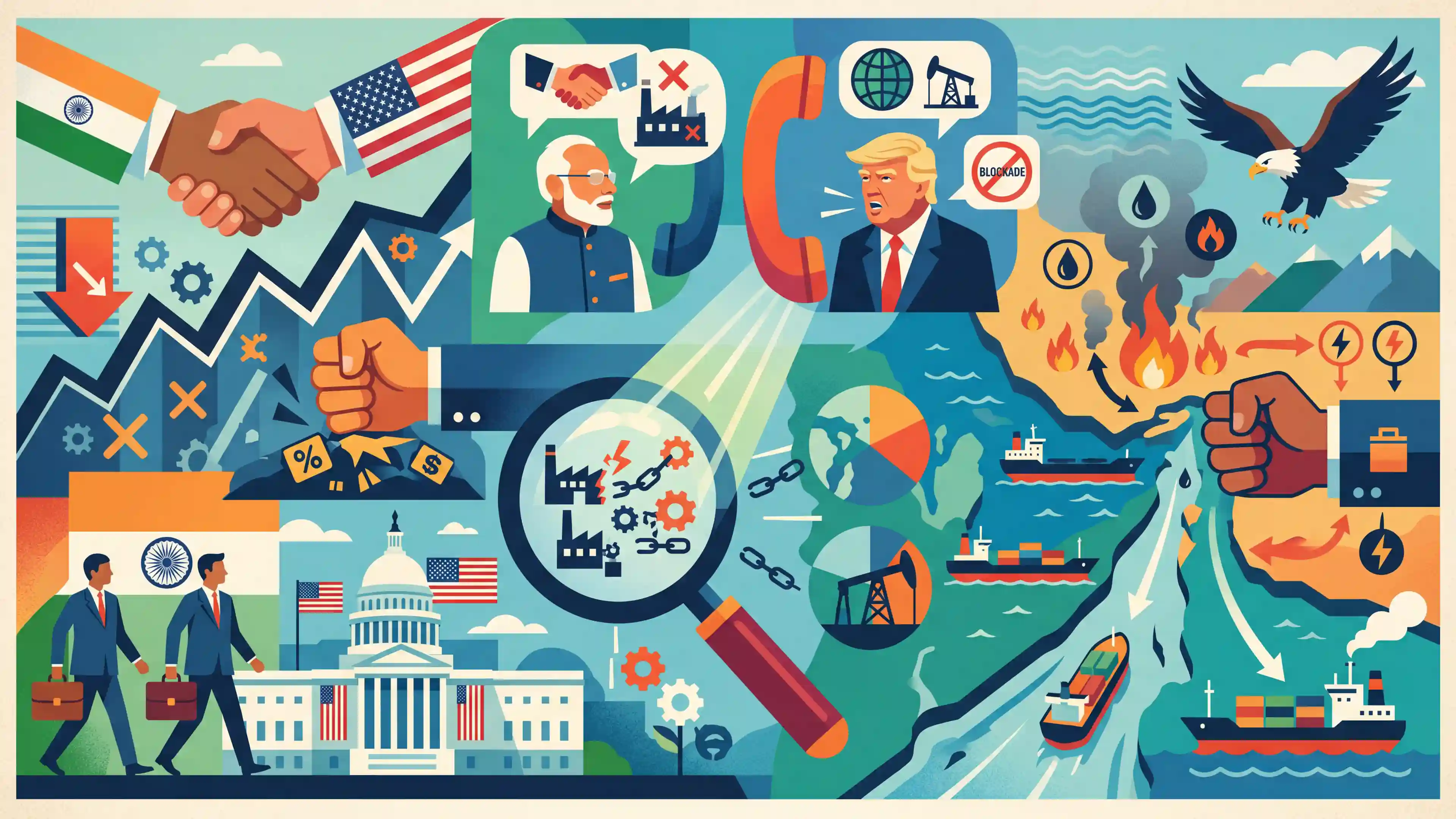
India and the US are set to resume negotiations on an interim bilateral trade agreement with an Indian delegation visiting Washington on April 20. The talks were previously derailed when the US imposed a temporary 10% tariff on all global imports, neutralizing a prior concession that lowered tariffs on Indian goods to 18%. Complicating the trade landscape further, the USTR has initiated broad Section 301 investigations into forced labor and industrial policies across numerous economies. Amidst these trade tensions, PM Modi recently spoke with President Trump, flagging trade concerns and highlighting the geopolitical necessity of keeping the Strait of Hormuz open for global energy security.
Key Points
- An Indian delegation is scheduled to travel to Washington on April 20 to resume negotiations on an interim bilateral trade agreement.
- The trade agreement faced delays after a US Supreme Court ruling prompted President Trump to impose a temporary 150-day 10% tariff on all imports starting February 24.
- This new universal tariff eroded the competitive advantage India had recently negotiated when the US agreed to reduce tariffs on Indian goods to 18%.
- The US Trade Representative (USTR) has added pressure by launching Section 301 investigations into 60 economies regarding forced labor and 16 economies over industrial policies.
- In a recent phone conversation with President Trump, PM Modi emphasized the strategic importance of keeping the Strait of Hormuz open to secure energy flows and maritime trade.
Important Terms
Section 301 investigation

A provision under the US Trade Act of 1974 allowing the US to investigate and unilaterally retaliate against foreign trade practices deemed unfair or discriminatory.
UPSC context
GS2/GS3: International Relations and Economy; tests understanding of unilateral trade enforcement tools and their impact on India's 'Make in India' and exports.
United States Trade Representative (USTR)
The US government agency responsible for developing and recommending trade policy to the President and conducting bilateral and multilateral trade negotiations.
UPSC context
GS2: Bilateral Relations; tests knowledge of key international trade bodies and their role in shaping India-US economic ties.
Strait of Hormuz
A critical maritime chokepoint between the Persian Gulf and the Gulf of Oman, through which approximately 20% of global oil and gas shipments pass.
UPSC context
GS1/GS2: Geography and Energy Security; tests awareness of global maritime chokepoints and India's vulnerability to Middle East supply chain disruptions.
Trade Protectionism
Economic policy of restricting imports through tariffs, quotas, or regulations to shield domestic industries and workers from foreign competition.
UPSC context
GS3: Indian Economy; tests ability to analyze global trade trends (deglobalization) and their effects on India's trade balance and growth.
Interim Trade Agreement
A limited-scope trade deal focusing on specific goods or sectors, often serving as a preliminary step toward a comprehensive Free Trade Agreement (FTA).
UPSC context
GS3: International Trade; tests understanding of different types of trade pacts and the 'Early Harvest Scheme' strategy in diplomacy.
Prelims Trap
"Section 301 investigations are a mechanism under the WTO dispute settlement framework."
Section 301 is a unilateral US domestic law (Trade Act of 1974), not a WTO mechanism. It allows the US to bypass the WTO Dispute Settlement Body.
Static Concepts Connected
What is the geographical and strategic significance of the Strait of Hormuz?
- Location: It connects the Persian Gulf to the Gulf of Oman and the Arabian Sea.
- Bordering Nations: It is bordered by Iran to the north, and Oman (Musandam Peninsula) and the UAE to the south.
- Energy Transit: It is a critical maritime chokepoint, facilitating the transit of nearly 40% of India's crude oil imports and a massive share of global LNG.
How do unilateral trade measures like Section 301 conflict with WTO principles?
- Most-Favored-Nation (MFN): Unilateral or universal tariffs often violate the MFN principle, which requires countries to treat all WTO members equally without discrimination.
- Dispute Resolution: The WTO mandates that members use its multilateral Dispute Settlement Body rather than enacting unilateral retaliatory tariffs to resolve trade grievances.
Cross-Topic Patterns
Labor standards as non-tariff barriers
Developed nations are increasingly weaponizing domestic laws and ILO labor standards (like forced labor conventions) as non-tariff barriers to restrict imports from developing economies under the guise of ethical trade.
Trade diplomacy meets energy security
India's bilateral trade negotiations are heavily intertwined with geopolitical imperatives; ensuring the Strait of Hormuz remains open is vital for India's energy security and uninterrupted crude oil imports.

Expect a 2026 prelims map question on Middle East chokepoints (Hormuz/Bab el-Mandeb) paired with a trade question on non-tariff barriers.
Linked PYQs · 3
Linked PYQs · 3
- 2012MainsGS2
Discuss the likely negative impact of the protectionist measures proposed by the US on India's software industry.
- 2018PrelimsGS1
International Labour Organization's Conventions 138 and 182 are related to
- 2024PrelimsGS1
Consider the following statements : Statement-I : Sumed pipeline is a strategic route for Persian Gulf oil and natural gas shipments to Europe. Statement-II : Sumed pipeline connects the Red Sea with the Mediterranean Sea. Which one of the following is correct in respect of the above statements?
