India and US Resume Talks for Bilateral Trade Agreement
Source:The Hindu ↗
Why It Matters
The US is one of India's largest trading partners and a crucial strategic ally. Progress toward a Bilateral Trade Agreement (BTA) represents a significant shift in India's trade policy, aiming to secure reliable supply chains, boost exports, and attract foreign direct investment, which are critical for India's long-term economic growth.
Summary
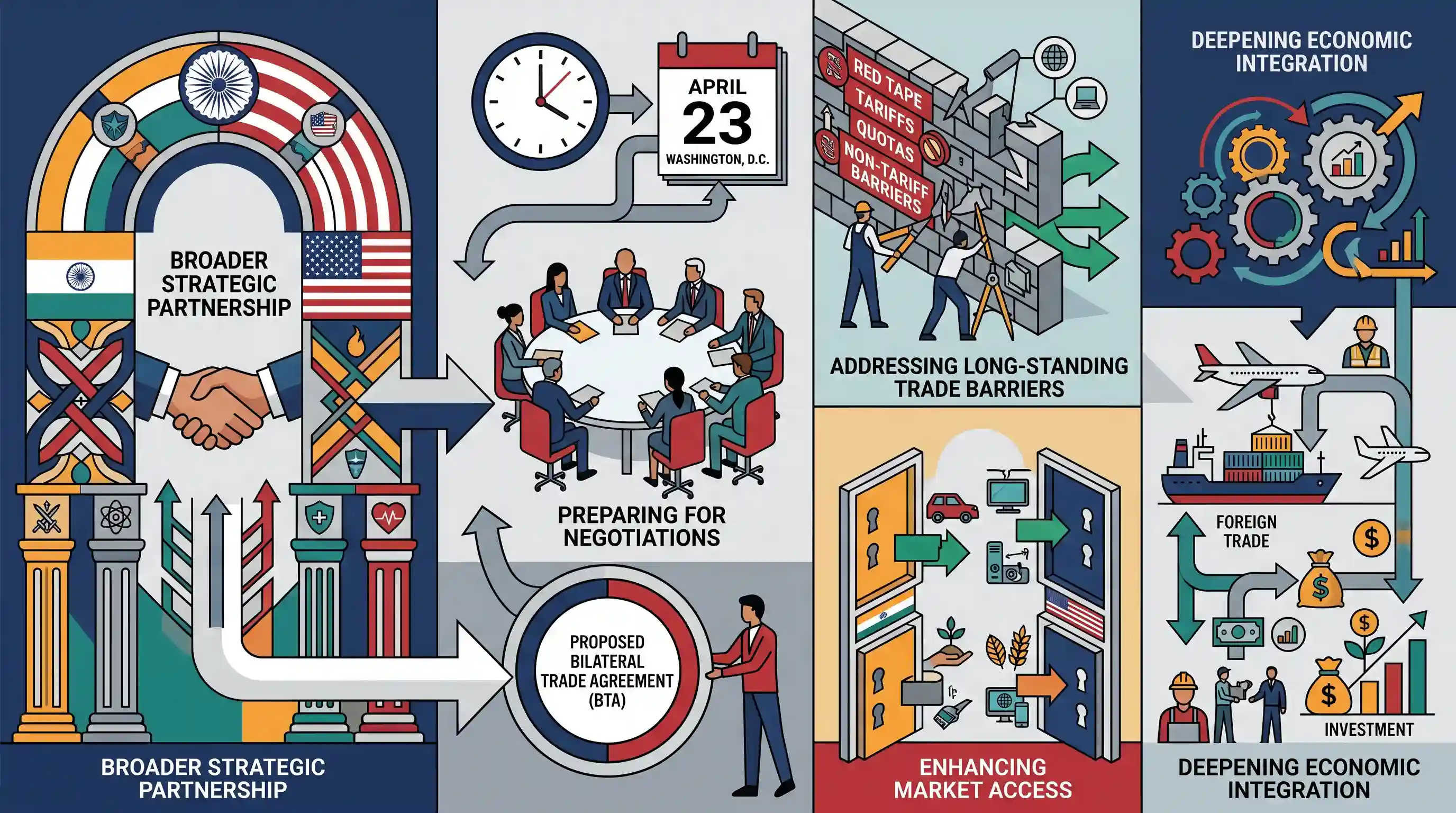
India and the United States are preparing for a new round of trade negotiations in Washington starting April 23, aimed at giving momentum to a proposed Bilateral Trade Agreement (BTA). The talks will seek to address long-standing trade barriers, enhance market access, and deepen economic integration between the two countries, which is a key component of their broader strategic partnership.
Key Points
- India and the United States are scheduled to hold critical trade talks in Washington starting April 23.
- The primary objective of these talks is to accelerate and provide fresh impetus to the ongoing negotiations for a formal Bilateral Trade Agreement (BTA).
- The discussions are expected to focus on resolving existing trade frictions, improving market access, and lowering tariff and non-tariff barriers.
- A successful BTA would solidify the economic pillar of the India-US strategic partnership, enhancing bilateral trade volumes and aligning supply chain resilience efforts.
Important Terms
Bilateral Trade Agreement (BTA)

A trade treaty between two nations to reduce or eliminate tariffs, quotas, and other barriers to encourage economic cooperation and investment.
UPSC context
GS-II (International Relations) and GS-III (Indian Economy); tests India's shift toward reciprocal trade diplomacy and strategic partnerships.
Interim Trade Agreement
A preliminary pact implementing limited concessions (like tariff cuts on specific goods) while negotiations for a comprehensive Free Trade Agreement (FTA) continue.
UPSC context
GS-III (Economy); involves WTO Article XXIV compliance and its role in phased economic integration.
Market Access
The degree to which a nation allows foreign goods/services into its economy, governed by tariff levels and regulatory requirements.
UPSC context
GS-III (Foreign Trade); essential for analyzing trade imbalances and export competitiveness in textiles, pharma, and agriculture.
Non-Tariff Barriers (NTBs)
Trade restrictions—such as quotas, licenses, and technical standards—that limit imports through means other than direct taxes (tariffs).
UPSC context
GS-III (Economy/Trade); highlights regulatory friction like Quality Control Orders (QCOs) and sanitary/phytosanitary measures.
Special 301 Report
An annual U.S. report identifying trading partners with inadequate Intellectual Property Rights (IPR) protection; India frequently features on its Priority Watch List.
UPSC context
GS-II/III; reflects bilateral tensions regarding India's patent laws (Patents Act Section 3d) and pharmaceutical pricing.
Rules of Origin
Criteria used to determine the source of a product to ensure that preferential trade benefits only apply to the partner nations.
UPSC context
GS-III (Economy); critical for preventing trade diversion and ensuring domestic value addition in free trade zones.
Trade Policy Forum (TPF)
The premier bilateral mechanism between India and the U.S. for resolving trade issues and expanding economic engagement.
UPSC context
GS-II (International Relations); represents the formal institutional framework for high-level India-US economic diplomacy.
Prelims Trap
"The Indo-Pacific Economic Framework (IPEF) acts as a comprehensive Free Trade Agreement offering tariff cuts between India and the US."
IPEF is not a traditional FTA; it explicitly excludes market access and tariff reduction pillars. India is pursuing a separate BTA for these specific economic benefits.
Static Concepts Connected
What is the Generalized System of Preferences (GSP) in international trade?
- Origin: Instituted under UNCTAD in 1971 to assist developing countries in growing their economies through international trade.
- Mechanism: Developed nations grant non-reciprocal preferential tariff treatment (often duty-free access) to select imports originating from developing nations.
- India's Status: The US revoked India's GSP beneficiary status in 2019, citing a lack of reciprocal and equitable market access for US goods.
How do standard FTAs differ from Comprehensive Economic Partnership Agreements (CEPA)?
- Standard FTA: Focuses primarily on eliminating or reducing customs duties on goods traded between partner countries on a negative-list basis.
- CEPA/CECA: Much broader in scope, covering trade in services, cross-border investment, IPR, government procurement, and competition rules alongside goods.
- BTA (Bilateral Trade Agreement): A negotiated treaty between two nations to mutually reduce barriers. The ongoing India-US talks seek to define the exact scope of this bilateral pact.
Cross-Topic Patterns
Pivot from Eastern to Western FTAs
India's trade strategy has pivoted from Asian multilateral pacts (like RCEP) to negotiating bilateral agreements with Western partners like the UAE, Australia, UK, and the US, leveraging complementary economic structures.
IPEF structural gaps vs Bilateral FTAs
India joined the IPEF Supply Chain pillar but opted out of the Trade pillar to protect domestic interests. The separate US-India BTA negotiations aim to bridge this missing market-access gap.

Expect a Prelims question comparing the IPEF structure with traditional FTAs, focusing on tariff cuts, market access, and GSP provisions.
Linked PYQs · 3
Linked PYQs · 3
- 2002PrelimsGS1
India has the maximum volume of foreign trade with
- 2020PrelimsGS1
With reference to the international trade of India at present, which of the following statements is/are correct? 1. India's merchandise exports are less than its merchandise imports. 2. India's imports of iron and steel, chemicals, fertilisers and machinery have decreased in recent years. 3. India's exports of services are more than its imports of services. 4. India suffers from an overall trade/current account deficit. Select the correct answer using the code given below:
- 2014MainsGS2
The aim of Information Technology Agreements (ITAs) is to lower all taxes and tariffs on information technology products by signatories to zero. What impact would such agreements have on India's interests?
