Opposition criticizes India US Trade Deal over Farming Impacts
Source:The Hindu ↗
Why It Matters
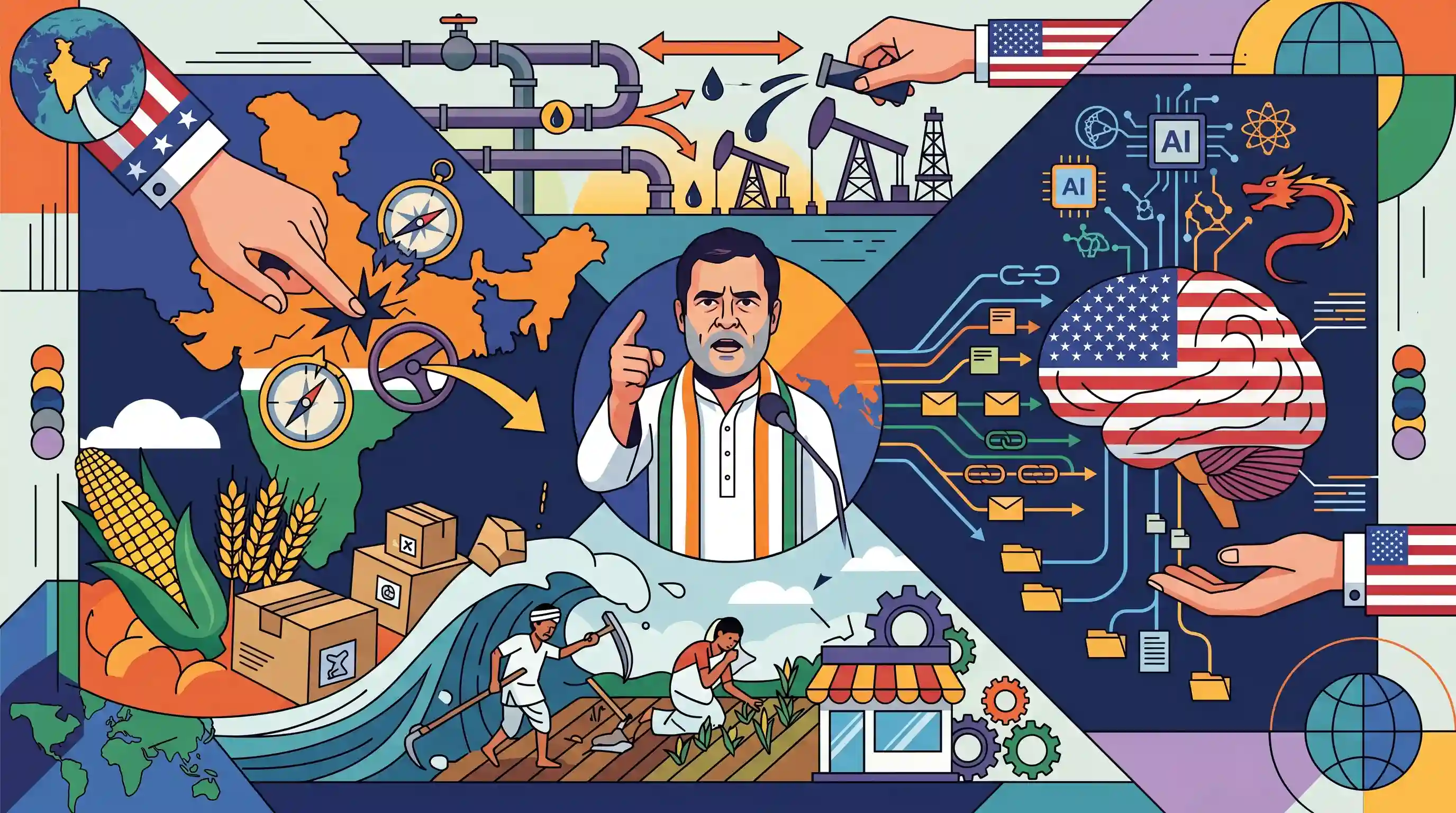
The debate around this trade pact highlights the core tensions in India's foreign policy and trade negotiations: balancing a vital strategic partnership with the US against the need to protect sensitive domestic sectors like agriculture, while maintaining strategic autonomy in energy procurement and data governance.
Summary
Congress leader Rahul Gandhi heavily criticized the recently signed India-US trade deal, describing it as a capitulation to US pressure that will destroy Indian agriculture, MSMEs, and strategic autonomy. He alleged that the pact forces India to import ₹9 lakh crore of US goods annually, opening domestic markets to American agricultural products at the expense of local farmers. Furthermore, he claimed the deal compromises India's data sovereignty to support US Artificial Intelligence development against China, and undermines energy security by surrendering control over India's oil sourcing to US directives.
Key Points
- Critics allege the India-US trade deal will devastate Indian agriculture and MSMEs by allowing unchecked imports of US agricultural products like apples, walnuts, soybeans, and cotton.
- The opposition claims the agreement includes a mandatory commitment for India to purchase ₹9 lakh crore worth of US products annually.
- Concerns are raised regarding data sovereignty, with allegations that Indian data is being transferred to the US to bolster its Artificial Intelligence capabilities in the rivalry with China.
- The deal is also criticized for allegedly compromising India's strategic autonomy and energy security by allowing the US to dictate India's oil sourcing.
- Political opposition leaders claim the deal was signed under duress, linking it to the "Epstein files" and criminal investigations into the Adani group.
Important Terms
Strategic Autonomy

A state's ability to pursue independent foreign and security policies based on national interest without aligning permanently with any major power bloc or being subject to external constraints.
UPSC context
GS Paper II (IR). Tests understanding of India's shift from non-alignment to multi-alignment while maintaining sovereign decision-making.
Data Sovereignty
The principle that a nation has legal jurisdiction and control over data generated, stored, and processed within its borders, emphasizing localization and protection from foreign influence.
UPSC context
GS Paper III (Technology/Security). Tests awareness of digital colonialism and the role of data as a national asset for AI.
Energy Security
The uninterrupted availability of energy sources at an affordable price, encompassing physical availability, economic affordability, and environmental sustainability of supply chains.
UPSC context
GS Paper III (Energy/Infrastructure). Tests knowledge of India's import dependency and the strategic risks of volatile global energy markets.
India-US Trade Deal
A bilateral pact (referenced as an interim framework in 2026) aimed at reducing tariffs and increasing market access for goods like agricultural products and technology.
UPSC context
GS Paper II (Bilateral Agreements). Tests analysis of trade-offs between export market access and protection of domestic agricultural/industrial interests.
MSMEs
Small-scale businesses serving as the backbone of India's manufacturing and employment, often vulnerable to competition from large-scale foreign imports under liberalized trade regimes.
UPSC context
GS Paper III (Economy). Tests understanding of domestic industry vulnerabilities and the socio-economic impact of trade policies.
Distillers Dried Grains (DDG)
A high-protein byproduct of ethanol production used as animal feed; its import is controversial due to potential links to genetically modified (GM) crops.
UPSC context
GS Paper III (Agriculture). Relevant for debates on GM crop regulations, farm subsidies, and threats to the domestic dairy sector.
MGNREGA
A social security scheme providing a legal guarantee for 100 days of annual wage employment to rural households to enhance livelihood security.
UPSC context
GS Paper II (Social Justice). Tests understanding of rural safety nets and the impact of budgetary or legislative changes.
Prelims Trap
Fixed mandatory import targets in FTAs are fully protected under WTO's Article XXIV exceptions.
Fixed monetary import targets reflect 'managed trade'. This distorts free markets and often violates WTO's MFN principle by arbitrarily displacing other nations' exports.
Static Concepts Connected
How does 'Managed Trade' conflict with WTO principles?
- Quantitative targets: Mandatory import values distort free markets and often violate the General Elimination of Quantitative Restrictions (GATT Article XI).
- MFN Violation: Forcing a country to buy from one specific nation can arbitrarily displace other trading partners, breaching Most-Favoured-Nation rules.
- Article XXIV limits: While FTAs allow tariff reductions between members, they do not explicitly protect managed trade targets from WTO scrutiny.
What is 'Sovereign AI' and why is it critical for data sovereignty?
- Sovereign AI: Developing artificial intelligence using a nation's own localized data, compute infrastructure, and domestic talent.
- Compute Colonialism: Avoids over-reliance on foreign tech giants, preventing data extraction and algorithmic bias dictated by foreign jurisdictions.
- Data Localization: Aligns with frameworks like the DPDP Act, ensuring sensitive citizen data is not freely transferred under external trade pressures.
Cross-Topic Patterns
Agriculture + WTO AoA
The influx of subsidized US farm goods highlights the clash between developed-world 'Amber Box' subsidies and India's MSP framework, a recurring WTO battleground.
Data Localization + AI Imperialism
Trade pacts demanding unrestricted cross-border data flows directly clash with India's DPDP Act, testing the government's push to build 'Sovereign AI' via the IndiaAI Mission.
Strategic Autonomy + Energy Security
Tying trade deals to oil-sourcing directives mirrors past US sanctions pressures (e.g., CAATSA, Iran/Russia oil), fundamentally testing India's multi-aligned foreign policy and energy security.

Expect 2026 Prelims to test 'managed trade' vs WTO MFN rules, or merge 'Sovereign AI' concepts with cross-border data flow regulations.
Linked PYQs · 4
Linked PYQs · 4
- 2025MainsGS2
"Energy security constitutes the dominant kingpin of India's foreign policy, and is linked with India's overarching influence in Middle Eastern countries.” How would you integrate energy security with India's foreign policy trajectories in the coming years?
- 2024MainsGS2
Discuss the geopolitical and geostrategic importance of Maldives for India with a focus on global trade and energy flows. Further also discuss how this relationship affects India's maritime security and regional stability amidst international competition ?
- 2023MainsGS3
What are the direct and indirect subsidies provided to farm sector in India? Discuss the issues raised by the World Trade Organization (WTO) in relation to agricultural subsidies.
- 2023MainsGS3
Introduce the concept of Artificial Intelligence (AI). How does Al help clinical diagnosis? Do you perceive any threat to privacy of the individual in the use of Al in healthcare?
