India US Bilateral Trade Agreement and Supply Chain Security
Source:The Hindu ↗
Why It Matters
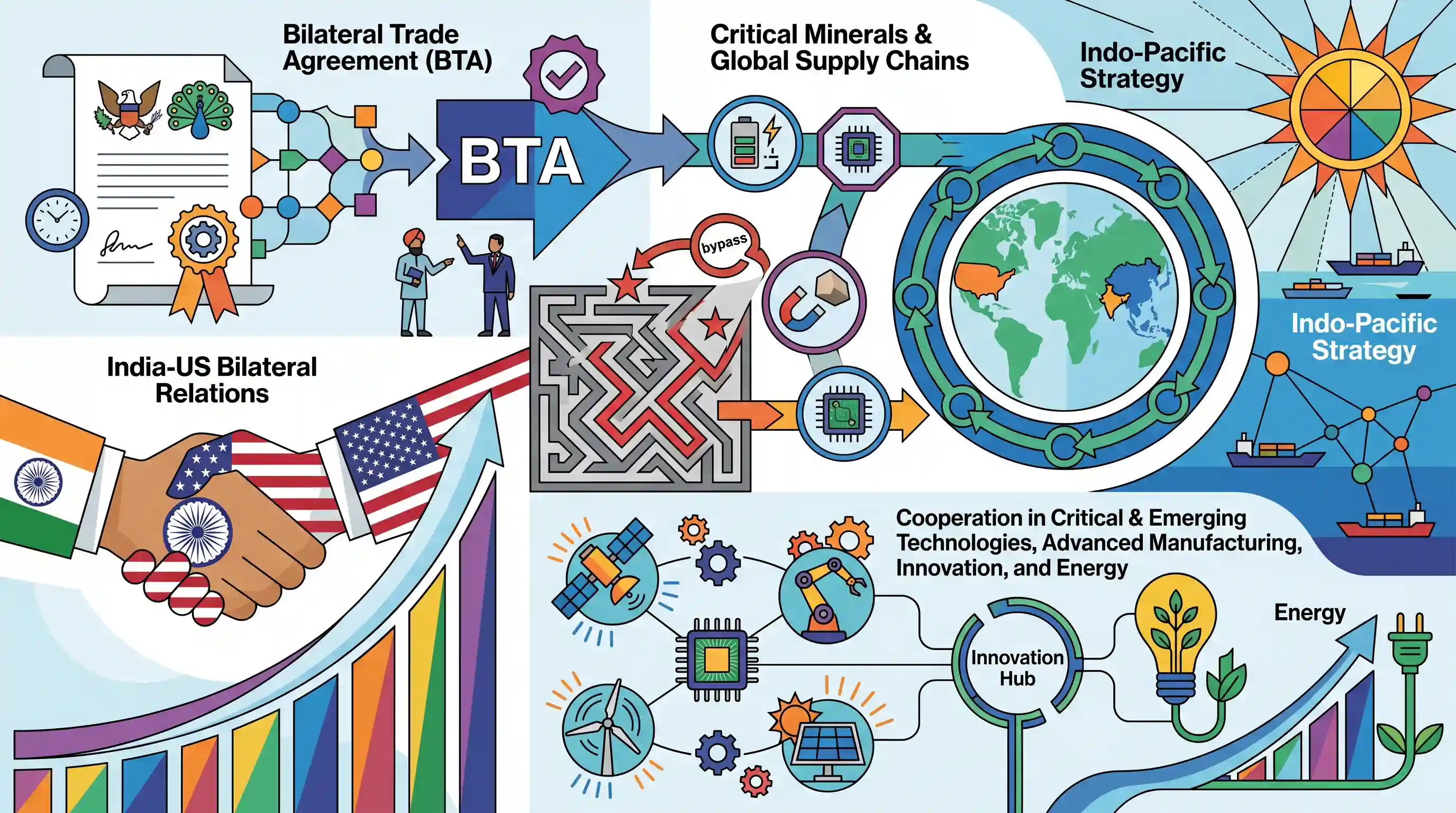
The expected Bilateral Trade Agreement (BTA) between India and the U.S. is a critical development in India's economic diplomacy, showcasing the transition from strategic partnerships to deep economic integration. It highlights the focus on securing critical mineral supply chains, countering China's dominance, and expanding cooperation in emerging technologies, making it highly relevant for GS2 (Bilateral Relations) and GS3 (Economy and Technology).
Summary
U.S. Ambassador to India Sergio Gor announced that India and the United States are on the verge of signing a Bilateral Trade Agreement (BTA), with final negotiations expected to conclude during a high-level U.S. delegation visit to India in early June. The delegation, featuring U.S. Secretary of State Marco Rubio and Trade Representative Jamieson Greer, aims to finalize the remaining details. This trade deal builds on a recent critical minerals agreement designed to secure supply chains and bypass China's export controls. The comprehensive pact will also enhance cooperation in critical and emerging technologies, advanced manufacturing, innovation, and energy, reflecting the growth of bilateral trade to $220 billion over the past two decades.
Key Points
- A comprehensive India-U.S. Bilateral Trade Agreement (BTA) is expected to be signed within weeks, following the finalization of the remaining 1% of negotiations during an upcoming U.S. delegation visit from June 1-4.
- The U.S. delegation will include Secretary of State Marco Rubio and U.S. Trade Representative Jamieson Greer.
- The upcoming trade deal builds upon a recently signed bilateral agreement on critical minerals, aiming to secure global supply chains and counter China's export controls.
- India-U.S. bilateral trade has grown remarkably from $20 billion to approximately $220 billion in goods and services over the last two decades.
- The trade partnership will focus on critical and emerging technologies, innovation, advanced manufacturing, and energy security.
Important Terms
Bilateral Trade Agreement (BTA)

A comprehensive pact reducing tariffs and non-tariff barriers to boost commerce. Current India-U.S. negotiations (2025-26) target a $500 billion trade goal and a 'trusted ecosystem' for resilient supply chains.
UPSC context
GS Paper II/III: Crucial for India-U.S. strategic partnership, addressing trade deficits, and securing market access for Indian exports.
Critical Minerals Cooperation Framework
A 2026 framework for bilateral cooperation in mining, processing, and recycling rare earths and strategic minerals. It aims to reduce reliance on China-dominated supply chains for high-tech and defense industries.
UPSC context
GS Paper II/III: Significant for energy security, semiconductor manufacturing, and the Indo-Pacific strategy's focus on supply chain resilience.
Quad (Quadrilateral Security Dialogue)
A strategic dialogue between India, USA, Japan, and Australia. In 2026, it expanded from maritime security to 'geo-economic' cooperation, including a $20 billion critical minerals initiative.
UPSC context
GS Paper II: A key 'minilateral' forum for balancing regional power and ensuring a free and open Indo-Pacific.
U.S. Trade Representative (USTR)
The chief trade negotiator and advisor for the U.S. President. In India-U.S. relations, the USTR leads the Trade Policy Forum to resolve sectoral disputes and finalize trade deals.
UPSC context
GS Paper II/III: Central to bilateral trade diplomacy, GSP status negotiations, and addressing IP/tariff barriers.
Trade Policy Forum (TPF)
The premier bilateral mechanism for trade between India and the U.S., co-chaired by the Indian Commerce Minister and the USTR to resolve long-standing trade irritants and policy differences.
UPSC context
GS Paper II/III: Key institutional mechanism for economic diplomacy and resolving disputes related to agriculture, services, and IPR.
Indo-Pacific Strategy
A strategic framework to ensure a free, open, and rules-based order in the Indo-Pacific. It focuses on maritime security, infrastructure, and countering economic coercion in the region.
UPSC context
GS Paper II: Core of India's foreign policy (SAGAR) and its alignment with Western partners against regional hegemonies.
Prelims Trap
"The India-US Bilateral Trade Agreement is a traditional Comprehensive Economic Partnership eliminating all tariffs on goods."
India and the US do not have a traditional full-scale FTA. This modern BTA focuses on strategic supply chains, critical minerals, and technology (iCET) rather than zero-tariff comprehensive goods trade.
Static Concepts Connected
What distinguishes a traditional Free Trade Agreement (FTA) from modern strategic trade pacts?
- Traditional FTA: Eliminates or significantly reduces customs duties on a specified list of goods (negative list approach).
- CECA / CEPA: Includes trade in services, investment, IPR, government procurement, and dispute settlement mechanisms alongside goods.
- Modern Strategic Pacts: Focuses on non-tariff barriers, supply chain resilience, critical technologies, and strategic de-risking without necessarily mandating zero tariffs.
Why are "Critical Minerals" strategically significant for national security?
- Economic Definition: Minerals deemed essential for modern technology and economic security, but characterized by high supply-chain vulnerability.
- Strategic Applications: Vital for manufacturing EVs, semiconductors, solar panels, and advanced defense systems (e.g., rare earth permanent magnets).
- Supply Vulnerability: Global supply and processing is heavily monopolized by single countries (often China), creating significant geopolitical leverage and export-control risks.
Cross-Topic Patterns
Tech-Diplomacy and iCET synergy
The BTA integrates the Initiative on Critical and Emerging Technology (iCET), mirroring the Quad's mandate to create trusted, China-independent semiconductor and AI supply chains.
Minerals Security Partnership (MSP) linkage
This bilateral mineral pact runs parallel to the US-led Minerals Security Partnership (MSP), which India joined to secure lithium, cobalt, and rare earths for clean energy transitions.

Expect a multi-statement question interlinking the India-US BTA, iCET, and the Minerals Security Partnership focusing on China de-risking.
Linked PYQs · 2
Linked PYQs · 2
- 2020MainsGS2
Quadrilateral Security Dialogue (Quad)' is transforming itself into a trade bloc from a military alliance, in present times - Discuss.
- 2018MainsGS2
India and USA are two large democracies. Examine the basic tenets on which the two political systems are based.
