Political parties clash over newly signed India US trade pact
Source:The Hindu ↗
Why It Matters
The India-U.S. trade pact signifies a major shift in bilateral economic relations, directly impacting India's tariff structures, domestic manufacturing (Make in India), and foreign policy positioning amidst the global shift from multilateralism towards bilateralism.
Summary
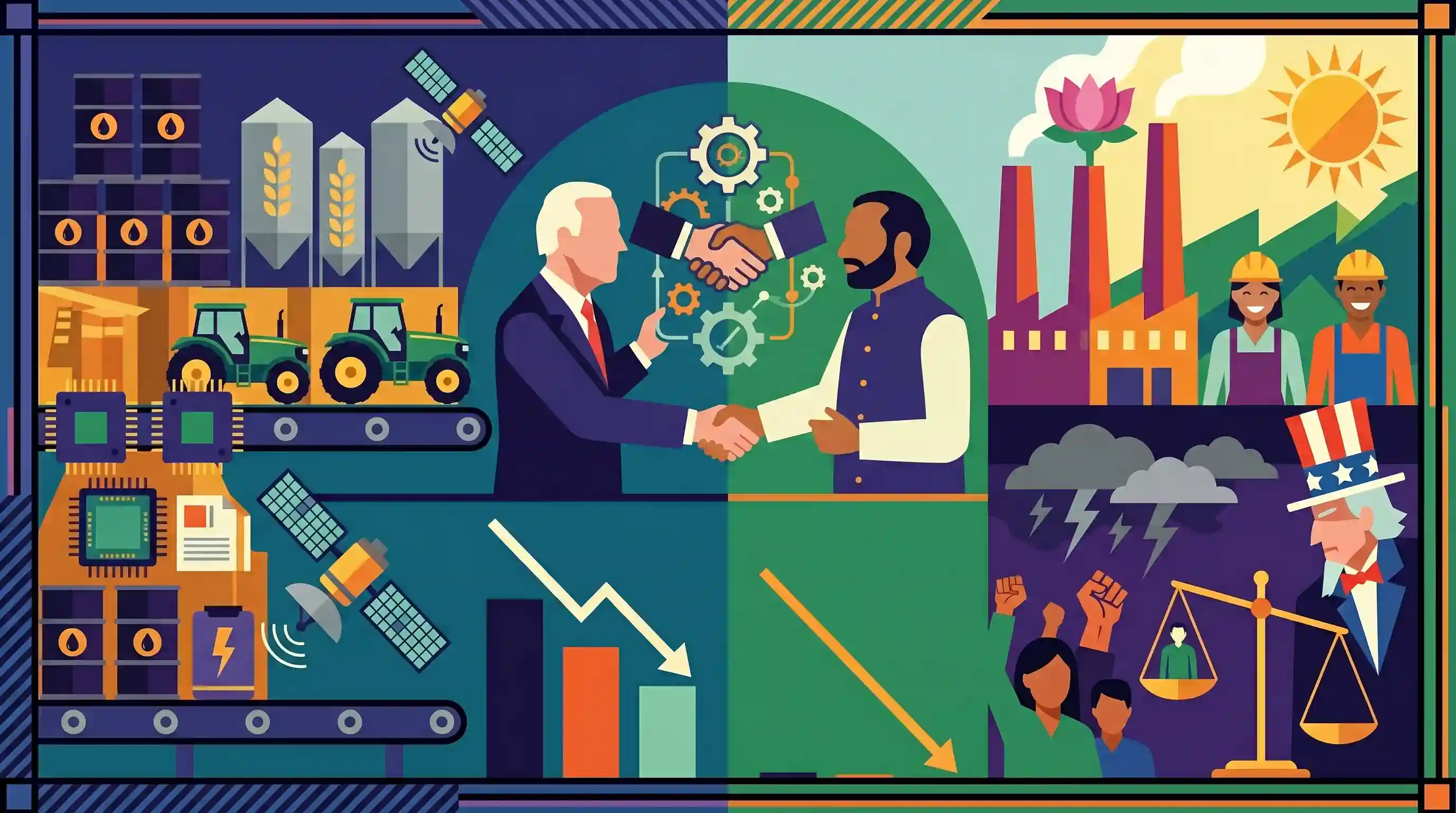
The United States and India have reached a historic bilateral trade agreement. U.S. President Donald Trump announced that the deal reduces reciprocal tariffs on Indian goods from 25% to 18%, while India has agreed to reduce tariffs and non-tariff barriers to zero for the U.S. Additionally, India has committed to purchasing over $500 billion of American energy, technology, and agricultural products. NDA leaders praised the pact as a boost to 'Make in India,' economic growth, and job creation, attributing its success to PM Modi's leadership. Conversely, the Opposition, led by the Congress party, strongly criticized the deal, asserting that the Prime Minister yielded to U.S. pressure and that the agreement disproportionately favors American interests.
Key Points
- The U.S. will lower reciprocal tariffs on Indian goods from 25% to 18%.
- India has committed to reducing both tariff and non-tariff barriers to zero against the U.S.
- India pledged to purchase over $500 billion worth of American products, including energy, technology, and agriculture.
- Union ministers claim the deal will stimulate economic growth, create employment, and strengthen the 'Make in India' initiative.
- The Opposition accuses the government of capitulation, arguing the deal compromises India's economic sovereignty and reflects U.S. leverage over the Prime Minister.
Important Terms
India-U.S. Bilateral Trade Agreement

A formal pact between two nations to reduce trade barriers, lower tariffs, and increase market access, aiming to strengthen economic and strategic ties.
UPSC context
GS Paper II (International Relations); tests understanding of bilateral groupings and agreements affecting India’s interests.
Make in India
A flagship 2014 initiative to transform India into a global manufacturing hub by encouraging domestic production, attracting FDI, and fostering innovation across 25 key sectors.
UPSC context
GS Paper III (Indian Economy); tests knowledge of industrial policy and growth strategies.
Reciprocal Tariffs
A 'tit-for-tat' trade strategy where a country imposes import duties equal to those levied by its trading partner on its own exports to ensure fairness.
UPSC context
GS Paper III (Economy/Trade); tests understanding of protectionism and its impact on global supply chains.
Non-tariff Barriers
Trade restrictions such as quotas, licensing, or technical standards that obstruct imports through means other than direct customs duties.
UPSC context
GS Paper III (Economy); tests knowledge of international trade barriers beyond simple taxes.
Economic Diplomacy
The use of economic tools and negotiations to advance a nation's foreign policy interests, focusing on trade, investment, and energy security.
UPSC context
GS Paper II (International Relations); tests the linkage between economic interests and foreign policy.
National Democratic Alliance (NDA)
A BJP-led centre-right political coalition in India formed in 1998, emphasizing economic reform, national security, and collective governance.
UPSC context
GS Paper II (Polity/Governance); tests understanding of coalition politics and executive functioning in India.
Prelims Trap
The India-US trade deal establishes a reciprocal zero-tariff regime, offering Indian MSMEs duty-free access to American markets.
This tests awareness of the deal's asymmetry. India agreed to reduce tariffs and NTBs to zero for the US, but the US only reduced tariffs from 25% to 18%.
Static Concepts Connected
What are Non-Tariff Barriers (NTBs) in international trade?
- Definition: Trade restrictions that do not take the form of direct taxes, including import quotas, embargoes, licensing requirements, and technical standard certifications.
- SPS Measures: Sanitary and Phytosanitary (SPS) measures are common NTBs used to protect human or plant health, but are often weaponized against developing nations' agricultural exports.
- WTO Stance: The WTO encourages 'tariffication'—converting opaque non-tariff barriers into transparent, predictable tariffs—to ensure fair and measurable trade practices.
How do bilateral zero-tariff deals bypass the WTO's MFN principle?
- MFN Principle: Under WTO rules, granting a trade favor (like zero tariffs) to one country must immediately be extended to all other WTO member nations.
- GATT Article XXIV: This provides an exception to MFN, allowing bilateral or regional Free Trade Agreements if they eliminate duties on 'substantially all trade' between the partners.
Cross-Topic Patterns
Energy security shift: Russia to US
The $500B US procurement commitment signals a structural shift in India's energy diplomacy, pivoting away from discounted Russian crude toward American LNG to balance bilateral trade deficits.
WTO agriculture disputes and MSP regime
Zero-tariff access for US agriculture intersects with GS3 topics. Heavily subsidized American farming could threaten Indian smallholder farmers and complicate India's defense of its MSP regime at the WTO.

Expect a GS3 Mains question analyzing if zero-tariff commitments to the US undermine the 'Make in India' initiative and domestic MSMEs.
Linked PYQs · 2
Linked PYQs · 2
- 2019MainsGS2
‘What introduces friction into the ties between India and the United States is that Washington is still unable to find for India a position in its global strategy, which would satisfy India's national self-esteem and ambitions.’ Explain with suitable examples.
- 2025MainsGS3
What are the challenges before the Indian economy when the world is moving away from free trade and multilateralism to protectionism and bilateralism? How can these challenges be met?
