India US Strategic Partnership and Energy Autonomy Dynamics
Source:Indian Express ↗
Why It Matters
This issue is highly relevant for UPSC GS Paper 2 (International Relations), as the evolving India-US strategic partnership is central to India's foreign policy. Understanding the nuances of this relationship—including the shared goal of countering China and the divergence over relations with Russia—is crucial for analyzing India's strategy of multi-alignment and its pursuit of national interests in a multipolar world.
Summary
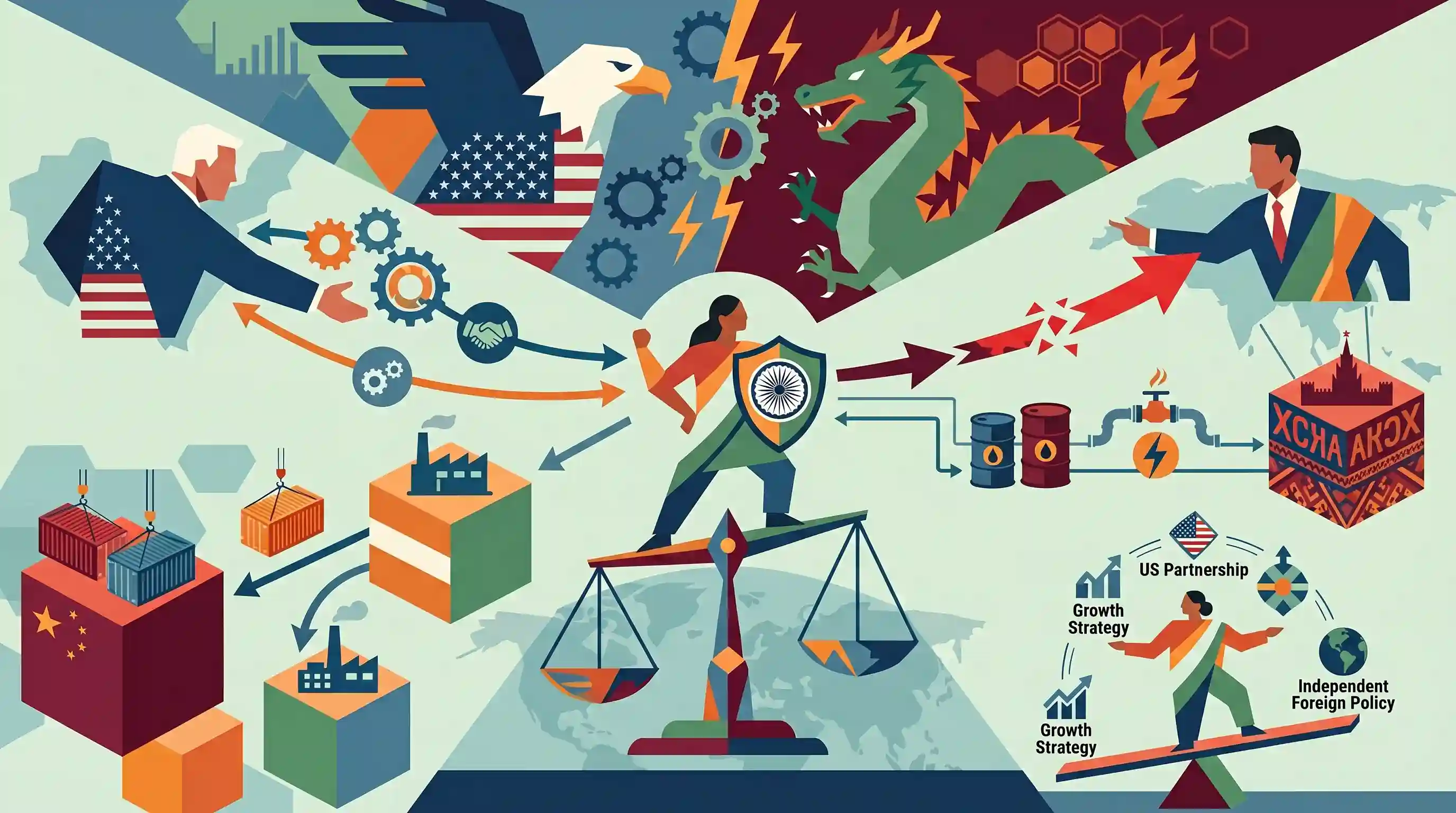
The article analyzes the evolving dynamics of India-US relations, arguing that the US-China rivalry is the fundamental catalyst for their deepening strategic ties. While Washington views New Delhi as a crucial partner to counterbalance China's political and economic dominance—particularly through the 'China Plus One' supply chain strategy—complexities persist. India's steadfast commitment to strategic autonomy, exemplified by its continued procurement of Russian oil for domestic energy security, creates friction with the US's expectation of a clear strategic alignment. The piece highlights the delicate balance India must maintain between leveraging the US partnership for its growth strategy and resisting pressures to abandon its independent foreign policy stance.
Key Points
- The US-China geopolitical rivalry is the primary driver strengthening the strategic partnership between Washington and New Delhi.
- The United States is promoting India as a viable alternative for global manufacturing to reduce dependence on Chinese supply chains (the 'China Plus One' strategy).
- Friction remains in the India-US relationship, notably due to India's continued purchase of discounted Russian oil amidst Western sanctions, highlighting its commitment to strategic autonomy.
- Washington increasingly expects New Delhi to make definitive strategic choices, while India continues to balance its multi-aligned foreign policy to secure domestic economic growth and energy security.
Important Terms
China Plus One Strategy

A business strategy where companies diversify supply chains by investing in countries other than China to reduce over-reliance and mitigate risks from geopolitical tensions or disruptions.
UPSC context
GS Paper II/III: Tests understanding of global manufacturing shifts and India's potential as a supply chain alternative.
Strategic Autonomy
The principle of making independent foreign policy and defense decisions based on national interests, without being constrained by formal military alliances or external pressures.
UPSC context
GS Paper II: Essential for analyzing India’s independent stance in a polarized world, such as the US-Russia-China triangle.
Supply Chain Resilience Initiative (SCRI)
A trilateral partnership between India, Japan, and Australia aimed at diversifying supply chains in the Indo-Pacific to reduce economic dependence on China and ensure regional resilience.
UPSC context
GS Paper II: Relevant for Indo-Pacific geopolitics and regional cooperation to counter economic dominance.
Energy Security
The uninterrupted availability of energy sources at an affordable price, involving the diversification of imports and expansion of domestic production to fuel national growth.
UPSC context
GS Paper III: Crucial for evaluating India’s oil diplomacy and its impact on its strategic international partnerships.
Multi-alignment
A foreign policy approach of engaging with multiple competing global power centers simultaneously to maximize benefits on an issue-by-issue basis without exclusive bloc alignment.
UPSC context
GS Paper II: Evolution of Non-Alignment; tests the ability to analyze India’s participation in Quad, BRICS, and SCO.
Prelims Trap
'China Plus One' is a formal multilateral treaty led by the US to counter China.
It is a global corporate business strategy adopted by MNCs to diversify supply chains away from China, not a formal intergovernmental treaty or official government scheme.
Static Concepts Connected
What distinguishes 'Multi-Alignment' from traditional 'Non-Alignment' in India's foreign policy?
- Non-Alignment Focus: Maintaining ideological distance from Cold War power blocs to preserve sovereignty and avoid being drawn into proxy wars.
- Multi-Alignment Focus: Actively engaging with multiple, often competing, powers (e.g., US in Quad, Russia/China in BRICS/SCO) simultaneously.
- Core Objective: Shifted from defensive neutrality to proactive, issue-based partnerships aimed at maximizing national economic and security interests.
How does India capitalize on the 'China Plus One' strategy?
- FDI Attraction: Positioning India as a resilient manufacturing alternative for global MNCs seeking to de-risk their supply chains.
- Policy Support: Deploying Production Linked Incentive (PLI) schemes and the National Logistics Policy (NLP) to boost domestic manufacturing competitiveness.
- Sectoral Focus: Targeting specific vulnerabilities in global chains like semiconductors, active pharmaceutical ingredients (APIs), and critical minerals.
Cross-Topic Patterns
Geopolitics of Supply Chains + Domestic PLI
The global 'China Plus One' geopolitical shift directly drives India's domestic economic strategy, making schemes like PLI essential for absorbing fleeing MNC manufacturing capital.
Strategic Autonomy + Macroeconomic Stability
India's IR stance on discounted Russian oil is fundamentally an economic imperative to manage domestic fuel inflation and preserve forex reserves, linking foreign policy to RBI's macro-management.

Mains 2026: Expect a 15-marker evaluating India's 'Multi-Alignment' balancing US supply chain integration with Russian energy ties.
Linked PYQs · 4
Linked PYQs · 4
- 2024MainsGS2
‘The West is fostering India as an alternative to reduce dependence on China's supply chain and as a strategic ally to counter China's political and economic dominance.’ Explain this statement with examples.
- 2021MainsGS2
“The USA is facing an existential threat in the form of a China, that is much more challenging than the erstwhile Soviet Union.” Explain.
- 2025MainsGS2
"Energy security constitutes the dominant kingpin of India's foreign policy, and is linked with India's overarching influence in Middle Eastern countries.” How would you integrate energy security with India's foreign policy trajectories in the coming years?
- 2023MainsGS2
‘The expansion and strengthening of NATO and a stronger US-Europe strategic partnership works well for India.’ What is your opinion about this statement ? Give reasons and examples to support your answer.
