Strategic Autonomy Russian Oil Imports and India US Economic Alignment
Source:Indian Express ↗
Why It Matters
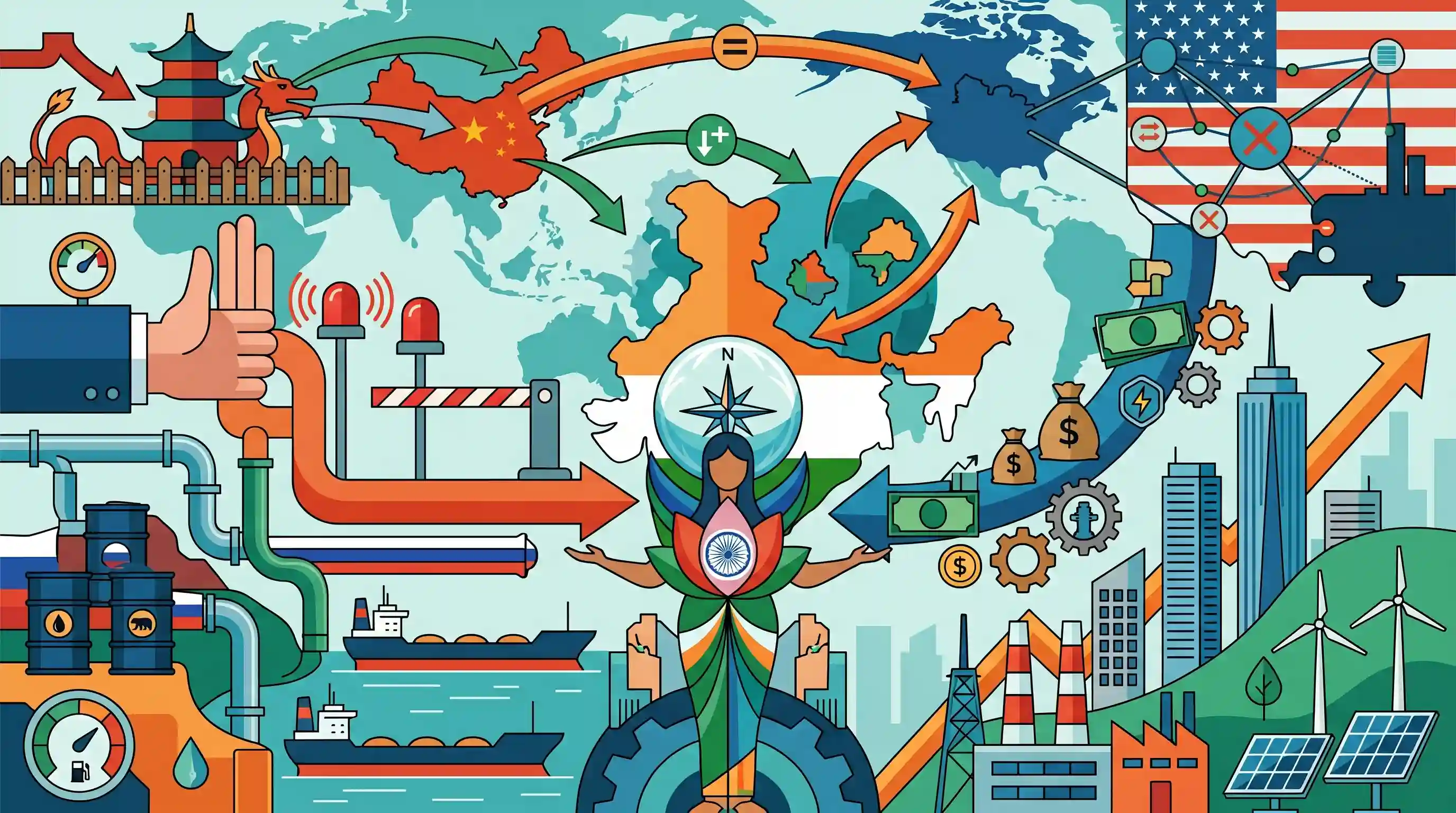
The article encapsulates the core dilemma of modern Indian foreign policy: balancing strategic autonomy (maintaining ties with Russia for energy needs) against the economic imperative of aligning with Western partners for supply chain integration and manufacturing growth. It serves as a prime case study for GS2 questions on India-US friction points and GS3 questions on manufacturing and energy security.
Summary
The article analyzes the complex dynamics of the India-US strategic and economic partnership within the context of shifting global supply chains. As Washington promotes the 'China Plus One' strategy to counter Beijing's dominance, it seeks to avoid the 'China mistake'—aiding the rise of a future geopolitical rival—by tying economic cooperation and potential trade deals to geopolitical alignment. Specifically, the US is pressuring New Delhi to reduce its reliance on Russian oil. For India, however, discounted Russian crude is vital for domestic energy security and managing inflation, just as US and Western investments are essential for boosting domestic manufacturing and economic growth. Navigating this friction requires India to carefully balance its fundamental need for strategic autonomy with the economic opportunities of integrating into US-led global value chains.
Key Points
- The US views India as a primary beneficiary of its 'China Plus One' strategy, aiming to build resilient supply chains and avoid a repeat of the 'China mistake'.
- Washington is implicitly forcing a strategic choice on New Delhi, using potential trade agreements and economic ties as leverage to pressure India to distance itself from Russia.
- India's continued procurement of discounted Russian oil remains central to its energy security and macroeconomic stability, posing a point of friction with US expectations.
- The core challenge for India's growth strategy is balancing the influx of Western capital and manufacturing relocation with its traditional policy of strategic autonomy.
Important Terms
China Plus One Strategy

A business strategy where companies diversify manufacturing and supply chains beyond China to other developing economies like India to mitigate risks from geopolitical tensions and disruptions.
UPSC context
GS Paper 2/3: International Relations & Economy. Tests understanding of shifting global supply chains and India's manufacturing competitiveness.
Strategic Autonomy
A nation's ability to make sovereign foreign policy and defense decisions based on national interests without being constrained by external pressures or alliance obligations.
UPSC context
GS Paper 2: International Relations. Essential for analyzing India's balancing act between major powers like the US, Russia, and China.
Energy Security
The continuous availability of energy sources at an affordable price, encompassing long-term investments and short-term ability to respond to supply-demand changes.
UPSC context
GS Paper 3: Infrastructure/Energy. Tests knowledge of India's crude oil dependency, import diversification, and impact of global sanctions.
Global Value Chains (GVCs)
International production sharing where different stages of the production process (design, assembly, marketing) are located across multiple countries to optimize costs and efficiency.
UPSC context
GS Paper 3: Economy/Trade. Focuses on India's integration into global markets and its transition from low-end to high-value manufacturing.
Comprehensive Global Strategic Partnership
The evolved India-US bilateral relationship characterized by deep cooperation in defense, technology, trade, and shared democratic values, despite intermittent trade and geopolitical frictions.
UPSC context
GS Paper 2: Bilateral Groupings. Tests understanding of the most consequential 21st-century partnership and its regional stability implications.
Multi-alignment
A pragmatic foreign policy approach of engaging with multiple global powers and groupings simultaneously to maximize national interest and maintain policy independence.
UPSC context
GS Paper 2: International Relations. Represents the modern evolution of Non-Alignment, testing India's diplomatic flexibility in a multipolar world.
Prelims Trap
India complies with the G7 price cap mechanism on Russian oil to secure US trade waivers.
India officially does not recognize the G7 price cap on Russian oil. It makes purchasing decisions based purely on market dynamics and national energy security, not Western compliance.
Static Concepts Connected
How does Strategic Autonomy differ from traditional Non-Alignment (NAM)?
- Core Focus: NAM maintained distance from Cold War blocs; Strategic Autonomy actively forms issue-based partnerships to maximize national interest.
- Economic dimension: NAM had anti-imperialist economic undertones; Strategic Autonomy actively seeks integration into global value chains across rival economic blocs.
- Military posture: NAM avoided military alliances; Strategic Autonomy allows for deep defense pacts (e.g., LEMOA, COMCASA with the US) without binding treaty commitments.
How do global crude oil prices directly impact India's macroeconomic stability?
- External Sector: High oil prices widen the trade deficit, as India imports over 80% of its crude requirements, negatively impacting the Current Account Deficit (CAD) and rupee valuation.
- Imported Inflation: Expensive crude increases domestic transport and production costs, leading to broader cost-push inflation across sectors.
- Fiscal Deficit: Rising fuel prices often force the government to cut excise duties or increase subsidies, directly straining fiscal deficit targets.
Cross-Topic Patterns
China Plus One meets PLI Scheme
The geopolitical push for supply chain diversification (China Plus One) structurally complements India's domestic PLI scheme, which aims to attract relocating western capital and build export capacity.
Fossil fuel diplomacy vs. Green tech
While friction exists over Russian fossil fuels, India simultaneously relies heavily on US and Western technology transfers for its long-term green energy transition and critical mineral supply chains.

Expect a Mains GS2 question evaluating how 'weaponization of supply chains' forces India to balance US tech needs with Russian energy ties.
Linked PYQs · 3
Linked PYQs · 3
- 2019MainsGS2
‘What introduces friction into the ties between India and the United States is that Washington is still unable to find for India a position in its global strategy, which would satisfy India's national self-esteem and ambitions.’ Explain with suitable examples.
- 2025MainsGS2
"Energy security constitutes the dominant kingpin of India's foreign policy, and is linked with India's overarching influence in Middle Eastern countries.” How would you integrate energy security with India's foreign policy trajectories in the coming years?
- 2023MainsGS3
Faster economic growth requires increased share of the manufacturing sector in GDP, particularly of MSMEs. Comment on the present policies of the Government in this regard.
