Timeline and WTO MFN Compliance in India US Trade Agreement
Source:The Hindu ↗
Why It Matters
This article highlights the procedural and legal mechanics of bilateral trade negotiations, showcasing the contrast between unilateral executive actions (U.S.) and WTO-compliant MFN tariff adjustments (India). It is highly relevant for understanding India-U.S. strategic ties, economic diplomacy, and global supply chain diversification.
Summary
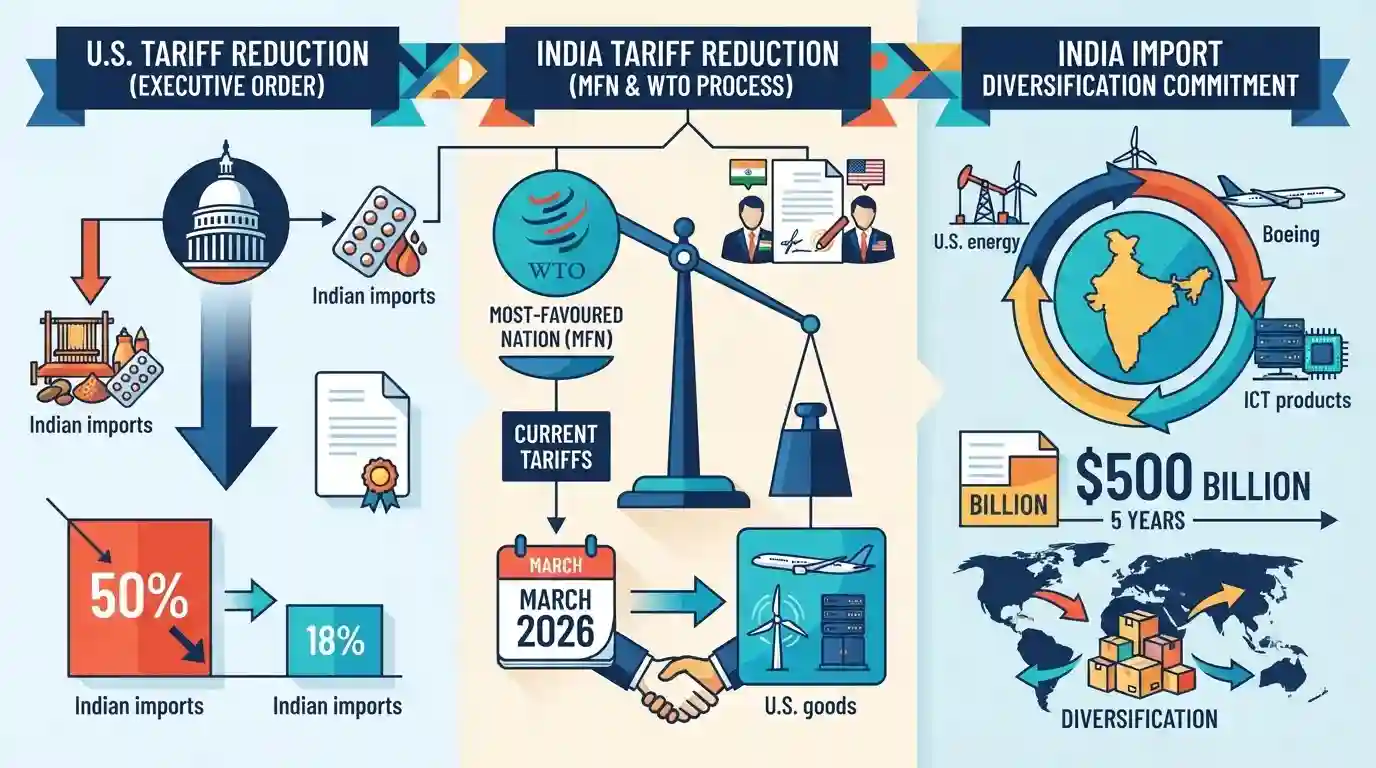
Commerce Minister Piyush Goyal announced that India and the U.S. are set to sign a joint statement on the first tranche of a Bilateral Trade Agreement. Under the deal, the U.S. will lower its tariffs on Indian imports from 50% to 18% via an executive order. However, India's tariff reductions on U.S. goods will only take effect after the formal legal agreement is signed in mid-March 2026, as India's tariffs are governed as Most-Favoured Nation (MFN) rates under World Trade Organisation (WTO) rules. Additionally, India has committed to importing $500 billion in goods (such as energy, aircraft from Boeing, and ICT products) from the U.S. over the next five years to diversify its global import portfolio.
Key Points
- A joint statement on the first tranche of the India-U.S. Bilateral Trade Agreement is scheduled to be finalized within four to five days, with the formal legal agreement expected by mid-March 2026.
- The U.S. will reduce its tariffs on Indian goods from 50% to 18% via an presidential executive order shortly after the joint statement.
- India can only legally reduce its tariffs on U.S. goods after signing the formal legal agreement in mid-March because India's tariffs are designated as Most-Favoured Nation (MFN) tariffs under WTO rules, which require signed legal trade pacts to be modified.
- India has committed to buying at least $500 billion worth of goods from the U.S. over the next five years, focusing on critical areas such as energy, information and communication technology (ICT) products, data centre equipment, and aviation/aircraft parts.
- Key commercial purchases under this deal include aviation orders with Boeing estimated to exceed $100 billion (including engines and spare parts) and significant imports of data centre equipment, boosted by recent Indian budget concessions.
- India's global imports of these critical sectors are projected to exceed $2 trillion over the next five years, meaning the $500 billion U.S. purchase will help diversify India's supply chains.
Important Terms
India-U.S. Bilateral Trade Agreement

A proposed multi-sector trade pact between India and the U.S. aiming to reduce reciprocal tariffs, expand market access, and achieve a targeted $500 billion in bilateral trade.
UPSC context
GS Paper 2 (International Relations). Tests knowledge of bilateral agreements, export strategy, and economic diplomacy.
Most-Favoured Nation (MFN) Tariffs
Normal, non-discriminatory tariff rates applied under WTO rules, requiring a member country to grant all other members the same trade concessions and lowest tariffs it offers to any single nation.
UPSC context
GS Paper 3 (Economy). Crucial for understanding WTO regulations, international trade parity, and tariff rationalization.
World Trade Organisation (WTO)
The primary global intergovernmental organization established in 1995 to regulate international trade, negotiate agreements, and operate a binding dispute settlement mechanism for member nations.
UPSC context
GS Paper 2 (Global Groupings). Consistently tested regarding global economic governance, multilateral negotiations, and dispute resolution.
Ministry of Commerce and Industry
The key Indian government ministry responsible for formulating foreign trade policies, administering export promotion strategies, and negotiating bilateral and multilateral trade agreements on behalf of India.
UPSC context
GS Paper 2 (Governance). Relevant for institutional frameworks governing India's macroeconomic policies and foreign trade diplomacy.
Prelims Trap
India can unilaterally lower import tariffs specifically for the U.S. via executive decree before signing a formal bilateral agreement.
Under GATT Article I (MFN), unilateral tariff cuts to one nation must immediately apply to all WTO members. To restrict cuts to the US, a formal trade pact satisfying GATT Article XXIV exceptions is mandatory.
Static Concepts Connected
What is the Most-Favoured-Nation (MFN) principle and its exceptions under WTO?
- Core Principle: GATT Article I requires WTO members to treat all trading partners equally; tariff benefits given to one must be extended to all.
- FTA Exception: Article XXIV permits bilateral/regional free trade agreements (FTAs) and customs unions to lower tariffs preferentially without extending them to all.
- Developing Countries Exception: The Enabling Clause allows preferential trade arrangements (PTAs) for and among developing countries (like GSP) without violating MFN.
How do PTAs, FTAs, and CEPAs differ in depth?
- PTA: Involves a positive list of products where tariffs are reduced; it is the most basic form of trade agreement.
- FTA: Involves a negative list where tariffs are eliminated or reduced on 'substantially all trade' under GATT Article XXIV.
- CEPA: Comprehensive pact covering goods, services, investment, intellectual property, and regulatory cooperation (e.g., India-UAE CEPA).
Cross-Topic Patterns
GATT Article XXIV vs. MFN Bilateralism
Shows how escalating trade bilateralism leverages WTO exceptions, balancing domestic economic sovereignty with international treaty compliance in modern trade diplomacy.
Strategic Imports as Trade Bargaining Chips
India's $500B import commitment (crude/LNG) links commercial aviation and energy security directly to geostrategic trade concessions with Western partners.

Mains 2026 may analyze how India balances agricultural defensive interests with high-tech supply chain integration in bilateral trade pacts.
Linked PYQs · 4
Linked PYQs · 4
- 2018PrelimsGS1
Consider the following countries: 1. Australia 2. Canada 3. China 4. India 5. Japan 6. USA Which of the above are among the 'free-trade partners' of ASEAN?
- 2018MainsGS2
What are the key areas of reform if the WTO has to survive in the present context of "Trade War', especially keeping in mind the interest of India?
- 2016MainsGS2
The broader aims and objectives of WTO are to manage and promote international trade in the era of globalization. But the Doha round of negotiations seem doomed due to differences between the developed and the developing countries." Discuss in the Indian perspective.
- 2025MainsGS2
"Energy security constitutes the dominant kingpin of India's foreign policy, and is linked with India's overarching influence in Middle Eastern countries.” How would you integrate energy security with India's foreign policy trajectories in the coming years?
