India US Trade Deal Modify Commitments Clause and Policy Space
Source:Indian Express ↗
Why It Matters
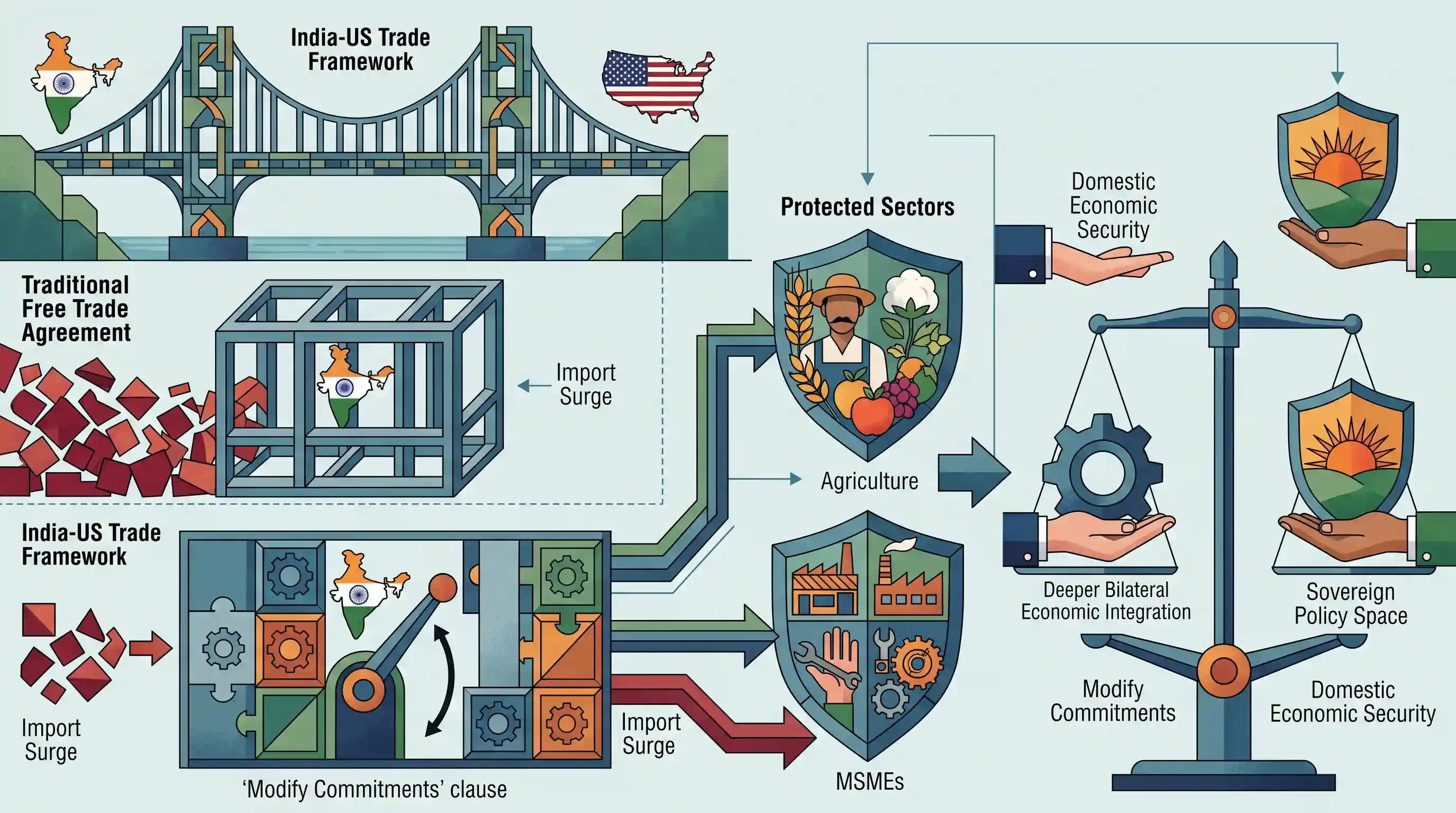
Understanding the nuances of bilateral trade negotiations is vital for UPSC aspirants, as it connects international relations (GS2) with economic development and trade policy (GS3). The 'modify commitments' clause demonstrates how India navigates complex economic diplomacy to balance global integration with domestic safeguards.
Summary
The article examines the strategic significance of a 'modify commitments' clause within the India-US trade framework agreement. This provision gives New Delhi essential flexibility, or 'wriggle room,' to adjust its trade commitments in response to changing domestic economic conditions. By avoiding the rigid constraints typical of traditional Free Trade Agreements, India can better protect sensitive sectors like agriculture and micro, small, and medium enterprises (MSMEs) from potential import surges. Ultimately, the clause illustrates India's approach to balancing deeper bilateral economic integration with the United States while safeguarding its sovereign policy space and domestic economic security.
Key Points
- A 'modify commitments' clause in the India-US trade framework provides India with the flexibility to alter or withdraw certain trade obligations if domestic conditions require it.
- This strategic 'wriggle room' is crucial for protecting vulnerable domestic sectors, such as agriculture and MSMEs, against unforeseen import surges or economic shocks.
- The inclusion of such a clause reflects a global shift from rigid, traditional Free Trade Agreements (FTAs) towards more adaptive and flexible bilateral economic arrangements.
- It allows India to deepen its economic and strategic partnership with the US while retaining sovereign policy space to ensure domestic economic security.
Important Terms
India-US Trade Policy Forum (TPF)

The primary bilateral mechanism established in 2005 to resolve trade and investment issues between India and the U.S., co-chaired by the Indian Commerce Minister and the USTR.
UPSC context
GS Paper-II (International Relations); tests understanding of bilateral institutional frameworks used to manage economic friction with India's largest trading partner.
Modify Commitments Clause
A legal provision in trade deals allowing a nation to adjust its tariff or market-access promises if the partner country unilaterally changes its own agreed-upon trade terms.
UPSC context
GS Paper-III (Economy); tests knowledge of "policy space" and the strategic flexibility required to protect sensitive domestic sectors in international negotiations.
Indo-Pacific Economic Framework (IPEF)
A US-led regional economic initiative launched in 2022 with 14 partners focusing on supply chains and clean energy; India participates in most pillars but opts out of the trade pillar.
UPSC context
GS Paper-II (International Relations); critical for analyzing India's selective engagement in regional blocs to balance economic growth with sovereignty.
Free Trade Agreement (FTA)
A treaty between countries to reduce or eliminate trade barriers like tariffs; typically more rigid and comprehensive than the "interim" or "framework" agreements India currently pursues with the US.
UPSC context
GS Paper-III (Economy); fundamental for comparing different levels of economic integration and understanding India's cautious approach to multi-sectoral trade liberalization.
United States Trade Representative (USTR)
The executive agency of the U.S. government responsible for developing and recommending trade policy and conducting bilateral and multilateral trade negotiations with nations like India.
UPSC context
GS Paper-II (International Relations); relevant for identifying key institutional stakeholders and counterparties in India's high-level trade diplomacy.
World Trade Organization (WTO)
The global international organization dealing with the rules of trade between nations, providing the overarching legal framework that permits "rebalancing" of commitments when trade rights are altered.
UPSC context
GS Paper-III (Economy); provides the normative global context for bilateral dispute resolution and the legal basis for adjusting trade commitments.
Prelims Trap
"The bilateral 'modify commitments' clause operates under the WTO's GATT Article XXVIII framework."
False. The bilateral clause is distinct from GATT Article XXVIII, which requires complex multilateral negotiations and compensatory adjustments across WTO members to alter bound schedules.
Static Concepts Connected
What is the difference between Bound Rates and Applied Rates?
- Bound Rate: The maximum tariff ceiling a WTO member legally commits to not exceeding for a specific product under its WTO schedule.
- Applied Rate: The actual tariff rate a country currently charges on an import. It can be dynamically altered as long as it remains below the bound rate.
- Water in Tariff: The gap between the bound and applied rate, which gives developing nations like India vital policy flexibility to raise tariffs during import surges.
What is GATT Article XXVIII?
- Core Purpose: A WTO provision allowing members to permanently modify or withdraw previously agreed trade concessions (like bound tariff rates) from their official schedules.
- Compensation Mandate: It requires complex negotiations with principal supplying nations, usually involving compensatory tariff reductions on other products to maintain the overall balance of trade concessions.
Cross-Topic Patterns
Strategic Opt-outs: IPEF Trade Pillar
India's insistence on flexibility mirrors its refusal to join the IPEF Trade Pillar, resisting binding mandates on labor, environment, and digital trade to preserve sovereign policy space.
RCEP ghost: Shielding sensitive sectors
The clause stems from the same defensive strategy that drove India out of RCEP—protecting vulnerable domestic constituencies like dairy, MSMEs, and agriculture from sudden import dumping.

Expect a Prelims question comparing the WTO's GATT Article XXVIII renegotiation provisions with modern bilateral trade flexibilities.
Linked PYQs · 3
Linked PYQs · 3
- 2025MainsGS3
What are the challenges before the Indian economy when the world is moving away from free trade and multilateralism to protectionism and bilateralism? How can these challenges be met?
- 2018MainsGS2
India and USA are two large democracies. Examine the basic tenets on which the two political systems are based.
- 2017PrelimsGS1
Consider the following statements: 1. India has ratified the Trade Facilitation Agreement (TFA) of WTO. 2. TFA is a part of WTO's Bali Ministerial Package of 2013. 3. TFA came into force in January 2016. Which of the statements given above is/are correct?
