India US trade agreement sets tariff framework at eighteen percent
Source:Indian Express ↗
Why It Matters
It provides a concrete example for GS2 and GS3 answers on how India leverages its strategic partnerships to secure energy interests (Russian oil) while managing protectionist economic policies (US tariffs) through bilateral negotiations.
Summary
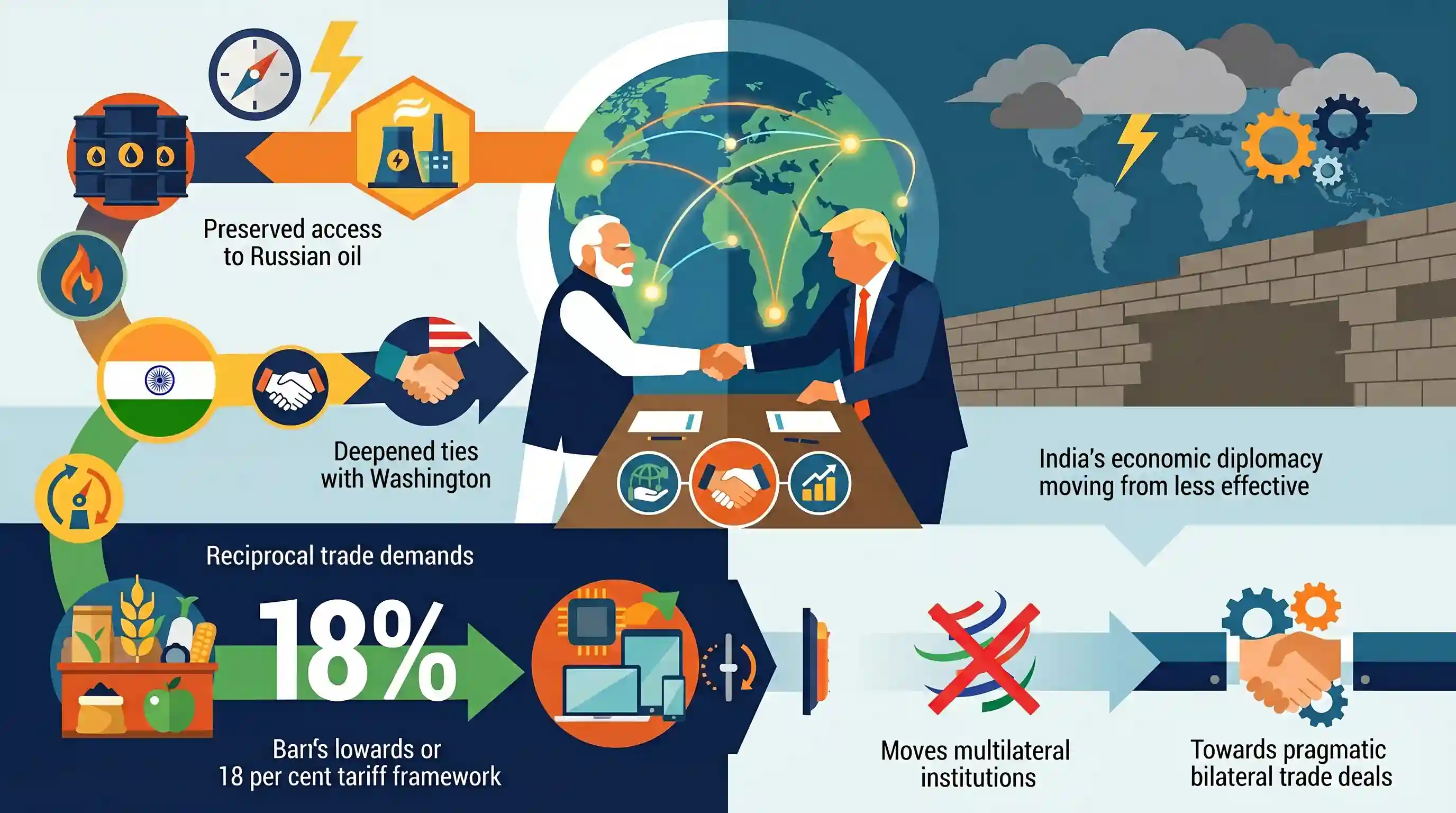
The article analyzes a historic India-US trade deal negotiated between Prime Minister Narendra Modi and US President Donald Trump. A key achievement of the agreement is India's successful balancing of its strategic autonomy, preserving its critical access to Russian oil for energy security while deepening ties with Washington. Furthermore, the deal addresses reciprocal trade demands, particularly involving an 18 per cent tariff framework. This bilateral agreement marks a significant shift in economic diplomacy, illustrating how India is navigating rising global protectionism by securing pragmatic, bilateral trade deals rather than relying solely on multilateral institutions.
Key Points
- A landmark bilateral trade agreement between India and the US underscores shifting geopolitical alliances and strengthening economic ties under Modi and Trump.
- India successfully navigated US pressure regarding its Russian oil imports, affirming its strategic autonomy and prioritizing domestic energy security.
- The negotiations addressed trade barriers, notably featuring a framework involving an 18 per cent tariff, reflecting a broader trend towards bilateral trade reciprocity.
- The deal highlights India's pragmatic economic diplomacy in an era where global trade is transitioning from multilateralism to protectionism and bilateralism.
Important Terms
Strategic Autonomy

A nation's capacity to pursue its foreign policy and national interests independently, avoiding over-dependence on any single power or bloc while maintaining multi-aligned relationships.
UPSC context
GS Paper-II (International Relations); tests India's balancing act between major powers like the US and Russia.
Reciprocal Tariff
A trade policy where a country mirrors the import duties of a partner nation, aimed at leveling the economic playing field or pressuring others to lower barriers.
UPSC context
GS Paper-III (Economy); examines trade barriers, global trade wars, and transactional diplomacy's impact on Indian exports.
Energy Security
Ensuring the uninterrupted availability of energy sources at an affordable price, often involving the diversification of fuel types and supply partners to mitigate geopolitical risks.
UPSC context
GS Paper-III (Infrastructure/Economy); relevant for India's reliance on imported crude and strategic energy diversification.
Protectionism
The economic policy of shielding domestic industries from foreign competition through tariffs, quotas, or other regulatory barriers to imports.
UPSC context
GS Paper-III (Economy); covers global trade trends, anti-globalization, and challenges for emerging economies.
Economic Diplomacy
The use of diplomatic resources and economic tools, such as trade agreements and investment incentives, to achieve a state’s national economic and strategic objectives.
UPSC context
GS Paper-II & III; focuses on how India leverages economic ties for geopolitical influence.
Bilateralism
A system of political, economic, or cultural relations between two sovereign states, often contrasted with multilateralism which involves multiple countries.
UPSC context
GS Paper-II; compares the efficacy of direct two-nation deals versus WTO-led multilateral frameworks.
Prelims Trap
"India officially joined the G7 price cap coalition on Russian oil to secure the US trade deal and avoid secondary sanctions."
India never officially joined the G7 price cap mechanism. It strategically uses non-Western shipping and insurance to continue importing crude without formally violating sanctions.
Static Concepts Connected
How do bilateral trade deals bypass the WTO's Most-Favoured-Nation (MFN) principle?
- MFN Principle: The MFN rule mandates that any favorable tariff concession granted to one WTO member must be equally extended to all other members.
- Article XXIV Exception: GATT allows countries to legally bypass MFN obligations if they form a Free Trade Agreement (FTA) that eliminates tariffs on 'substantially all trade'.
- Shift to Bilateralism: Due to gridlock at the WTO's Appellate Body, nations increasingly prefer bilateral FTAs to secure reciprocal market access outside the multilateral framework.
What distinguishes modern 'Strategic Autonomy' from traditional 'Non-Alignment'?
- Traditional Non-Alignment: Historically focused on ideological neutrality, anti-imperialism, and maintaining strict equidistance from major Cold War military blocs (US vs USSR).
- Strategic Autonomy: Emphasizes proactive, issue-based multi-alignment to maximize national interests. It allows simultaneous, deep partnerships with rival global powers without formal military alliances.
Cross-Topic Patterns
Rupee Internationalization & Russian Oil
Sustaining Russian oil imports despite Western financial sanctions directly triggered the RBI's push for Special Rupee Vostro Accounts, linking GS-2 geopolitics to GS-3 capital account convertibility.
Tariff Reciprocity & PLI Schemes
Negotiating tariff rates ties into India's Atmanirbhar Bharat push. Calculated protectionism and bilateral deals are now actively used to shield PLI-backed domestic manufacturing from external dumping.

Expect a 2026 multi-statement Prelims question testing WTO Article XXIV exceptions alongside India's stance on the G7 oil price cap.
Linked PYQs · 3
Linked PYQs · 3
- 2025MainsGS3
What are the challenges before the Indian economy when the world is moving away from free trade and multilateralism to protectionism and bilateralism? How can these challenges be met?
- 2018MainsGS3
How would the recent phenomena of protectionism and currency manipulations in world trade affect macroeconomic stability of India?
- 2025MainsGS2
"Energy security constitutes the dominant kingpin of India's foreign policy, and is linked with India's overarching influence in Middle Eastern countries.” How would you integrate energy security with India's foreign policy trajectories in the coming years?
