Prospective India US Trade Deal Raises Strategic Autonomy Concerns
Source:The Hindu ↗
Why It Matters
Understanding the tension between economic integration through trade deals and maintaining strategic autonomy is crucial for analyzing India's foreign policy and its bilateral relations with major powers like the US.
Summary
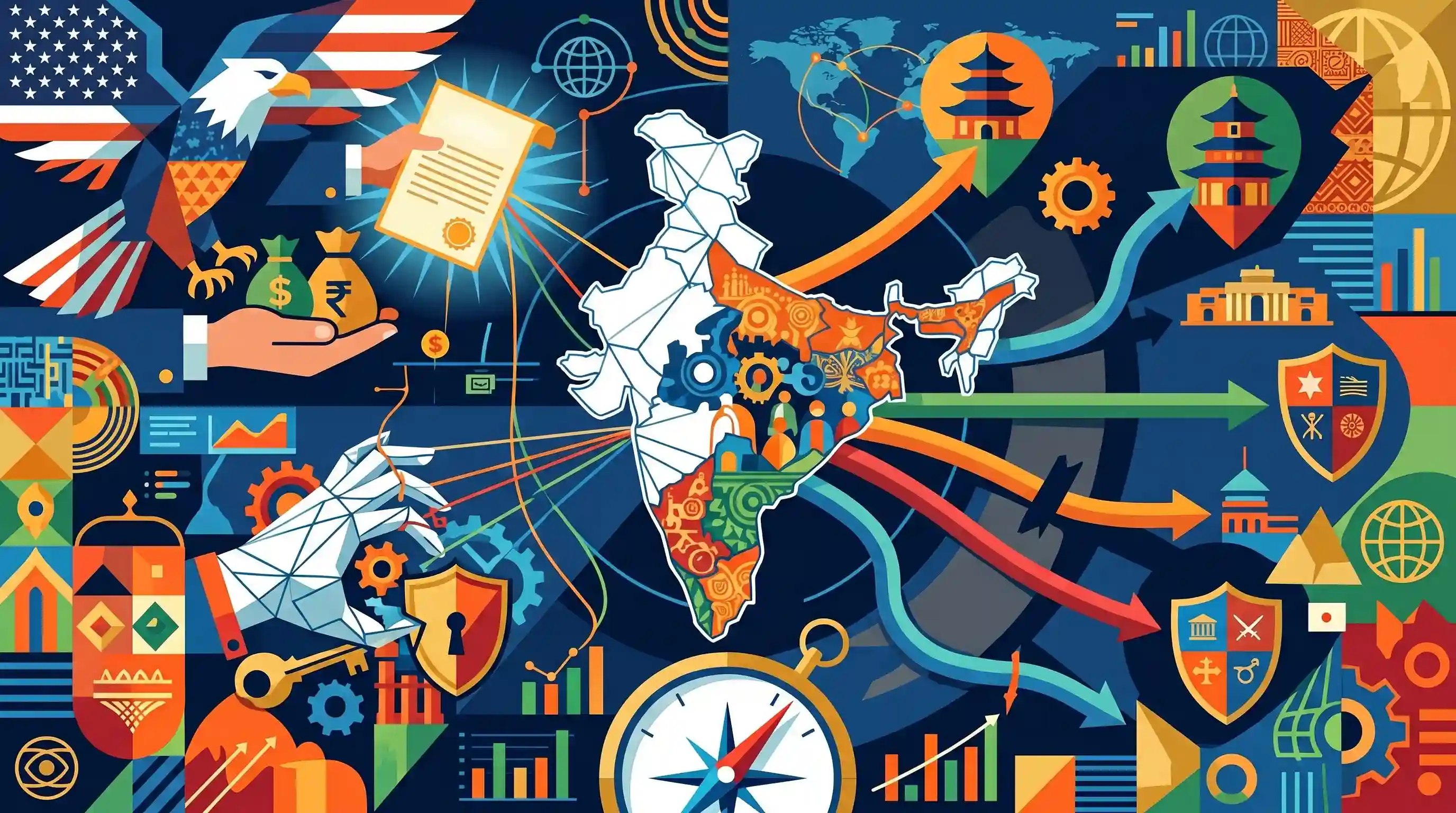
The article analyzes the implications of a prospective India-U.S. trade deal, arguing that while it may offer economic benefits, it poses significant risks to India's strategic autonomy. It suggests that by aligning too closely with U.S. economic and strategic frameworks, India may compromise its independent foreign policy, especially concerning its relations with other global powers. The piece emphasizes the need for India to negotiate trade agreements without sacrificing its economic sovereignty or strategic independence.
Key Points
- Evaluates the geopolitical and economic consequences of an India-U.S. trade deal.
- Argues that deeper economic integration with the U.S. may constrain India's strategic autonomy and independent foreign policy choices.
- Emphasizes the risk of India being drawn into U.S.-led global strategies at the expense of its own national interests.
- Recommends a balanced approach to trade deals that protects economic sovereignty while pursuing beneficial partnerships.
Important Terms
Strategic Autonomy

A nation's ability to pursue independent foreign policy and defense decisions without external pressure or alliance obligations, prioritizing flexibility and national interest in a multipolar world.
UPSC context
GS Paper II: Foreign Policy; critical for analyzing India's balance between major powers like the U.S., Russia, and China.
Economic Sovereignty
The authority of a state to independently determine its economic policies, resource allocation, and trade regulations without being constrained by international institutions or foreign governments.
UPSC context
GS Paper III: Economy; tests understanding of the trade-offs between global integration (globalization) and national policy space.
Free Trade Agreement (FTA)
A pact between two or more nations to reduce or eliminate tariffs, quotas, and other trade barriers to facilitate the free flow of goods and services.
UPSC context
GS Paper III: Indian Economy; essential for understanding trade policy and India's economic integration with global supply chains.
Generalised System of Preferences (GSP)
A non-reciprocal preferential tariff system where developed countries grant duty-free or reduced-duty access to imports from developing countries to promote their economic growth.
UPSC context
GS Paper II & III: International Relations/Economy; significant for discussing historical India-U.S. trade friction and export competitiveness.
Multi-alignment
India's contemporary foreign policy approach of engaging with multiple global powers simultaneously on a project-to-project or interest-based basis, moving beyond traditional non-alignment.
UPSC context
GS Paper II: International Relations; evaluates India's evolving diplomatic strategy in a multipolar world order.
Bilateral Trade Agreement
A formal trade agreement between two nations designed to lower trade barriers and boost economic cooperation through reciprocal concessions.
UPSC context
GS Paper III: Economy; relates to India's shift toward bilateralism in the face of a stalling multilateral WTO framework.
Prelims Trap
The signing of the four foundational agreements elevates India to a formal treaty ally of the United States.
India deliberately avoids formal treaty alliances to preserve its strategic autonomy. Foundational agreements enhance military interoperability, not binding mutual defense commitments.
Static Concepts Connected
What defines 'Strategic Autonomy' in India's current foreign policy?
- Multi-alignment: Engaging concurrently with multiple rival global powers (e.g., Quad with US, SCO with Russia/China) based on national interests.
- No formal alliances: Avoiding bloc politics and formal treaty alliances to retain independent decision-making in defense, procurement, and diplomacy.
What are the core WTO-related trade frictions between India and the US?
- Public Stockholding: The US frequently challenges India's Minimum Support Price (MSP) and agricultural subsidies at the WTO, claiming they distort global trade.
- GSP Revocation: The US withdrew India's Generalized System of Preferences status in 2019, demanding greater market access and relaxing of e-commerce rules.
- Data Localization: The US aggressively lobbies against India's data localization rules, which mandate storing sensitive financial and personal data domestically.
Cross-Topic Patterns
Trade agreements and domestic economic sovereignty
Modern FTAs increasingly embed non-trade issues like data localization, intellectual property, and labor standards, forcing domestic legislative changes that can undermine a developing nation's economic sovereignty.
Multi-alignment: Quad vs BRICS
Deepening economic and strategic ties with the US tests India’s multi-alignment balancing act, specifically its parallel engagements with the Russia-China led SCO and BRICS groupings.

Expect a 2026 Mains question analyzing how India's pursuit of strategic autonomy acts as a ceiling on its economic integration with the US.
Linked PYQs · 2
Linked PYQs · 2
- 2019MainsGS2
‘What introduces friction into the ties between India and the United States is that Washington is still unable to find for India a position in its global strategy, which would satisfy India's national self-esteem and ambitions.’ Explain with suitable examples.
- 2023MainsGS2
‘The expansion and strengthening of NATO and a stronger US-Europe strategic partnership works well for India.’ What is your opinion about this statement ? Give reasons and examples to support your answer.
