India US Interim Trade Framework and Tariff Negotiations
Source:Indian Express ↗
ఇది ఎందుకు ముఖ్యం
This article is highly relevant for GS Paper 3 (International Trade, Protectionism, and Export Competitiveness) and GS Paper 2 (Bilateral Relations between India and the US), as trade deals and tariff disputes directly influence India's foreign economic policy and global market integration.
సారాంశం
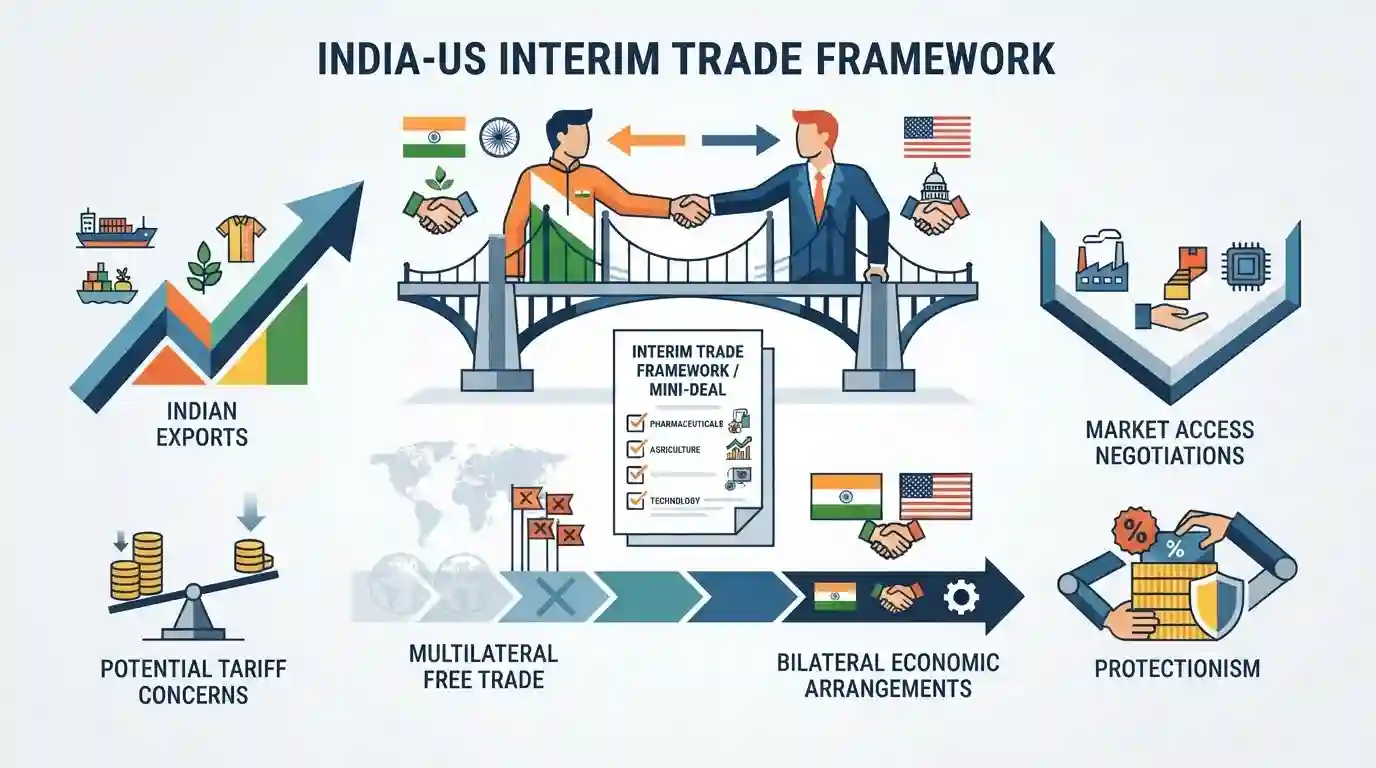
The article discusses the emerging contours of an India-US interim trade framework or mini-deal, examining potential tariff concerns, market access negotiations, and the broader shift from multilateral free trade to bilateral economic arrangements.
ముఖ్య అంశాలు
- India and the US are exploring an interim trade framework or mini-deal to address long-standing market access and tariff issues.
- Key contentious areas include US tariff concerns on Indian goods, market access for US agricultural and dairy products, and intellectual property rights (IPR).
- Shifting global trade dynamics towards bilateralism and protectionism pose unique challenges for India's export growth and integration into global value chains (GVCs).
- Interim trade frameworks allow nations to bypass complex, prolonged comprehensive Free Trade Agreement (FTA) negotiations to achieve quick economic gains.
ముఖ్యమైన పదాలు
World Trade Organization

An international organization established to regulate and facilitate global trade between nations through negotiated rules and dispute resolution mechanisms.
UPSC context
GS Paper II & III; tests understanding of global trade governance, multilateralism vs. bilateralism, and India's stance at the WTO.
United States Trade Representative
The executive branch agency of the United States government responsible for developing and recommending United States trade policy and conducting trade negotiations with foreign countries.
UPSC context
GS Paper II (International Relations - India-US Ties) & GS Paper III (Foreign Trade); tests knowledge of bilateral economic diplomacy.
ప్రిలిమ్స్ ఉచ్చు
Interim trade frameworks function as comprehensive Free Trade Agreements that permanently eliminate all bilateral tariffs immediately upon signing.
Aspirants often assume interim trade frameworks are formal, comprehensive Free Trade Agreements (FTAs) under WTO rules, whereas they are usually targeted, limited-scope arrangements bypassing full FTA negotiations.
అనుసంధానమైన స్థిర భావనలు
What are the key differences between a Comprehensive Free Trade Agreement (FTA) and an Interim Trade Agreement (Mini-Deal)?
- Scope & Depth: Comprehensive FTAs cover deep tariff eliminations across goods, services, investments, and regulatory standards, taking years to negotiate.
- Pragmatic Approach: Interim deals or mini-deals target specific sectors or early harvest gains to resolve immediate trade frictions without full treaty commitments.
- WTO Compliance: Interim agreements must eventually align with WTO Article XXIV requirements if they progress into full customs unions or comprehensive FTAs.
అంతర-అంశ నమూనాలు
Bilateral Mini-Deals vs. WTO Multilateralism
Bilateral mini-deals bypass WTO deadlock, reflecting a global shift toward pragmatic plurilateralism and strategic economic corridors like IPEF.

Expect statement-based MCQs on India-US interim trade framework, contrasting mini-deals with comprehensive FTAs and WTO rules.
అనుసంధాన PYQలు · 2
అనుసంధాన PYQలు · 2
- 2019MainsGS2
‘What introduces friction into the ties between India and the United States is that Washington is still unable to find for India a position in its global strategy, which would satisfy India's national self-esteem and ambitions.’ Explain with suitable examples.
- 2025MainsGS3
What are the challenges before the Indian economy when the world is moving away from free trade and multilateralism to protectionism and bilateralism? How can these challenges be met?
