Bilateral trade pact offers major boost to electronics exports
Source:Indian Express ↗
Why It Matters
Electronics has emerged as one of India's fastest-growing export sectors, vital for structural economic transformation. For UPSC aspirants, this highlights the intersection of industrial policy (PLI scheme), foreign trade, and geopolitics (supply chain realignment away from China). It provides a concrete case study for Mains answers on how domestic reforms must align with bilateral diplomacy to boost manufacturing and exports.
Summary
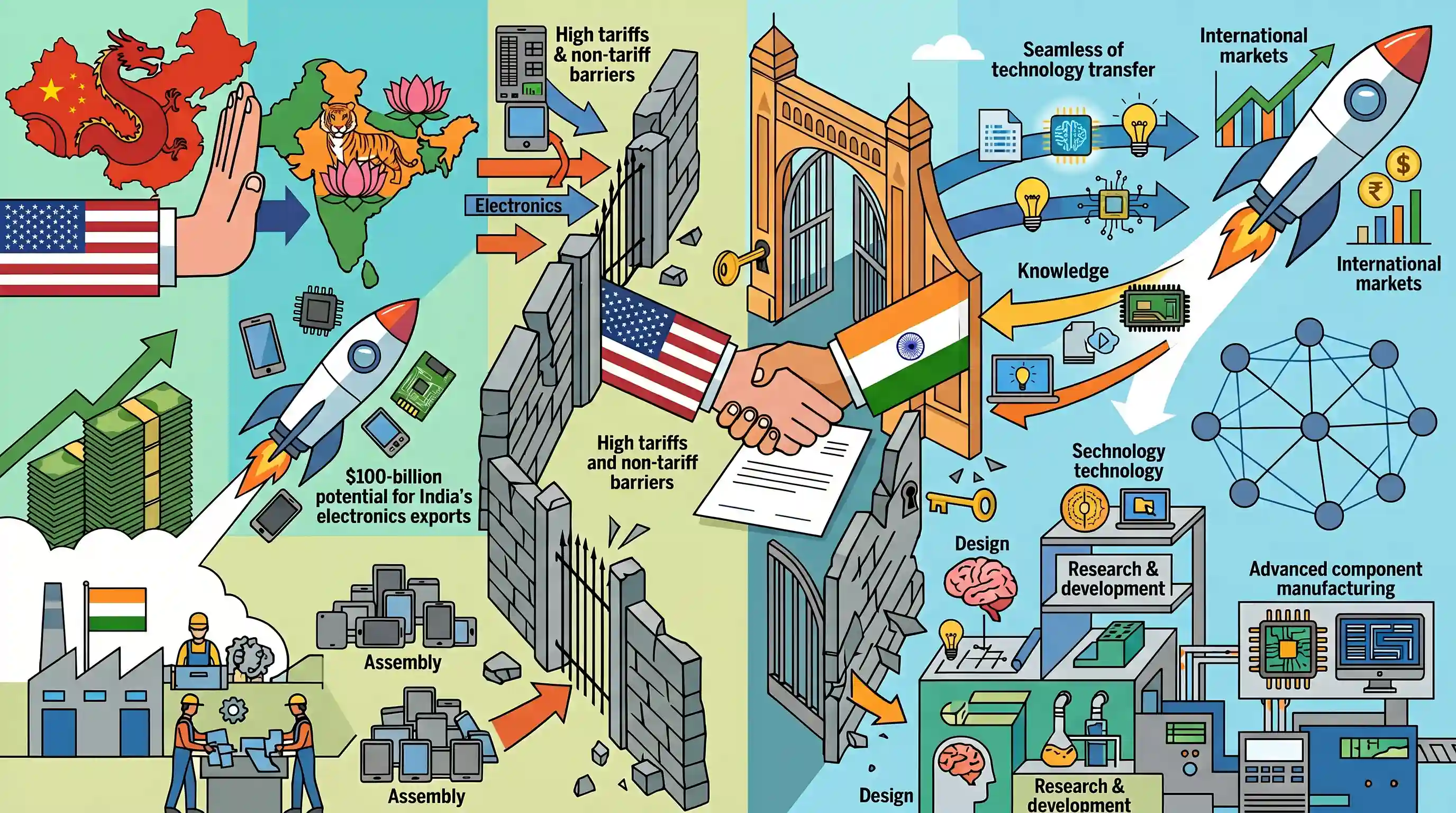
The article explores the massive $100-billion potential for India's electronics exports that could be unlocked through a dedicated trade deal with the United States. Driven by the US's 'China Plus One' supply chain de-risking strategy, India has a unique window to scale its electronics manufacturing. While domestic initiatives like the Production Linked Incentive (PLI) scheme have laid the groundwork by attracting companies like Apple to assemble devices in India, a formal bilateral trade agreement is crucial. Such a deal would help lower tariff and non-tariff barriers, facilitate seamless technology transfers, and integrate Indian manufacturers more deeply into critical Global Value Chains (GVCs), moving India from mere assembly to comprehensive component manufacturing.
Key Points
- The United States' strategic push to diversify supply chains away from China (China Plus One) presents a historic opportunity for India's electronics manufacturing sector.
- India aims to reach a $100-billion target in electronics exports, which hinges heavily on securing a favorable trade framework with the lucrative US market.
- While the Production Linked Incentive (PLI) scheme has successfully boosted smartphone assembly, a bilateral trade deal is necessary to attract deeper investments in IT hardware and component manufacturing.
- To remain competitive in Global Value Chains (GVCs), India must address domestic tariff barriers on intermediate electronics components alongside negotiating lower barriers abroad.
- An India-US trade pact would cement technological cooperation, spur Foreign Direct Investment (FDI) from American tech majors, and elevate India's status in the global tech ecosystem.
Important Terms
Production Linked Incentive (PLI) Scheme

A government scheme providing financial incentives (4-6%) to companies based on incremental sales of products manufactured in India, aiming to boost domestic production and exports.
UPSC context
GS3: Industrial Policy. Vital for evaluating "Atmanirbhar Bharat" and India's strategy to become a global electronics manufacturing hub.
Initiative on Critical and Emerging Technology (iCET)
A 2023 bilateral framework between India and the US to expand strategic technology partnership in artificial intelligence, semiconductors, space, and defense innovation.
UPSC context
GS2: International Relations. Represents the elevation of India-US ties to a strategic technology-sharing partnership.
China Plus One strategy
A business strategy where multinational corporations diversify their manufacturing bases beyond China to reduce supply chain dependency and mitigate geopolitical risks.
UPSC context
GS3: Indian Economy. Key to discussing India’s role as an alternative global factory and attracting Foreign Direct Investment.
Global Value Chains (GVC)
International production networks where different stages of a product's life cycle—design, assembly, and marketing—are distributed across multiple countries to maximize efficiency.
UPSC context
GS3: Economy. Tests understanding of how India can shift from low-end assembly to high-value component manufacturing.
Information Technology Agreement (ITA)
A WTO-led plurilateral agreement aimed at eliminating import duties and tariffs on a wide range of information technology and telecommunications products.
UPSC context
GS3: International Trade. Relevant for analyzing the impact of zero-tariff regimes on domestic industry competitiveness and export growth.
Prelims Trap
India is a signatory to both ITA-1 and ITA-2 under WTO, eliminating all tariffs on intermediate electronics components.
India signed ITA-1 (1997) but opted out of the 2015 expansion (ITA-2) to shield its domestic hardware sector. India actually maintains significant tariffs on newer tech components, complicating GVC integration.
Static Concepts Connected
What is the Information Technology Agreement (ITA) under the WTO?
- Plurilateral Agreement: It is a plurilateral WTO agreement aiming to completely eliminate duties on specific IT products covered by the pact.
- India's Stance: India signed ITA-1 in 1997 but refused to sign ITA-2 (2015) to protect its domestic manufacturing from cheap global imports.
How do Global Value Chains (GVCs) differ from traditional export models?
- Production Fragmentation: Different stages of production (R&D, component manufacturing, assembly, marketing) occur in different countries to optimize costs and efficiency.
- Import-Intensity: GVC exports rely heavily on intermediate imports. Therefore, high import tariffs on components disproportionately hurt a country's final export competitiveness.
Cross-Topic Patterns
iCET + Supply Chain Resilience
The India-US Initiative on Critical and Emerging Technology (iCET) directly connects GS-2 bilateral diplomacy to GS-3 industrial policy by focusing on resilient, de-risked semiconductor and electronics ecosystems.
Protectionism vs. GVC Integration
The push for Atmanirbhar Bharat often raises tariffs on intermediate goods. This creates a conceptual clash with the Economic Survey's premise that successful GVC integration strictly requires low component tariffs.

Expect a 2026 Prelims multi-statement question linking PLI scheme criteria, WTO's ITA-2 applicability, and intermediate tariff barriers.
Linked PYQs · 3
Linked PYQs · 3
- 2014MainsGS2
The aim of Information Technology Agreements (ITAs) is to lower all taxes and tariffs on information technology products by signatories to zero. What impact would such agreements have on India's interests?
- 2025MainsGS3
Discuss the rationale of the Production Linked Incentive (PLI) scheme. What are its achievements? In what way can the functioning and outcomes of the scheme be improved?
- 2025MainsGS3
What are the challenges before the Indian economy when the world is moving away from free trade and multilateralism to protectionism and bilateralism? How can these challenges be met?
