Trade Diversification Strategy Amid US Policy Uncertainties
Source:Indian Express ↗
Why It Matters
Understanding the balance between short-term bilateral trade management and long-term diversification strategies is critical for answering questions on India's economic resilience in a protectionist global environment (GS3) and its foreign policy maneuvering (GS2).
Summary
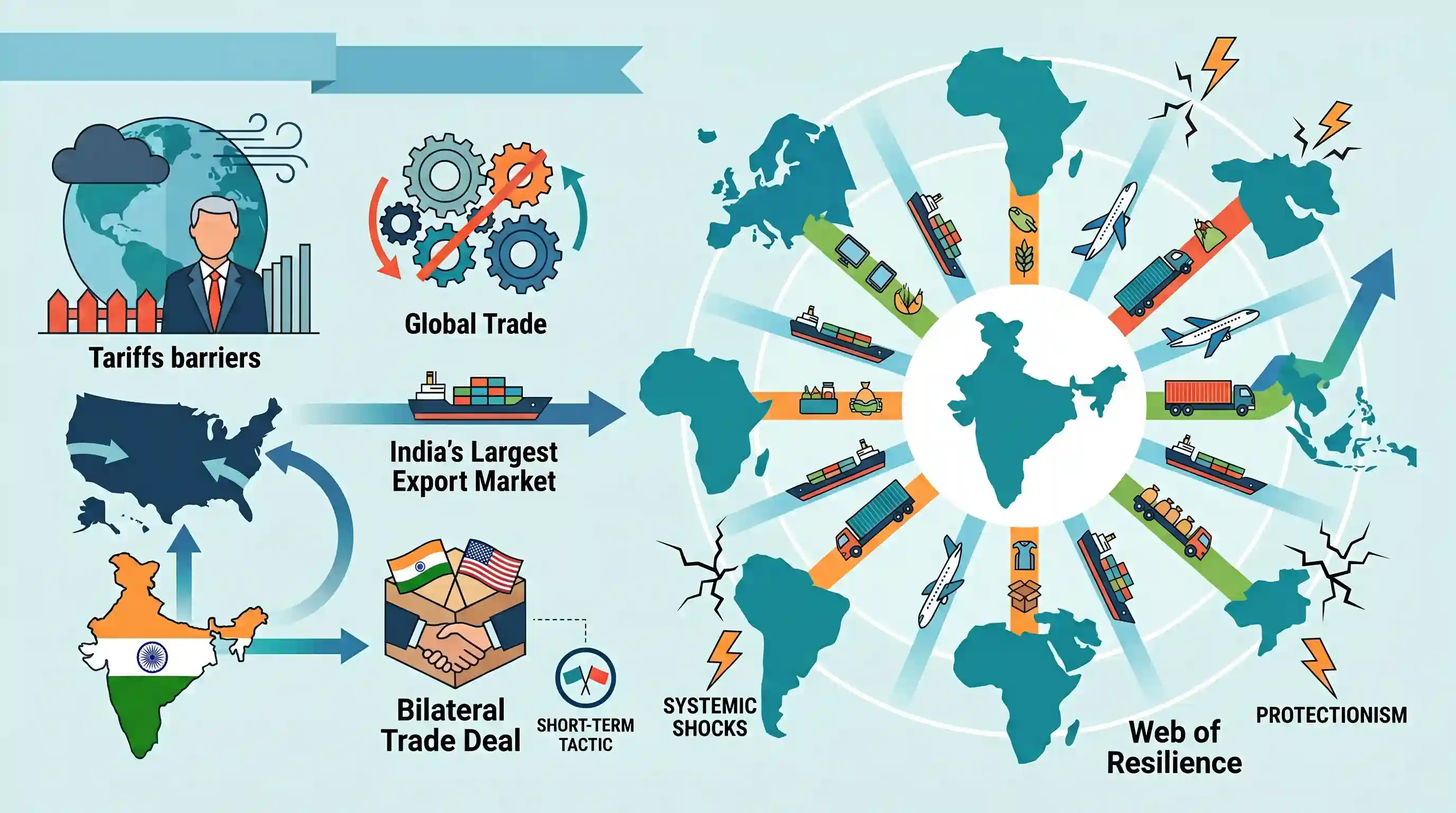
The article argues that the potential return of Donald Trump to the US presidency could bring renewed uncertainties to global trade, characterized by a transactional approach and tariff threats. While India might need to negotiate a specific bilateral trade deal with the US to protect its interests in its largest export market, this short-term tactical move should not derail its broader economic vision. The author emphasizes that India's long-term strategy must remain focused on trade diversification. By expanding its export destinations and import sources across multiple regions, India can build vital resilience against systemic shocks, growing global protectionism, and the decline of multilateral trade frameworks.
Key Points
- A potential Donald Trump presidency could introduce significant uncertainties in US trade policy, marked by transactional deals and the threat of tariffs.
- India may need to negotiate a bilateral trade agreement with the US to safeguard its exports and mitigate the impact of protectionist measures.
- Despite short-term tactical adjustments to manage US relations, India must not abandon its fundamental long-term strategy of trade diversification.
- Overdependence on a single export market creates vulnerabilities; expanding trade ties with diverse regions is essential for economic resilience.
- Diversification serves as a crucial buffer for India's macroeconomic stability against the rising global tide of protectionism and bilateralism.
Important Terms
Trade Diversification

A strategy to expand a country's range of export products and geographic destinations. It reduces over-reliance on single markets, mitigates risks from external shocks, and enhances economic resilience by exploring new partners.
UPSC context
GS-III (Economy); tests knowledge of export strategies, supply chain resilience (China-plus-one), and mitigating risks from global trade volatility.
Protectionism
Economic policy of restricting imports through tariffs, quotas, or subsidies to shield domestic industries from foreign competition. It is often driven by economic nationalism or transactional trade approaches.
UPSC context
GS-II (IR) and GS-III (Economy); tests analysis of shifting global trade trends (slowbalisation) and their impact on India’s competitiveness.
World Trade Organization (WTO)
The only global international organization dealing with the rules of trade between nations. It aims to ensure trade flows smoothly and predictably through negotiated agreements and a rule-based dispute settlement mechanism.
UPSC context
GS-II/GS-III; tests understanding of global trade governance, India's developmental concerns, and current institutional challenges like the Appellate Body crisis.
Multilateralism
A diplomatic and economic framework where multiple countries cooperate based on shared norms and institutional rules, such as the WTO system, to manage global trade and security collectively.
UPSC context
GS-II (International Relations); tests understanding of the global order, institutional diplomacy, and the shift toward regional or minilateral pacts.
Bilateral Trade Agreement
An economic treaty between two nations to reduce or eliminate trade barriers, such as tariffs and quotas, to encourage the exchange of goods and services and strengthen economic ties.
UPSC context
GS-III (Economy); tests understanding of India’s FTA strategy, market access negotiations, and bilateral economic diplomacy with major partners.
Prelims Trap
The US is India's largest trading partner and accounts for India's largest bilateral trade deficit.
While the US is India’s largest export destination and a top trading partner, India maintains a trade surplus with the US. The largest trade deficit is historically with China.
Static Concepts Connected
What differentiates a standard Free Trade Agreement (FTA) from a CECA and CEPA?
- Standard FTA: Focuses predominantly on reducing or eliminating customs duties (tariffs) on traded goods between partner countries.
- CECA: Broader than FTAs; includes negotiated tariff reductions on goods but also covers trade in services, investments, and economic cooperation.
- CEPA: The most comprehensive pact; encompasses goods, services, investments, intellectual property, competition laws, and government procurement (e.g., India-UAE CEPA).
How do bilateral FTAs legally bypass the WTO's Most-Favored-Nation (MFN) principle?
- MFN Rule: WTO mandates that members cannot discriminate between trading partners; granting a trade favor to one requires granting it to all WTO members.
- Article XXIV: An explicit WTO exception allowing members to set up regional FTAs or customs unions, thereby charging lower tariffs to treaty partners than the standard MFN rate.
- Enabling Clause: A specific exception allowing developed countries to give preferential tariff treatment to developing countries without extending it to all (e.g., the US GSP system).
Cross-Topic Patterns
Friendshoring & Critical Mineral Corridors
India’s diversification extends beyond standard exports to securing critical mineral supply chains through minilateral pacts like IPEF and Quad, reducing raw material dependency on a single geography.
Current Account Deficit (CAD) Management
Over-reliance on US markets exposes India to sudden tariff shocks, which can abruptly widen the CAD by suppressing export earnings amidst inelastic import bills for energy and electronics.

Expect a 2026 GS3 question analyzing India’s dual strategy of tactical US bilateralism versus strategic 'friendshoring' diversification.
Linked PYQs · 3
Linked PYQs · 3
- 2025MainsGS3
What are the challenges before the Indian economy when the world is moving away from free trade and multilateralism to protectionism and bilateralism? How can these challenges be met?
- 2018MainsGS3
How would the recent phenomena of protectionism and currency manipulations in world trade affect macroeconomic stability of India?
- 2019MainsGS2
‘What introduces friction into the ties between India and the United States is that Washington is still unable to find for India a position in its global strategy, which would satisfy India's national self-esteem and ambitions.’ Explain with suitable examples.
