India US Trade Negotiations Stalled Over Agricultural Market Access
Source:The Hindu ↗
Why It Matters
Trade negotiations between India and major global economies like the U.S. directly impact India's foreign policy and economic standing. This article highlights the friction between pursuing global integration through bilateral trade and protecting sensitive domestic sectors like agriculture—a recurring theme in GS2 (International Relations) and GS3 (Economy).
Summary
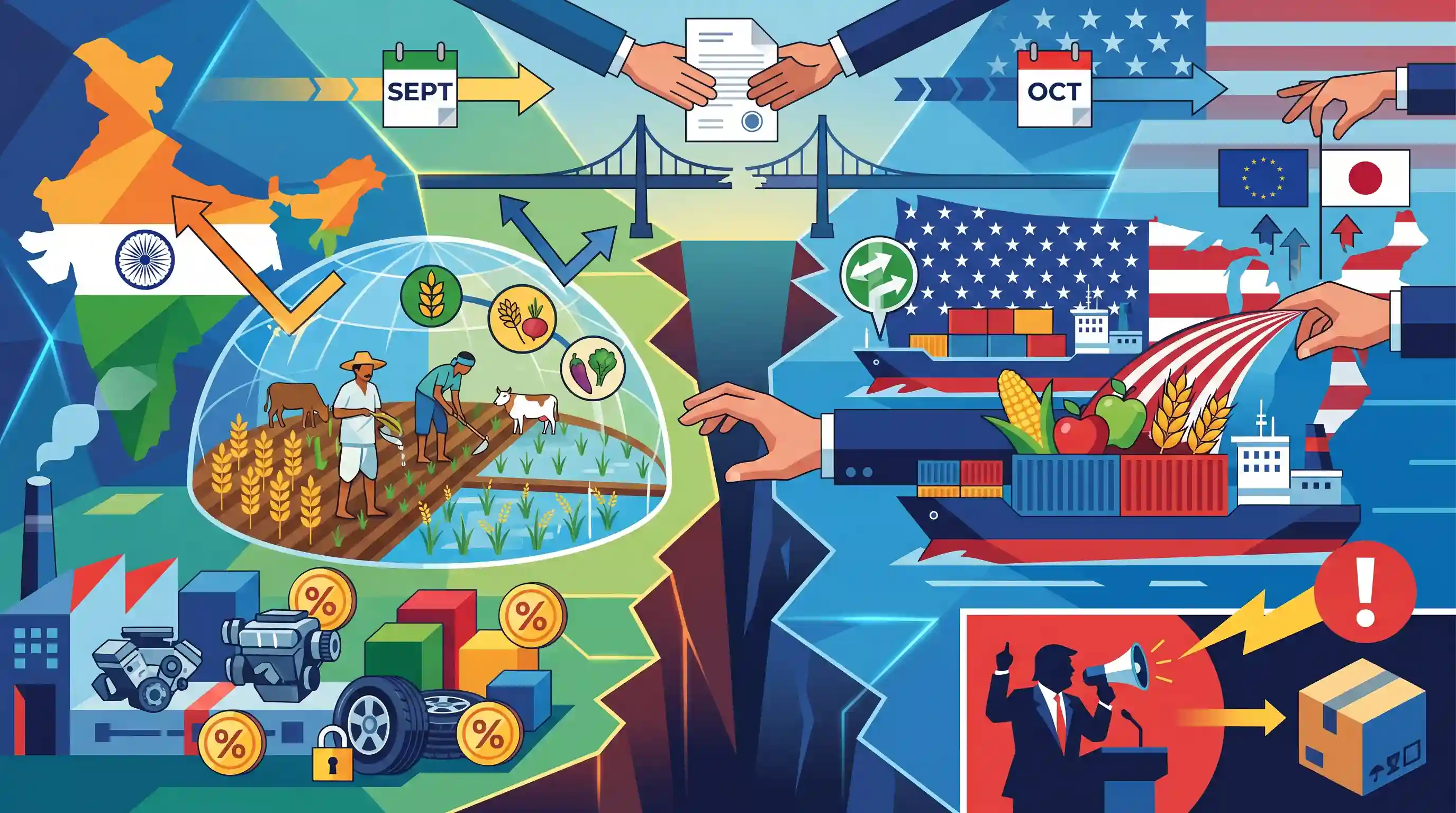
Negotiations for an India-U.S. trade deal are currently deadlocked due to disagreements over agricultural imports and automotive component duties. India is firmly resisting the opening of its agricultural sector to protect local farmers, whereas the U.S. considers this market access crucial to set a precedent for its future agreements with the EU and Japan. The focus of the talks has shifted toward securing a broader Bilateral Trade Agreement (BTA) by September or October, though Indian officials acknowledge the possibility of a sudden, surprise deal announcement by U.S. President Donald Trump.
Key Points
- India and the U.S. remain deadlocked over agricultural trade, with India resisting opening its agriculture sector to protect domestic farmers.
- The U.S. insists on agricultural market access in India to establish a precedent for its upcoming trade deals with the EU and Japan.
- Another major hurdle is the U.S. reluctance to reduce import duties on automotive components to zero.
- The focus of negotiations has shifted from an August 1 'mini deal' to a broader Bilateral Trade Agreement (BTA) targeted for September or October.
- Indian officials remain prepared for a potential surprise deal announcement by U.S. President Donald Trump, similar to his previous unilateral announcements involving Indonesia and Vietnam.
Important Terms
Bilateral Trade Agreement (BTA)

A formal treaty between two nations to reduce trade barriers like tariffs and quotas, encouraging economic cooperation and increasing exchange of goods and services.
UPSC context
GS Paper 2 (International Relations) and GS Paper 3 (Economy). Tests understanding of trade diplomacy and regional/bilateral groupings.
Generalized System of Preferences (GSP)
A U.S. trade program providing non-reciprocal, duty-free entry for thousands of products from designated beneficiary countries to aid their economic development.
UPSC context
GS Paper 2/3. Frequently appears in Prelims regarding trade concessions and international trade laws (WTO).
Market Access
The conditions, determined by a country's trade policies, under which foreign goods can enter its domestic market, often restricted by tariffs or quotas.
UPSC context
GS Paper 3 (Economy). Core concept in negotiations regarding Ease of Doing Business and WTO-led trade liberalization.
Non-Tariff Barriers (NTBs)
Trade restrictions such as quotas, sanctions, or technical standards (e.g., sanitary and phytosanitary measures) that limit imports without using direct customs duties.
UPSC context
GS Paper 3. Relevant for agriculture and pharmaceutical sectors, specifically regarding 'technical barriers to trade' and sanitary norms.
Reciprocal Tariffs
Taxes imposed by one country on imports from another in direct response to similar tariffs placed on its own exports by that partner.
UPSC context
GS Paper 3. Relates to 'trade wars' and protectionism, specifically the 'Tariff King' narrative often used by the U.S. against India.
Strategic Autonomy
A nation's ability to pursue its own foreign policy and economic interests without being unduly influenced or coerced by other states.
UPSC context
GS Paper 2. Key pillar of Indian foreign policy; tested in the context of balancing relations between major powers (U.S., Russia, China).
Prelims Trap
India and the United States currently operate under a bilateral Free Trade Agreement (FTA) covering goods and services.
India and the US do NOT have a comprehensive FTA or CEPA. Negotiations are ongoing, and India heavily protects its agriculture sector.
Static Concepts Connected
Why is India defensive about opening its agricultural sector in FTAs?
- Livelihood security: Over 40% of India's workforce depends on agriculture, operating predominantly on highly vulnerable small and marginal landholdings.
- Subsidized imports: Developed nations heavily support farmers via farm bills; tariff-free imports of US dairy or poultry would crash domestic prices.
- Non-tariff barriers: Developed nations often block Indian agri-exports using stringent Sanitary and Phytosanitary (SPS) measures, making reciprocal access unequal.
What distinguishes a PTA, FTA, and CEPA in India's trade diplomacy?
- PTA: Reduces tariffs on a specific 'positive list' of negotiated goods.
- FTA: Reduces or eliminates tariffs on the vast majority of goods, using a 'negative list' to shield sensitive sectors.
- CEPA / CECA: A highly comprehensive agreement covering goods, services, investments, intellectual property rights, and government procurement.
Cross-Topic Patterns
WTO Deadlock vs Bilateral BTAs
Developed nations increasingly use bilateral trade agreements to extract agricultural market access, bypassing the stalled multilateral WTO Doha Development Round and India's demands for public stockholding.
Auto PLI vs Global Tariff Barriers
India’s PLI scheme for auto components aims at export-led growth, but US reluctance to lower import duties highlights the friction between domestic manufacturing pushes and global protectionism.

Expect a 2026 multi-statement question linking India's defensive agricultural stance in bilateral FTAs with its WTO Peace Clause demands.
Linked PYQs · 4
Linked PYQs · 4
- 2019MainsGS2
‘What introduces friction into the ties between India and the United States is that Washington is still unable to find for India a position in its global strategy, which would satisfy India's national self-esteem and ambitions.’ Explain with suitable examples.
- 2023MainsGS3
What are the direct and indirect subsidies provided to farm sector in India? Discuss the issues raised by the World Trade Organization (WTO) in relation to agricultural subsidies.
- 2025MainsGS3
What are the challenges before the Indian economy when the world is moving away from free trade and multilateralism to protectionism and bilateralism? How can these challenges be met?
- 2012MainsGS2
Discuss the likely negative impact of the protectionist measures proposed by the US on India's software industry.
