Bilateral Tariffs and Energy Diversification in India US Trade Deal
Source:The Hindu ↗
Why It Matters
This historic trade deal resolves an intense period of tariff disputes and shifts India away from Russian energy dependence, fundamentally altering bilateral relations and having long-term implications for India's agricultural and industrial sectors under the new zero-tariff regime.
Summary
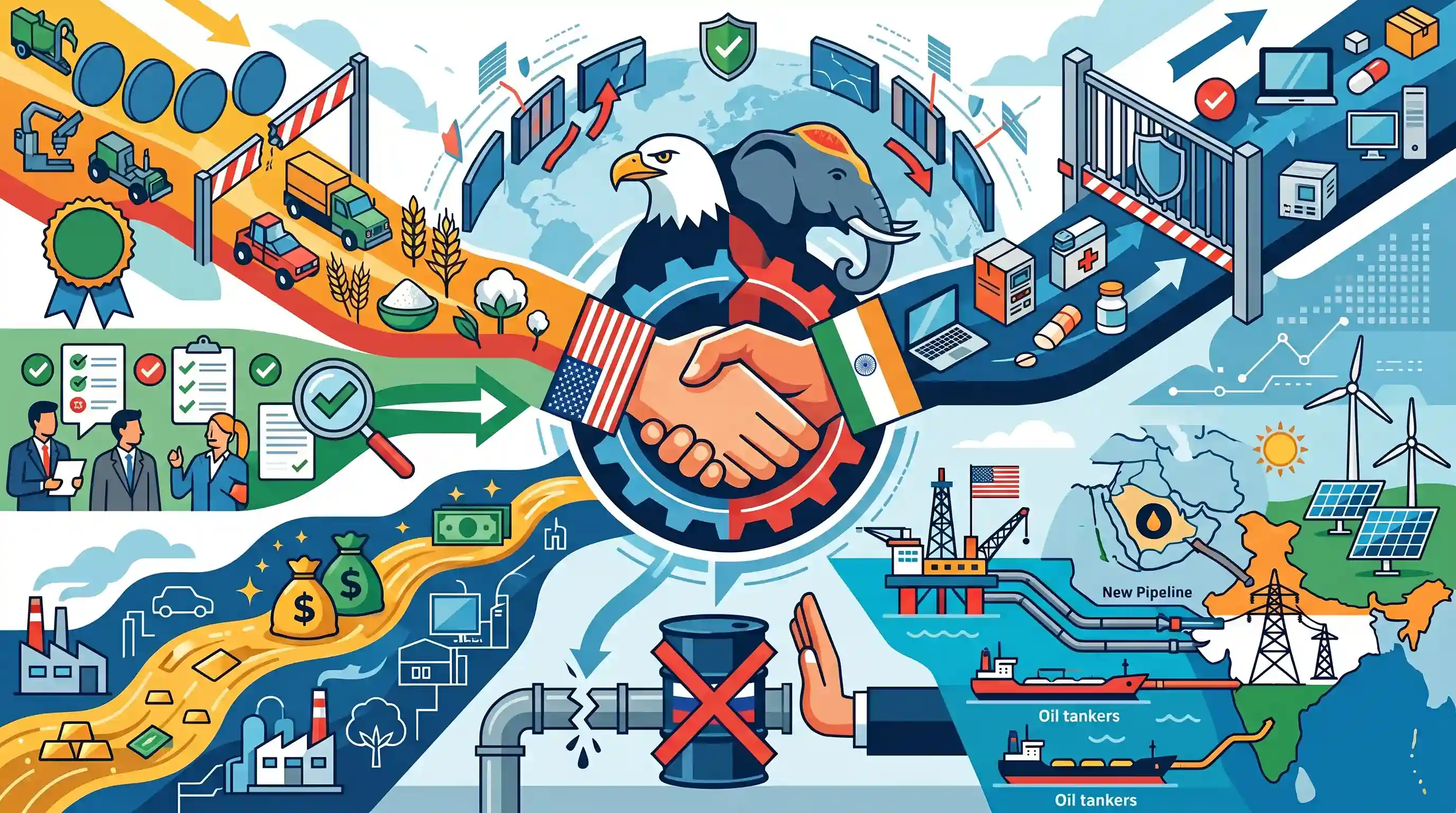
The United States and India have finalized a landmark bilateral trade deal, heavily pushed by President Trump and Prime Minister Modi. In this agreement, India will reduce tariffs to 0% on a vast array of US industrial and agricultural goods, while recognizing key US regulatory standards to ease non-tariff barriers. In exchange, the US has dropped its reciprocal tariff on Indian goods to 18%. Furthermore, the agreement encompasses major strategic concessions, including India's pledge to invest $500 billion in American products and its commitment to phase out imports of Russian oil, diversifying its energy footprint toward the US and other global markets.
Key Points
- India agreed to slash its tariffs to 0% on nearly 98-99% of American industrial and agricultural goods, including items like tree nuts, wine, and vegetables.
- The US will reduce its reciprocal tariffs imposed on Indian goods from 25% to 18%, keeping a baseline tariff due to the existing trade deficit.
- India has committed to investing $500 billion in American energy, technology, and agriculture, including a 'BUY AMERICAN' pledge.
- The pact includes an agreement to recognize certain US regulatory standards, aiming to mitigate non-tariff barriers to trade.
- Geopolitically, the deal cements India's move to phase out purchases of Russian oil, diversifying its energy imports toward the US, Venezuela, and Gulf nations.
Important Terms
India-US Bilateral Trade Agreement

A formal pact between India and the United States to reduce trade barriers; the 2026 landmark deal includes tariff reductions and India's $500 billion investment pledge in American goods.
UPSC context
GS Paper 2: Bilateral Agreements; GS Paper 3: Indian Economy (Trade). Tests understanding of economic diplomacy and strategic partnerships.
Critical Minerals
Metallic or non-metallic elements (e.g., Lithium, Cobalt) essential for modern technologies and national security, but highly vulnerable to supply chain disruptions due to geographical concentration.
UPSC context
GS Paper 3: Science and Technology; Resources. Tests knowledge of strategic resource management and clean energy transition.
Quad (Quadrilateral Security Dialogue)
An informal strategic forum comprising India, the US, Japan, and Australia, aimed at ensuring a "free, open, and inclusive" Indo-Pacific region through maritime and economic cooperation.
UPSC context
GS Paper 2: International Relations; Regional Groupings. Tests analysis of Indo-Pacific geopolitics and maritime security.
Non-Tariff Barriers (NTBs)
Trade restrictions—such as quotas, licensing, technical regulations, or sanitary standards—that limit imports without using direct taxes (tariffs).
UPSC context
GS Paper 3: Economic Development; International Trade. Tests understanding of protectionism and barriers to export competitiveness.
Energy Security
The uninterrupted availability of energy sources at an affordable price; for India, this involves diversifying energy imports and transitioning to sustainable domestic sources.
UPSC context
GS Paper 3: Infrastructure (Energy). Tests knowledge of India's import dependency, strategic petroleum reserves, and global energy diplomacy.
Reciprocal Tariffs
Import taxes imposed by a country in response to similar duties levied by a trading partner, often used as leverage in trade negotiations to ensure "fair" market access.
UPSC context
GS Paper 3: Indian Economy (Trade Policy). Tests understanding of trade wars, protectionism, and bilateral negotiation tactics.
Prelims Trap
Under the new pact, both India and the US have slashed reciprocal tariffs to zero percent.
The tariff reductions are highly asymmetric. While India slashed tariffs to 0% on most American goods, the US only reduced its reciprocal tariff on Indian goods to 18% due to trade deficits.
Static Concepts Connected
What are Non-Tariff Barriers (NTBs) in international trade?
- Definition: Trade restrictions that do not take the form of direct tariffs, such as import quotas, licensing requirements, and embargoes.
- SPS Measures: Rules ensuring food safety and animal/plant health (under WTO rules), frequently used by developed nations as de facto trade barriers.
- Mutual Recognition: Bilateral mechanisms where countries agree to accept each other's regulatory standards and testing procedures, substantially reducing NTB-related friction.
How does India manage its extreme crude oil import dependency?
- Import Vulnerability: India imports over 85% of its crude oil requirements, making its macro-economy highly vulnerable to global geopolitical shocks and price volatility.
- Supplier Diversification: Shifting reliance from a few Middle Eastern or Russian suppliers to a broader mix, including the US, Latin America, and African nations.
- Strategic Reserves: Maintaining underground rock caverns (Visakhapatnam, Mangaluru, Padur) under ISPRL to buffer against short-term global supply disruptions.
Cross-Topic Patterns
Energy security shaping foreign policy
India's commitment to phase out Russian oil for US alternatives shows how energy sourcing is now directly utilized as a bargaining chip for bilateral strategic and economic leverage.
Quad's shift to economic statecraft
Pairing this trade pact with critical mineral discussions shows the US-India axis and the Quad are expanding beyond Indo-Pacific maritime security into core supply chain resilience.

Expect a GS-2 Mains question analyzing the evolution of India's 'Strategic Autonomy' following its major energy concessions to the US.
Linked PYQs · 3
Linked PYQs · 3
- 2012MainsGS2
Discuss the likely negative impact of the protectionist measures proposed by the US on India's software industry.
- 2025MainsGS2
"Energy security constitutes the dominant kingpin of India's foreign policy, and is linked with India's overarching influence in Middle Eastern countries.” How would you integrate energy security with India's foreign policy trajectories in the coming years?
- 2025MainsGS3
What are the challenges before the Indian economy when the world is moving away from free trade and multilateralism to protectionism and bilateralism? How can these challenges be met?
