US Section 301 Tariffs and Bilateral Trade Negotiations
Source:Indian Express ↗
Why It Matters
The evolving US trade policy presents a significant challenge to India's economic stability and export competitiveness. The imposition of Section 301 tariffs could profoundly impact foreign investment flows, currency valuation, and the broader strategic partnership, making it crucial for UPSC aspirants to understand the intersection of geopolitics, trade law, and macroeconomic indicators.
Summary
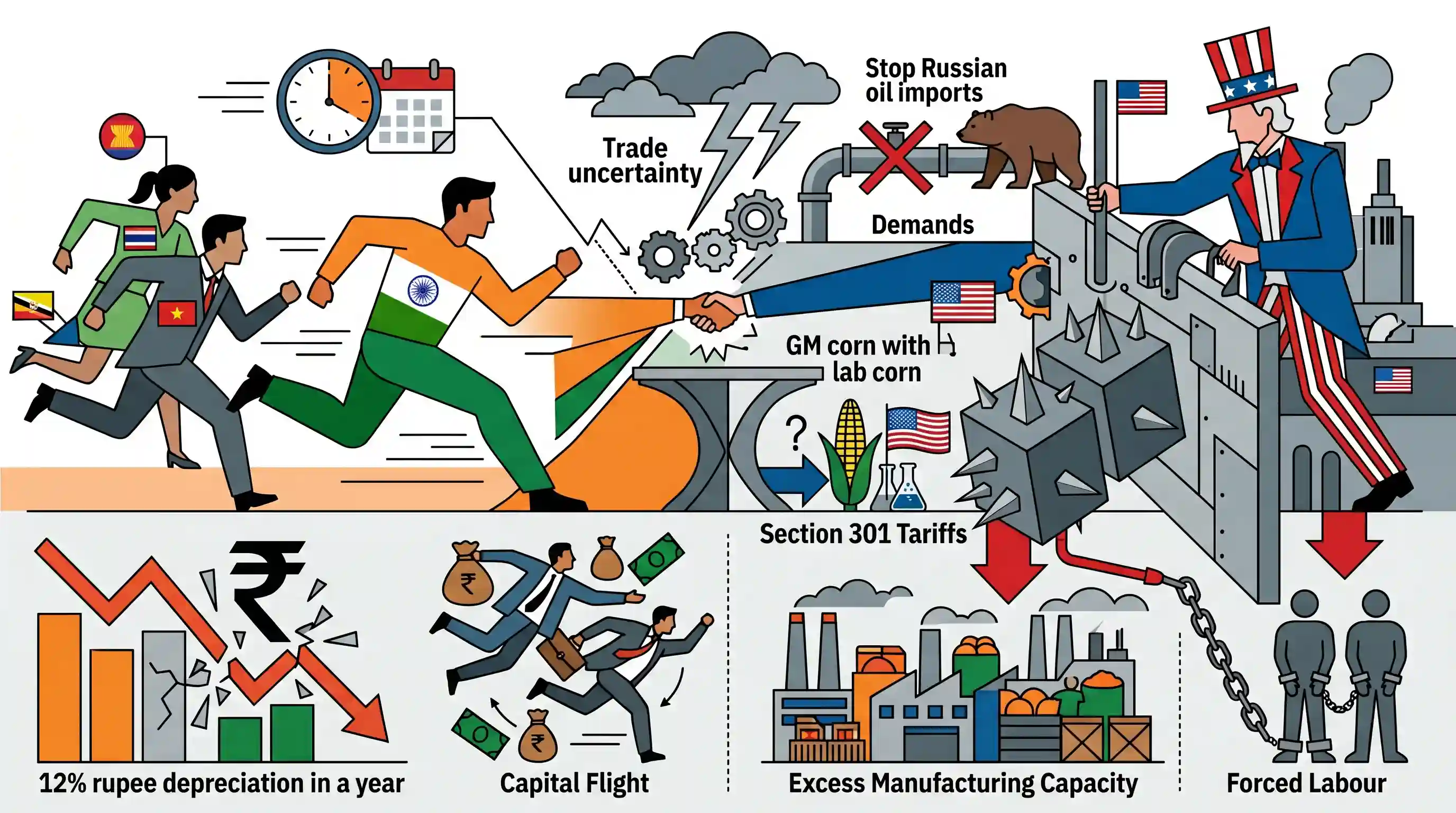
India is currently in the final stages of negotiating a bilateral trade agreement with the United States, aiming to secure preferential market access ahead of its Southeast Asian competitors. The urgency stems from the impending lapse of US global tariffs on July 24, which the US administration plans to replace with potent Section 301 tariffs. Unlike previous tariffs under the IEEPA, Section 301 grants the US executive branch significant authority to impose strict duties on goods and services, targeting issues like excess manufacturing capacity and forced labour in several countries, including India. Negotiations are fraught with difficult US demands, such as requiring India to phase out Russian oil imports and accept American GM crops. The ongoing trade uncertainty has negatively impacted India's economy, leading to foreign capital flight and a 12% depreciation of the rupee in the past year.
Key Points
- India is negotiating a bilateral trade agreement with the US to secure preferential market access over Southeast Asian competitors before current US tariffs lapse.
- The US is shifting its protectionist approach from IEEPA and Section 122 tariffs to the stricter Section 301, which gives the executive branch broad legal authority to impose tariffs without Congressional oversight.
- The US has initiated Section 301 investigations into India and other countries regarding excess manufacturing capacity and forced labour.
- As conditions for trade concessions, the US has demanded that India reduce its purchases of discounted Russian oil and permit the import of genetically-modified American agricultural products.
- The looming threat of US tariffs has already triggered capital flight from India, contributing to a nearly 12% depreciation of the Indian Rupee over the past year.
Important Terms
Section 301

A provision of the US Trade Act of 1974 authorizing the USTR to investigate and retaliate against foreign trade practices deemed unfair or violating international agreements.
UPSC context
GS II (International Relations) & GS III (Economy); tests knowledge of unilateral trade tools and their impact on Indian exports and global supply chains.
Section 122
A provision under the US Trade Act of 1974 allowing the US President to impose temporary (150-day) global import surcharges to address serious balance-of-payments deficits.
UPSC context
GS III (Economy); relevant for understanding macroeconomic trade safeguards and currency-related trade tensions between India and the US.
International Emergency Economic Powers Act (IEEPA)
A 1977 US law granting the President broad authority to regulate international commerce and freeze assets during a declared national emergency involving an external threat.
UPSC context
GS II; tests awareness of legal frameworks governing executive power in trade and the limits of emergency-based tariffs.
Trade Act of 1974
The primary US legislation establishing fast-track authority for trade agreements and mechanisms (Sections 122, 201, 301) to protect domestic industries from foreign competition.
UPSC context
GS II & III; the statutory foundation for most US trade actions affecting India's market access.
US-India Bilateral Trade Agreement (BTA)
An interim trade deal between New Delhi and Washington aimed at securing preferential market access and reducing tariffs on industrial and agricultural products.
UPSC context
GS II (Bilateral Groupings/Agreements); critical for India’s strategy in global supply chains and competition with ASEAN peers.
US Trade Representative (USTR)
The US executive agency responsible for developing and coordinating international trade policy and conducting negotiations with foreign governments.
UPSC context
GS II; the primary institution India engages with for trade dispute resolution and market access negotiations.
Prelims Trap
Section 301 tariffs are authorized by the WTO to counter unfair trade practices.
Section 301 is a unilateral US domestic law (Trade Act of 1974) that explicitly bypasses the multilateral WTO dispute settlement mechanism.
Static Concepts Connected
How does trade uncertainty trigger Rupee depreciation?
- Capital Flight: Tariff threats lower expected export earnings, prompting foreign portfolio investors (FPIs) to withdraw capital from Indian markets.
- Currency Dynamics: Exiting investors sell INR to buy USD, creating an oversupply of Rupees and driving down its exchange rate value.
- CAD Impact: A depreciating Rupee makes inelastic imports like crude oil costlier, widening the Current Account Deficit and compounding economic stress.
What are the WTO-sanctioned trade remedy measures?
- Anti-dumping Duty: Imposed on foreign goods that are exported at prices lower than their domestic normal value, injuring local industry.
- Countervailing Duty: Levied to neutralize the negative effects of specific subsidies provided by the exporting country's government.
- Safeguard Measures: Temporary tariffs or quotas applied to protect domestic industries from a sudden, unforeseen surge in imports.
Cross-Topic Patterns
Energy security vs. market access
US demands to phase out Russian oil in exchange for trade concessions directly pits India's economic diplomacy against its core principle of strategic autonomy.
GM crops as non-tariff leverage
Linking trade deals to the acceptance of American GM crops mirrors historical Indo-US frictions over agriculture, dairy, and intellectual property rights in FTA negotiations.

A 2026 Prelims question will likely contrast US unilateral Section 301 tariffs with multilateral WTO dispute settlement mechanisms.
Linked PYQs · 3
Linked PYQs · 3
- 2022PrelimsGS1
Consider the following statements: 1. Tight monetary policy of US Federal Reserve could lead to capital flight. 2. Capital flight may increase the interest cost of firms with existing External Commercial Borrowings (ECBs). 3. Devaluation of domestic currency decreases the currency risk associated with ECBs. Which of the statements given above are correct?
- 2021PrelimsGS1
Consider the following statements : The effect of devaluation of a currency is that it necessarily 1. improves the competitiveness of the domestic exports in the foreign markets 2. increases the foreign value of domestic currency 3. improves the trade balance Which of the above statements is/are correct?
- 2012MainsGS2
Discuss the likely negative impact of the protectionist measures proposed by the US on India's software industry.
