India and US reschedule trade talks amid tariff policy shifts
Source:The Hindu ↗
Why It Matters
Bilateral trade deals and the impact of major economies' protectionist policies (like U.S. tariffs) are critical for UPSC GS2 (International Relations) and GS3 (Economy), as they directly affect India's export competitiveness, economic growth, and strategic partnerships.
Summary
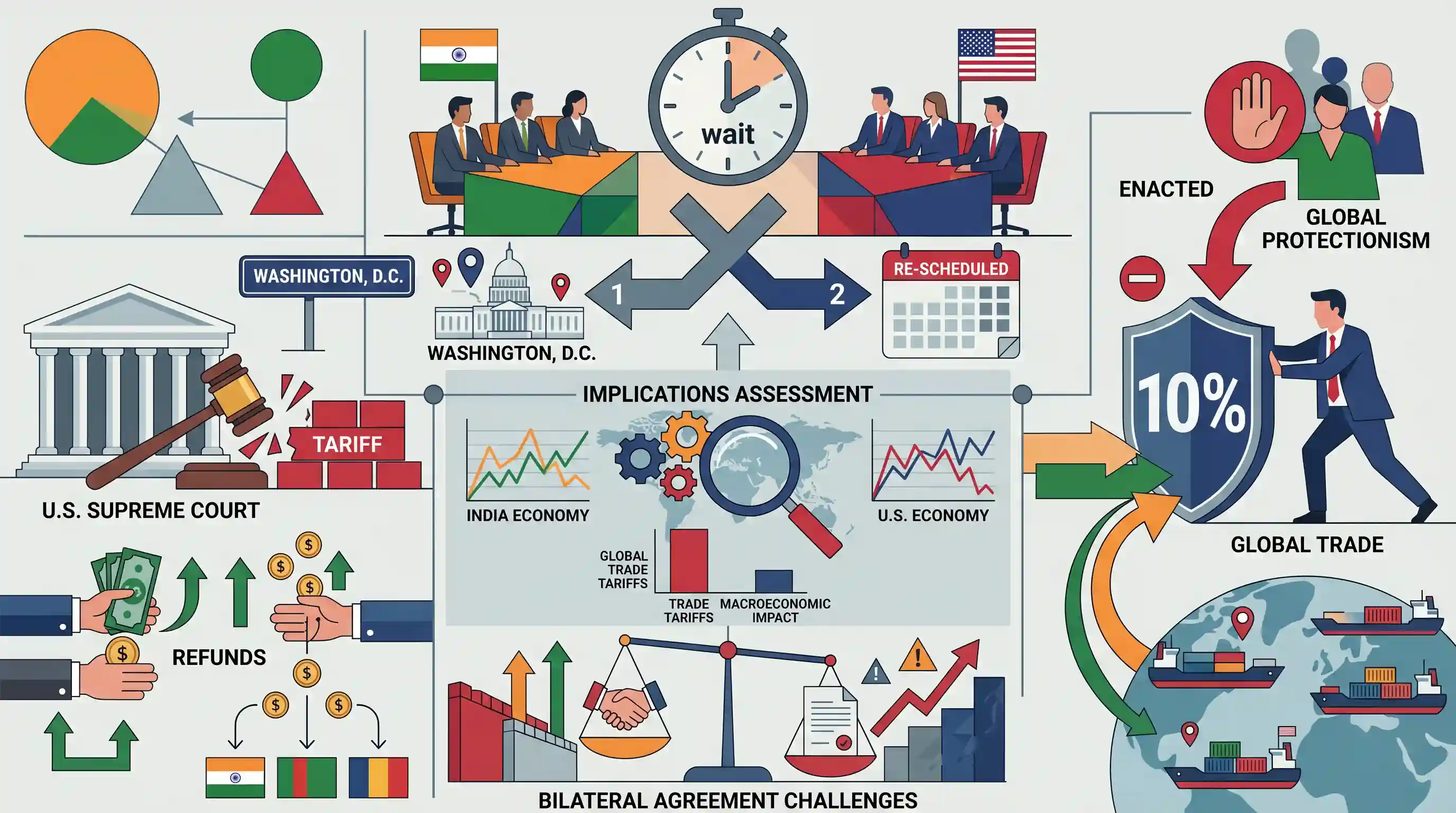
India and the United States have decided to reschedule a key meeting of their chief trade negotiators in Washington, initially set to finalize an interim bilateral trade pact. The postponement provides both nations time to assess the implications of recent major developments in U.S. trade policy. Notably, this follows a U.S. Supreme Court ruling striking down sweeping tariffs previously imposed by the Trump administration, even as new 10% tariffs on global imports (including from India) have recently been enacted. The delay underscores the complexities of navigating bilateral trade agreements amidst rising protectionism.
Key Points
- India and the U.S. have postponed their chief negotiators' meeting in Washington, which was aimed at finalizing an interim trade pact.
- The delay allows both sides to evaluate the implications of recent trade policy shifts, particularly following a U.S. Supreme Court ruling that invalidated sweeping tariffs from the Trump administration.
- Recent U.S. trade actions include the imposition of 10% tariffs on all countries, including India, for 150 days, highlighting ongoing global trade protectionism.
Important Terms
India-U.S. Interim Trade Pact

A preliminary, limited-scope agreement designed to reduce trade barriers and market access disputes in specific sectors before finalizing a comprehensive Bilateral Trade Agreement (BTA).
UPSC context
GS Paper II (International Relations) - Significant for analyzing the economic pillars of the India-US strategic partnership and trade diplomacy.
U.S. Supreme Court (SCOTUS)
The highest U.S. court; recently ruled (2026) that the President lacks inherent power to impose sweeping tariffs under emergency laws without specific Congressional authorization.
UPSC context
GS Paper II (Comparative Constitution) - Tests understanding of checks and balances and judicial review of executive power over commerce.
Section 122 (Trade Act of 1974)
A U.S. legal provision granting the President authority to impose temporary (up to 150 days) import surcharges to address serious balance-of-payments deficits.
UPSC context
GS Paper III (Economy) - Relevant for understanding non-tariff barriers and legal instruments of protectionism in global trade.
International Emergency Economic Powers Act (IEEPA)
A 1977 law allowing the U.S. President to regulate international commerce during national emergencies; its broad use for tariff imposition was curtailed by the 2026 SCOTUS ruling.
UPSC context
GS Paper II/III - Important for analyzing the intersection of national security laws and international trade policy.
Generalised System of Preferences (GSP)
A trade program where developed nations grant non-reciprocal, duty-free access to products from developing countries to promote economic growth; India’s status was revoked in 2019.
UPSC context
GS Paper II/III - Vital for discussing India's trade status and preferential market access in multilateral/bilateral forums.
Protectionism
Economic policy of restricting imports through tariffs or quotas to protect domestic industries from foreign competition, often characterized by "America First" or "Viksit Bharat" narratives.
UPSC context
GS Paper III (Economy) - Evaluates the impact of global trade shifts on India’s manufacturing and export competitiveness.
Prelims Trap
Interim trade pacts automatically bypass WTO's Most-Favored-Nation (MFN) rules without conditions.
Under GATT Article XXIV, interim pacts only bypass MFN if they include a clear plan and schedule to form a full FTA covering 'substantially all trade'.
Static Concepts Connected
What are Early Harvest Schemes (Interim Trade Agreements)?
- Definition: A precursor agreement where trading partners reduce tariffs on a limited set of goods before concluding a comprehensive Free Trade Agreement (FTA).
- WTO Compliance: Permitted under GATT Article XXIV if they serve as an interim step toward a full FTA covering "substantially all trade" within a reasonable timeframe.
- Strategic Utility: Used to build trust and immediate market access, bypassing the slow, complex negotiations of comprehensive deals (e.g., India-Australia ECTA began similarly).
What is the Generalized System of Preferences (GSP)?
- Mechanism: A non-reciprocal preferential tariff system that provides duty-free entry for specific products from developing nations to developed markets.
- WTO Exception: Operates as an exception to the WTO's MFN principle, authorized by an "Enabling Clause" negotiated under UNCTAD.
- India-US Context: The US revoked India's GSP status in 2019, eliminating zero-tariff benefits for over $5.5 billion in Indian exports, sparking current mini-deal negotiations.
Cross-Topic Patterns
Interim Pacts vs. IPEF Trade Pillar
While bilateral tariff pacts stall over protectionism, India and the US continue to engage through the Indo-Pacific Economic Framework (IPEF), though India notably opted out of its trade pillar.
Global Protectionism vs. Export Resilience
The 10% blanket US tariff directly tests the macroeconomic resilience of India's labor-intensive, export-driven sectors (like textiles and gems) against rising 'beggar-thy-neighbour' policies.

GATT Article XXIV rules on 'Early Harvest Schemes' and their MFN exceptions are highly likely to appear as a Prelims statement in 2026.
Linked PYQs · 3
Linked PYQs · 3
- 2025MainsGS3
What are the challenges before the Indian economy when the world is moving away from free trade and multilateralism to protectionism and bilateralism? How can these challenges be met?
- 2018MainsGS3
How would the recent phenomena of protectionism and currency manipulations in world trade affect macroeconomic stability of India?
- 2014MainsGS2
The aim of Information Technology Agreements (ITAs) is to lower all taxes and tariffs on information technology products by signatories to zero. What impact would such agreements have on India's interests?
