India-US Relations and Strategic Friction Over Unilateralism
Source:The Hindu ↗
Why It Matters
It addresses the core structural friction points in India-U.S. relations, particularly concerning unilateralism, strategic autonomy, and sovereignty, which are vital for understanding contemporary Indian foreign policy.
Summary
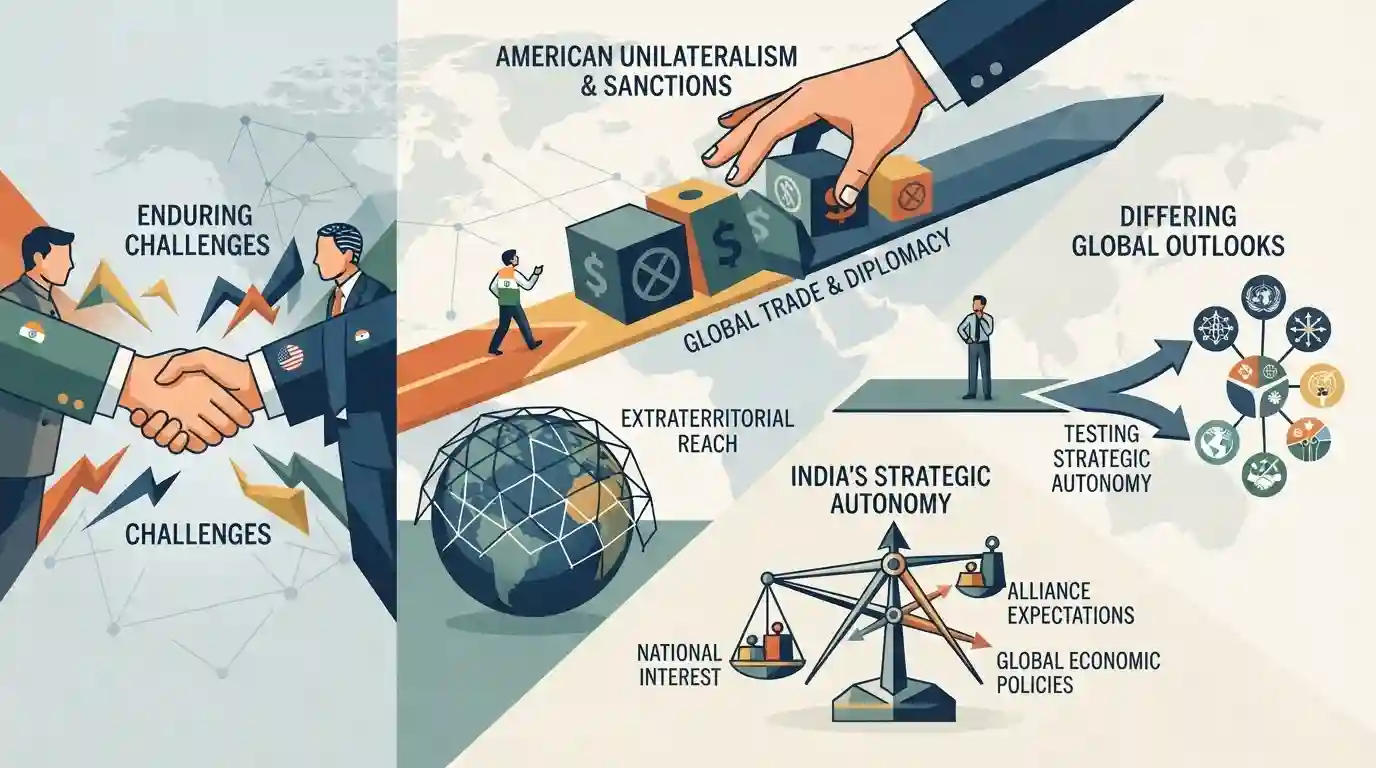
The article discusses the enduring challenges in India-U.S. relations, focusing on how American unilateralism, extraterritorial sanctions, and differing global outlooks create friction, testing India's policy of strategic autonomy.
Key Points
- American unilateralism and extraterritorial sanctions pose significant hurdles in India-U.S. strategic partnership.
- India's adherence to strategic autonomy and multi-alignment often clashes with Washington's global strategic expectations.
- Friction in bilateral ties stems from divergent approaches to international law, trade, and regional security architectures.
Important Terms
Strategic Autonomy

India’s foundational foreign policy principle of maintaining independent decision-making and sovereign external relations without entering into rigid military alliances, allowing it to engage with multiple global powers pragmatically.
UPSC context
Crucial for GS Paper II (International Relations - India and its neighborhood/major powers, bilateral agreements, non-alignment policy).
Extraterritorial Sanctions
Measures imposed by a single country targeting the economic or political activities of third-party nations and entities operating outside its own sovereign borders, frequently disrupting independent international commerce.
UPSC context
Important for GS Paper II (International Relations - Effects of policies of developed countries on India's interests and economic sovereignty).
American Unilateralism
A foreign policy approach where a powerful nation acts on the international stage based primarily on its own national interests, bypassing multilateral institutions and international consensus.
UPSC context
Relevant for GS Paper II (International Relations - Important International Institutions, Agencies and fora - their structure, mandate, and global governance).
Prelims Trap
A U.S. presidential waiver under CAATSA provides a permanent, unconditional exemption for all ongoing and future defense acquisitions from blacklisted nations.
Aspirants often assume CAATSA waivers exempt a country permanently from all secondary sanctions, whereas waivers are transactional, specific to individual deals, and subject to shifting geopolitical considerations.
Static Concepts Connected
What are the key implications of CAATSA and U.S. extraterritorial sanctions on India's strategic autonomy?
- CAATSA Legislation: Enacted in 2017, it targets countries engaging in significant transactions with Russia's defense and intelligence sectors.
- Extraterritorial Reach: Section 231 empowers the U.S. President to impose mandatory sanctions on third countries for major arms purchases from blacklisted nations.
- Waiver Provision: The U.S. President can grant waivers based on national security interests, which India sought during its S-400 missile system acquisition.
- Diplomatic Balancing: It forces India to carefully navigate its historical defense ties with Russia while deepening critical technology partnerships with the United States.
Cross-Topic Patterns
Defense Diversification vs. U.S. Sanctions Regime
India's defense diversification clashes with Washington's CAATSA, highlighting the tension between national security exemptions and global non-proliferation regimes.
Strategic Autonomy in Indo-Pacific Coalitions
Strategic autonomy forces India to balance traditional Eurasian partnerships with Indo-Pacific security architectures, testing the limits of multi-alignment.

CAATSA waivers, strategic autonomy, and extraterritorial sanctions are prime candidates for a multi-statement UPSC Prelims question.
Linked PYQs · 2
Linked PYQs · 2
- 2019MainsGS2
‘What introduces friction into the ties between India and the United States is that Washington is still unable to find for India a position in its global strategy, which would satisfy India's national self-esteem and ambitions.’ Explain with suitable examples.
- 2012MainsGS2
How have the US sanctions against Iran affected India's bilateral relations with Iran?
