India-US Tariff Dispute and Russian Oil Penalty Impact
Source:The Hindu ↗
Why It Matters
The article provides critical insights into India's current macroeconomic health from the perspective of the CEA. It highlights the intersection of geopolitics and economics (US tariffs due to Russian oil purchases) and outlines structural economic challenges, such as the impact of AI on job creation and the need for private sector R&D, which are highly relevant for GS-3 (Economy and S&T) and GS-2 (International Relations).
Summary
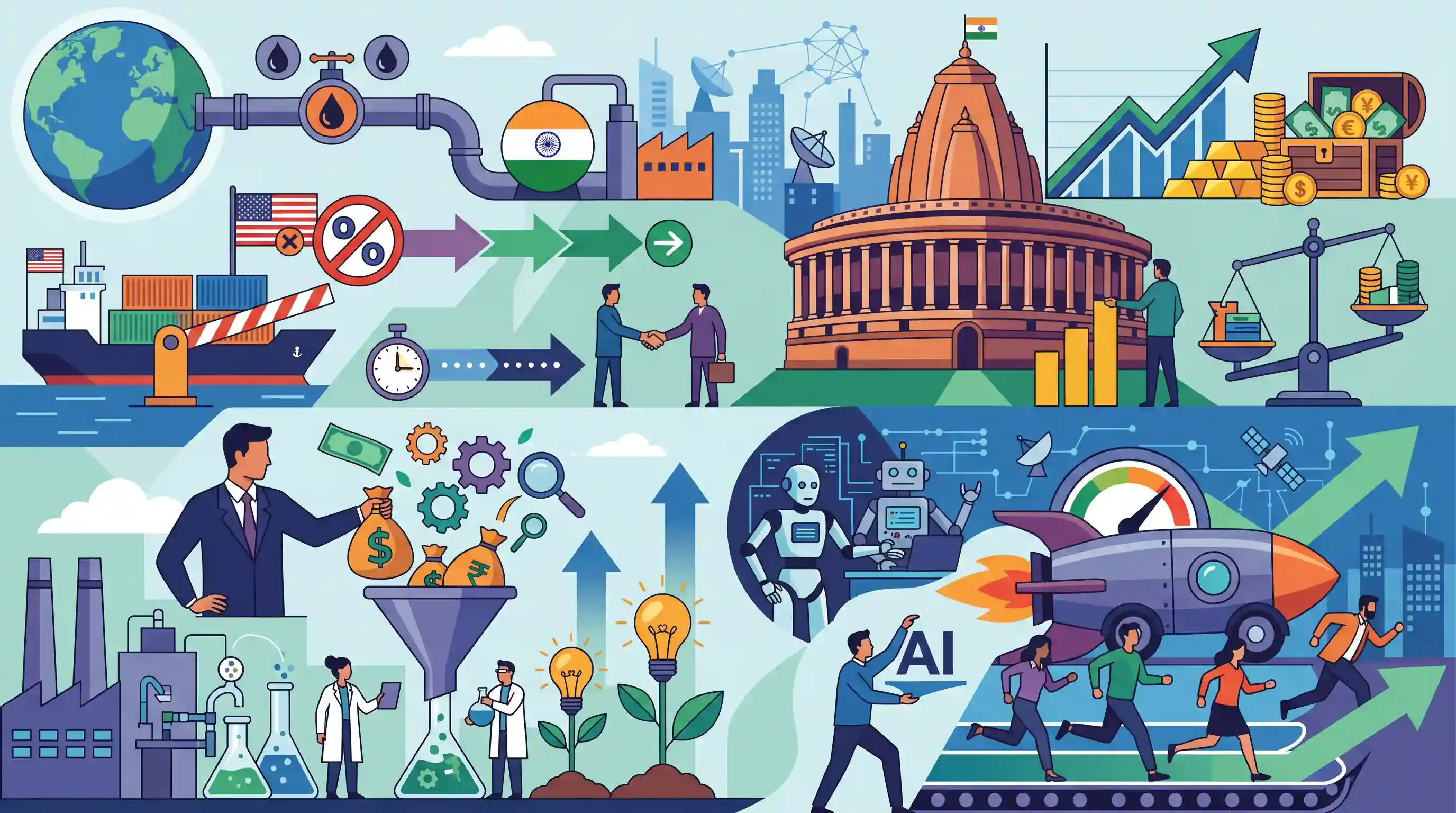
Chief Economic Adviser V. Anantha Nageswaran stated that trade friction with the US, stemming from a 25% tariff penalty on Indian products over the purchase of Russian oil, is expected to be resolved within 8-10 weeks. Despite global challenges, Nageswaran highlighted India's robust macroeconomic stability, citing a 7.8% GDP growth in Q1 2025-26, a manageable current account deficit, and strong forex reserves. He also pointed out the need for higher private sector investment in R&D and warned that India must maintain a 7% economic growth rate to offset the potential job losses caused by Artificial Intelligence.
Key Points
- The United States has imposed an additional 25% tariff on Indian products as a penalty for India's continued purchase of Russian oil, bringing total US levies on certain goods to 50%. India expects to resolve this issue in 8-10 weeks.
- India's macroeconomic fundamentals remain strong, with GDP growth of 7.8% in the first quarter of 2025-26, robust forex reserves, falling core inflation, and a very low current account deficit of 0.2%.
- The Chief Economic Adviser stressed the importance of maintaining a steady general government debt-to-GDP ratio, currently around 83%, to ensure international confidence.
- Private sector investment in Research and Development (R&D) needs to increase, as most current R&D funding comes from the government.
- To counteract the negative impact of Artificial Intelligence (AI) on employment, India needs to sustain an economic growth rate of at least 7%.
Important Terms
Chief Economic Adviser (CEA)

A senior official in the Ministry of Finance who acts as the primary economic advisor to the Government of India and traditionally authors the annual Economic Survey.
UPSC context
GS-3: Indian Economy; tests understanding of institutional roles in policy-making and the significance of the Economic Survey.
Gross Domestic Product (GDP)
The total value of goods and services produced within a country's borders in a specific period; India recorded 7.8% growth in Q1 2025-26.
UPSC context
GS-3: Growth and Development; essential for analyzing economic health, fiscal targets, and international growth comparisons.
Current Account Deficit (CAD)
A measurement of a country's trade where the value of the goods and services it imports exceeds the value of the products it exports.
UPSC context
GS-3: External Sector; tests knowledge of Balance of Payments (BoP) and currency stability.
Forex Reserves
Assets held by a central bank in foreign currencies, used to back liabilities, influence monetary policy, and act as a buffer against external shocks.
UPSC context
GS-3: External Sector; tests understanding of macroeconomic stability and the Reserve Bank of India's (RBI) intervention capacity.
Private Sector R&D
Activities undertaken by companies to innovate and introduce new products; currently, India's private sector contributes less than 40% of national R&D expenditure.
UPSC context
GS-3: Science and Technology; identifies structural weaknesses in India's innovation ecosystem and 'Viksit Bharat' goals.
AI-driven Job Displacement
The phenomenon where automation replaces human labor; the CEA suggests 7-8% growth is needed to absorb potential AI-driven job losses in India.
UPSC context
GS-3: Employment and Technology; tests the ability to analyze the socio-economic impacts of disruptive technology on a developing economy.
Bilateral Trade Tariffs
Taxes on imported goods often used as a tool in trade disputes; India faces a 25% penal tariff from the US over Russian oil imports.
UPSC context
GS-2: International Relations/Trade; examines India's diplomatic and economic maneuvering during global geopolitical shifts.
Prelims Trap
India's general government debt-to-GDP currently meets the 60% FRBM limit due to strong macroeconomic fundamentals.
Despite low CAD and strong GDP growth, India's general government debt is ~83%, well above the N.K. Singh Committee's recommended 60% ceiling.
Static Concepts Connected
What are the debt-to-GDP targets proposed by the N.K. Singh FRBM Committee?
- Overall Target: Recommended a combined 60% debt-to-GDP ratio for the general government.
- Target Breakdown: 40% limit for the Central government and 20% limit for State governments combined.
- Current Reality: General government debt hovers around 83%, requiring stabilization to maintain global investor confidence.
How does India's Gross Expenditure on R&D (GERD) funding structure compare globally?
- Publicly Driven: The government funds over 60% of India's R&D, unlike developed economies where the private sector dominates.
- Private Sector Lag: Contributes only about 36.4% to GERD, a structural weakness highlighted by the Chief Economic Adviser.
- Overall Spending: Remains stagnant at roughly 0.65% to 0.7% of GDP, significantly lower than the global average.
Cross-Topic Patterns
AI automation vs Demographic Dividend
AI-induced displacement of formal IT/BPO jobs challenges India's demographic dividend window, requiring an urgent sustained 7% GDP growth to create compensatory employment.
Strategic Autonomy & Trade Sanctions
The US imposing a 25% tariff penalty explicitly links India's geopolitical neutrality (purchasing discounted Russian oil) to bilateral trade barriers and economic headwinds.

Expect a 2026 multi-statement prelims question contrasting India's strong CAD/Forex with its high (~83%) debt-to-GDP against FRBM targets.
Linked PYQs · 5
Linked PYQs · 5
- 2012MainsGS2
How have the US sanctions against Iran affected India's bilateral relations with Iran?
- 2025MainsGS2
"Energy security constitutes the dominant kingpin of India's foreign policy, and is linked with India's overarching influence in Middle Eastern countries.” How would you integrate energy security with India's foreign policy trajectories in the coming years?
- 2022MainsGS3
Economic growth in the recent past has been led by increase in labour productivity." Explain this statement. Suggest the growth pattern that will lead to creation of more jobs without compromising labour productivity.
- 2020MainsGS3
Define potential GDP and explain its determinants. What are the factors that have been inhibiting India from realizing its potential GDP?
- 2019MainsGS3
Do you agree with the view that steady GDP growth and low inflation have left the Indian economy in good shape? Give reasons in support of your arguments.
