India US Talks on Energy and Defense Strategic Cooperation
Source:The Hindu ↗
Why It Matters
Crucial for understanding the trajectory of India-U.S. strategic, defense, and economic relations, particularly regarding trade negotiations and defense procurement diversification.
Summary
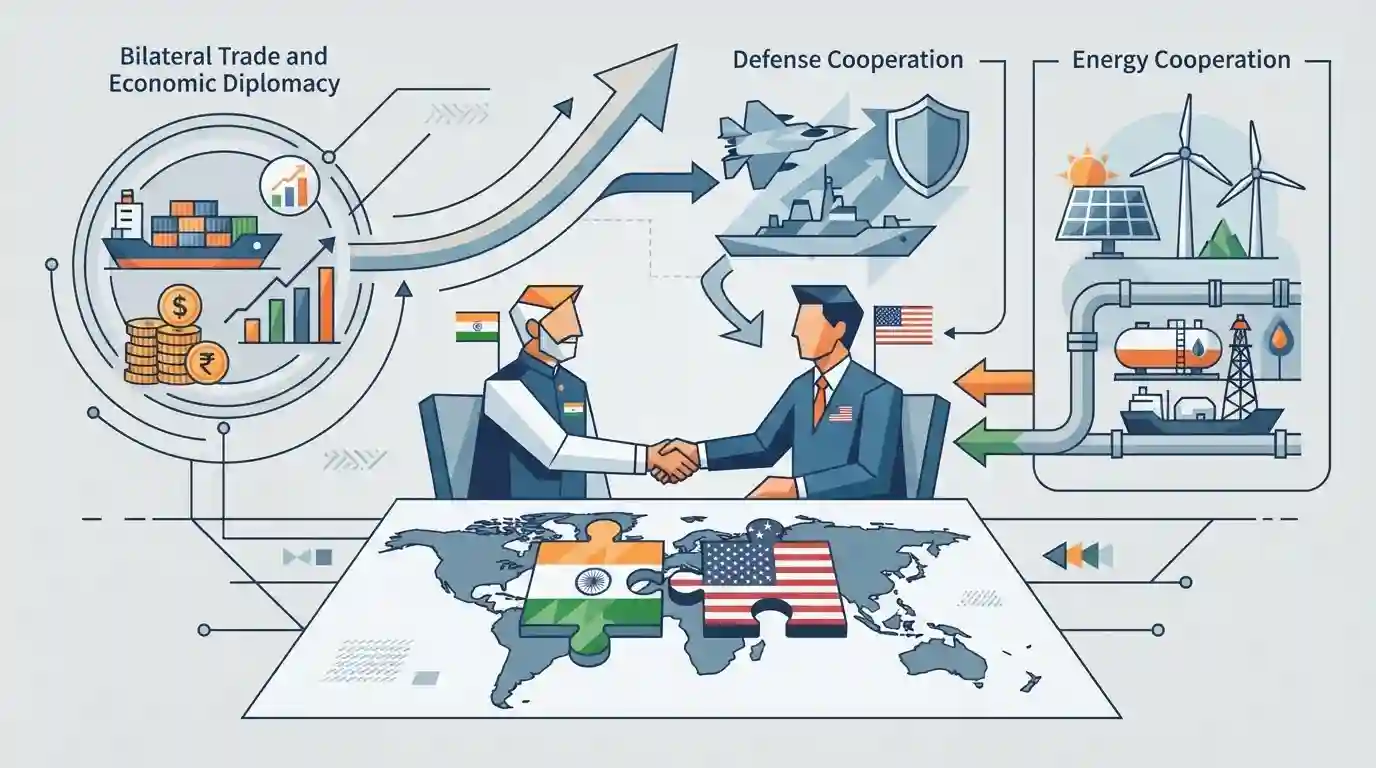
Discussions between India and the U.S. highlighted progress toward a bilateral trade deal, with calls for increased procurement of U.S. energy and defense goods to bolster strategic ties.
Key Points
- U.S. official Marco Rubio stated that a bilateral trade deal between India and the U.S. is close to finalization.
- New Delhi has been urged to boost purchases of U.S. energy and defense equipment.
- Talks focused heavily on deepening strategic, energy, and defense cooperation between the two democracies.
Important Terms
Bilateral Trade Agreement

A comprehensive pact currently under negotiation between India and the United States to enhance bilateral commerce, reduce tariff and non-tariff barriers, and bolster strategic economic ties.
UPSC context
GS Paper II (International Relations - India-U.S. relations) and GS Paper III (Indian Economy - Foreign Trade). Tests understanding of strategic trade pacts.
Defense Cooperation
Strategic collaboration between India and the U.S. involving joint military exercises, technology sharing, and defense procurement aimed at enhancing interoperability and regional security in the Indo-Pacific.
UPSC context
GS Paper II (Bilateral Relations, Security and Defense ties). Tests knowledge of India's multi-alignment and strategic partnerships.
Energy Cooperation
Cooperation in energy security, including crude oil imports, liquefied natural gas (LNG), and civil nuclear energy, aimed at diversifying supply chains and meeting rising domestic demand.
UPSC context
GS Paper II (International Relations) and GS Paper III (Energy Security). Tests how India balances bilateral trade and resource security.
Prelims Trap
Foundational military agreements imply a formal military alliance or mutual defense treaty between India and the United States.
Aspirants often assume foundational military pacts like LEMOA or BECA are formal military alliances (akin to NATO), whereas they are logistics and communications enablers that do not compromise India's strategic autonomy.
Static Concepts Connected
What are the four foundational defense cooperation agreements signed between India and the United States?
- GSIA (2002):: GSIA signed in 2002 to facilitate reciprocal sharing of classified military information between the two nations.
- LEMOA (2016):: LEMOA signed in 2016 providing reciprocal access to military logistics, supplies, and services (refueling, docking).
- COMCASA (2018):: COMCASA signed in 2018 permitting interoperability of U.S.-origin and Indian military communication equipment.
- BECA (2020):: BECA signed in 2020 enabling sharing of geospatial maps and high-end military aeronautical data.
Cross-Topic Patterns
Defence Trade vs. Indigenous Co-development
India's defence procurement shift from a buyer-seller model to co-development mirrors parallel indigenization mandates under Aatmanirbhar Bharat and iCET initiatives.
Energy Security and Indo-Pacific Geopolitics
Energy diversification toward U.S. LNG intersects with broader Indo-Pacific maritime security and strategic petroleum reserve management.

Foundational agreements (LEMOA, COMCASA, BECA) and their operational scope are perennial favorites for Prelims matching sets.
Linked PYQs · 2
Linked PYQs · 2
- 2020MainsGS2
What is the significance of Indo-US defence deals over Indo-Russian defence deals? Discuss with reference to stability in the Indo-Pacific region.
- 2019MainsGS2
‘What introduces friction into the ties between India and the United States is that Washington is still unable to find for India a position in its global strategy, which would satisfy India's national self-esteem and ambitions.’ Explain with suitable examples.
