India and US sign critical minerals pact to secure supply chains
Source:The Hindu ↗
Why It Matters
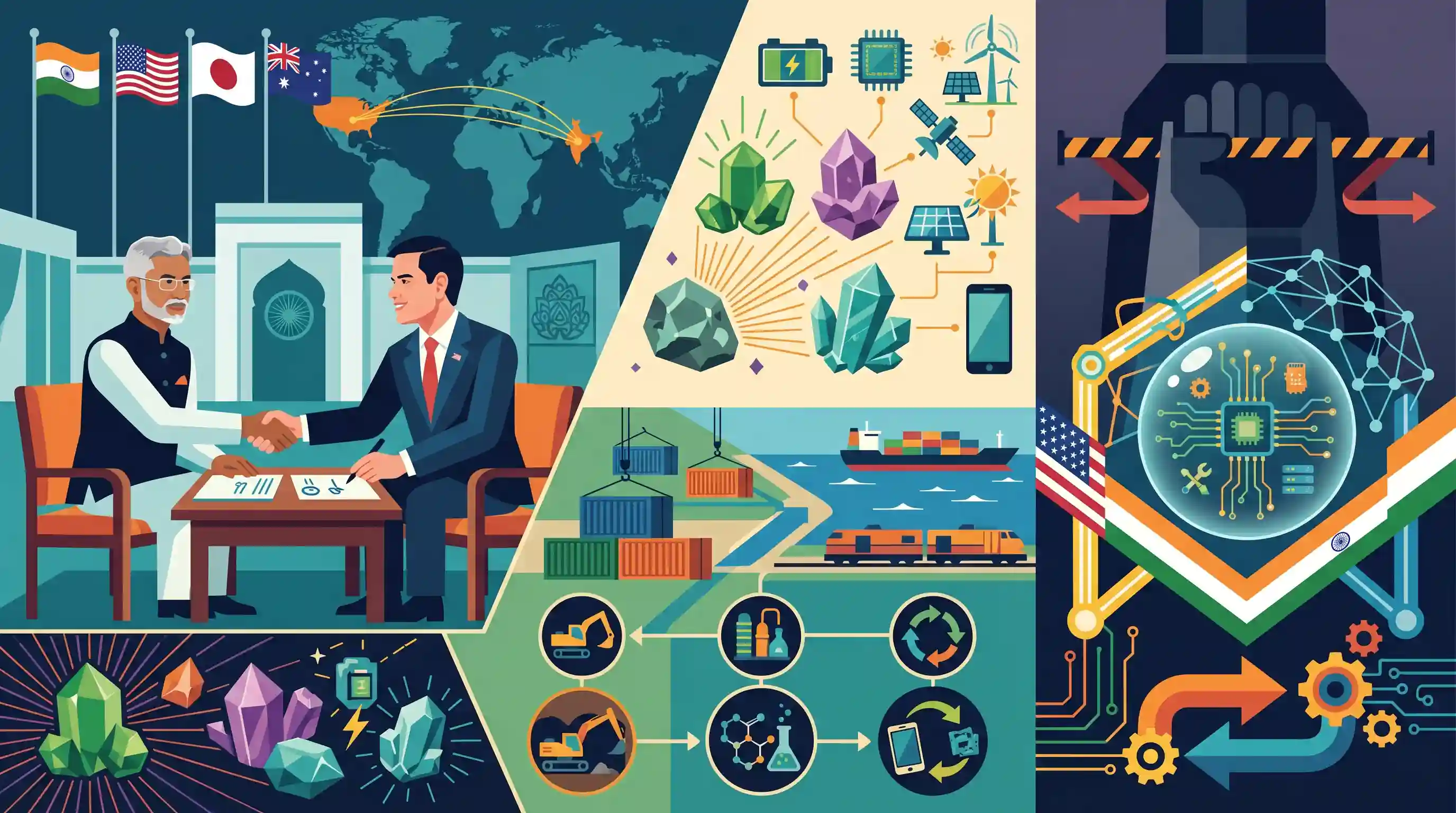
Critical minerals and rare earth elements are indispensable for advanced technologies, clean energy transitions, and national defense. China's near-monopoly on processing and exporting these materials creates severe geoeconomic vulnerabilities. Strategic agreements like the India-US framework and initiatives like Pax Silica are crucial steps for diversifying global supply chains and securing technological sovereignty for Quad nations and their partners.
Summary
India and the U.S. have formalized a critical minerals framework agreement during the Quad Foreign Ministers' meeting in New Delhi to secure reliable supply chains for critical minerals and rare earth elements. Signed in the presence of India's S. Jaishankar and U.S. Secretary of State Marco Rubio, the pact aims to enhance cooperation across mining, processing, and recycling. This strategic move addresses growing concerns over China's export controls and dominance in rare earth elements. The framework builds on the momentum of the U.S.-backed Pax Silica initiative, reinforcing the strategic partnership between India and the U.S. to protect their innovation economies from supply vulnerabilities.
Key Points
- India and the U.S. signed a framework agreement on the sidelines of the Quad Foreign Ministers' meeting in New Delhi to secure critical mineral supply chains.
- The agreement encompasses cooperation in the mining, processing, recycling, and investment related to critical minerals and rare earth elements.
- The deal is a strategic move to reduce vulnerability to single-source monopolies, notably China, which exercises significant control over the export of rare earths.
- This development builds upon the U.S.-backed Pax Silica initiative, which India recently joined to build a resilient supply chain for critical minerals and artificial intelligence.
Important Terms
Pax Silica initiative

A US-led strategic initiative aimed at securing global technology supply chains, specifically for semiconductors, artificial intelligence, and critical minerals, by building a trusted network of allies to reduce reliance on China.
UPSC context
GS Paper II (International Relations). Tests knowledge of technology-led diplomacy and strategic supply chain alliances.
Critical Minerals framework
A 2026 bilateral pact between India and the US to enhance cooperation in mining, processing, and recycling critical minerals, ensuring secure and diversified supply chains for innovation-driven industries.
UPSC context
GS Paper II & III. Concerns bilateral relations and energy security/industrial policy.
Quad (Quadrilateral Security Dialogue)
An informal strategic forum comprising India, the US, Japan, and Australia, committed to a free, open, and inclusive Indo-Pacific through cooperation in security, technology, and economic resilience.
UPSC context
GS Paper II. Key for understanding Indo-Pacific geopolitics and multilateral groupings.
Rare Earth Elements (REEs)
A group of 17 chemical elements essential for high-tech electronics, green energy, and defense systems. China currently dominates their global production and processing, creating strategic vulnerabilities.
UPSC context
GS Paper I (Geography) & III (Science/Security). Tests understanding of resource distribution and its geopolitical impact.
Supply Chain Resilience
The capacity of a global supply chain to withstand or recover quickly from disruptions, achieved by diversifying sources and reducing dependence on single-country monopolies.
UPSC context
GS Paper III (Economy). Relevant for industrial growth and economic security topics.
FORGE (Forum on Resource Geostrategic Engagement)
A US-led diplomatic initiative launched in 2026 to engage partners in securing critical mineral resources and protecting supply chains from coercive market practices.
UPSC context
GS Paper II. Tests knowledge of emerging US-led resource diplomacy frameworks.
Prelims Trap
China holds a global monopoly on rare earth element reserves, making it the sole source for critical minerals.
China dominates the processing and refining of rare earths (around 60-70%), not the natural reserves. Nations like India, Australia, and the US have significant unexploited domestic reserves.
Static Concepts Connected
What are Rare Earth Elements (REEs) and India's reserves?
- Definition: 17 elements (15 lanthanides, scandium, yttrium) that are foundational for AI hardware, defense equipment, and green energy technologies.
- India's Reserves: Found abundantly as monazite sands in the coastal placer deposits of Kerala, Tamil Nadu, and Odisha.
- Processing Deficit: Despite vast reserves, India lacks advanced metallurgical and processing capabilities, leading to reliance on imports for finished REE products.
What is the Minerals Security Partnership (MSP)?
- Formation: A US-led critical minerals alliance launched in 2022, currently involving 14 partner nations and the European Union.
- Objective: To catalyze public and private investment in responsible, resilient critical mineral supply chains globally.
- India's Status: India joined the MSP in 2023, formally integrating itself into the broader 'China-plus-one' critical minerals strategy.
Cross-Topic Patterns
Clean Energy & Mineral Geopolitics
The shift from fossil fuels to renewables (EVs, solar) shifts geopolitical power from petro-states to mineral-processing nations, making supply chain agreements essential for India's Panchamrit climate targets.
Pax Silica & AI Nationalism
Mineral security directly dictates semiconductor and AI supply chains. Securing critical minerals is a prerequisite for India’s AI Mission and reducing import reliance on Chinese and Taiwanese hardware.

Critical minerals (REEs, Lithium) mapped against multilateral groupings like MSP or Pax Silica will likely form a multi-statement 2026 Q.
Linked PYQs · 4
Linked PYQs · 4
- 2012PrelimsGS1
Recently, there has been a concern over the short supply of a group of elements called 'rare earth metals'. Why? 1. China, which is the largest producer of these elements, has imposed some restrictions on their export. 2. Other than China, Australia, Canada and Chile, these elements are not found in any country. 3. Rare earth metals are essential for the manufacture of various kinds of electronic items and there is a growing demand for these elements. Which of the statements given above is/are correct?
- 2025PrelimsGS1
Consider the following statements : Statement I: Some rare earth elements are used in the manufacture of flat television screens and computer monitors. Statement II : Some rare earth elements have phosphorescent properties. Which one of the following is correct in respect of the above statements?
- 2020MainsGS2
What is the significance of Indo-US defence deals over Indo-Russian defence deals? Discuss with reference to stability in the Indo-Pacific region.
- 2021MainsGS2
The newly tri-nation partnership AUKUS is aimed at countering China's ambitions in the Indo-Pacific region. Is it going to supersede the existing partnerships in the region? Discuss the strength and impact of AUKUS in the present scenario.
