India US Sign Ten Year Defence Partnership Framework Agreement
Source:Indian Express ↗
Why It Matters
The 10-year defence framework is a major milestone in India-US strategic ties. For UPSC aspirants, it is essential to understand how India navigates complex bilateral relations—balancing critical defence and security requirements (especially concerning the Indo-Pacific) while managing economic and trade frictions.
Summary
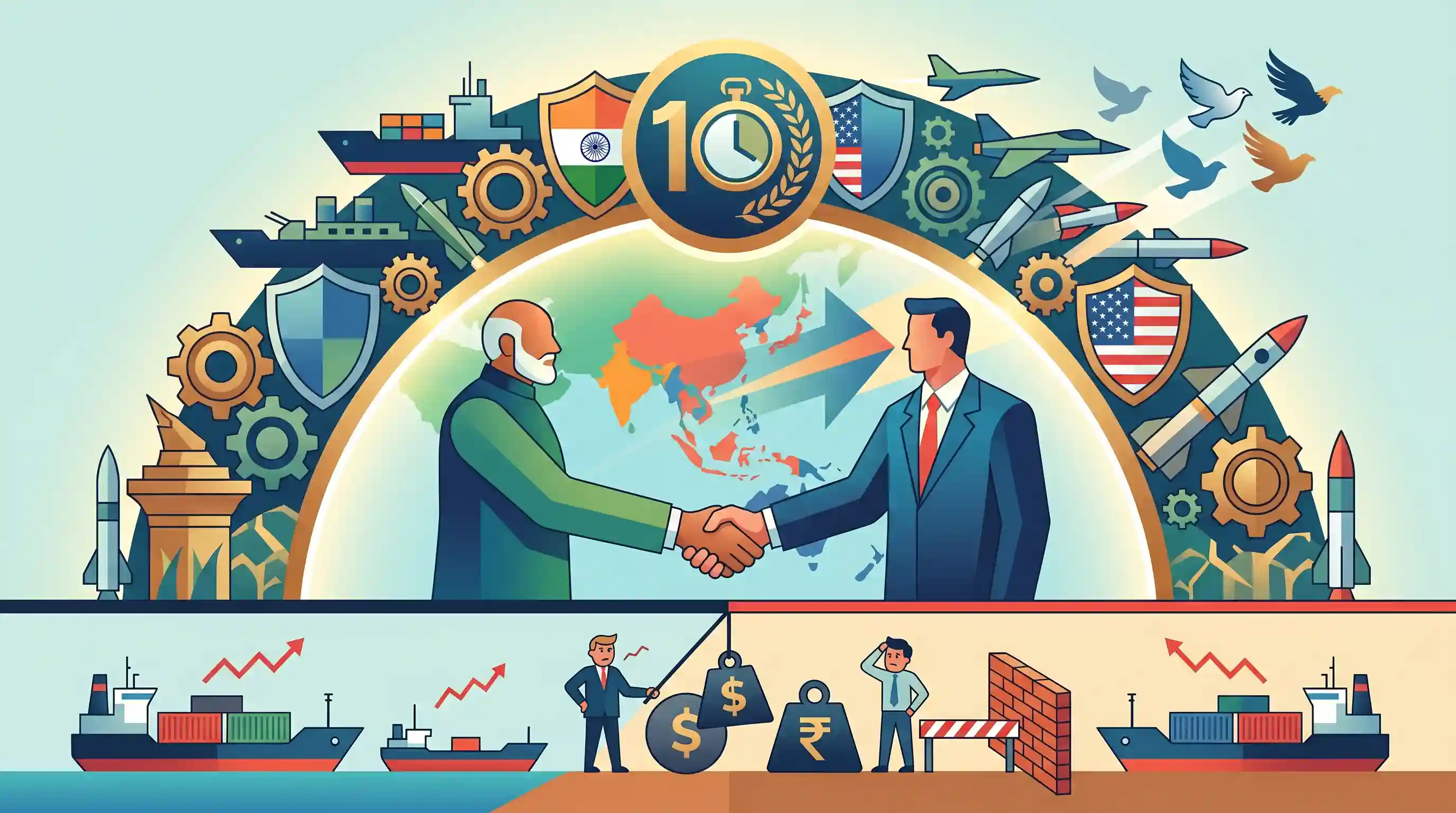
India and the United States have signed a new 10-year defence partnership framework to enhance bilateral military cooperation, interoperability, and strategic coordination. The agreement highlights the deepening strategic convergence between New Delhi and Washington, driven by shared security interests in the Indo-Pacific region. Significantly, this long-term defence alignment has been achieved despite ongoing bilateral friction over trade tariffs and protectionist measures, underscoring the resilience and compartmentalization of the modern India-US strategic partnership.
Key Points
- India and the US signed a new 10-year defence partnership framework to deepen bilateral military cooperation and strategic alignment.
- The framework aims to enhance interoperability, defence technology sharing, and joint security initiatives over the next decade.
- This agreement underscores a strong strategic convergence, largely driven by shared interests in maintaining stability in the Indo-Pacific region.
- Significantly, the long-term defence pact has been sealed despite ongoing bilateral friction over trade tariffs and protectionist measures.
- The development highlights the maturity of India-US relations, where core strategic and defence interests are successfully compartmentalized from economic disputes.
Important Terms
10-Year Defence Partnership Framework

A comprehensive roadmap for India-US defense ties focusing on technology co-production, joint research, and interoperability across land, sea, air, space, and cyber domains.
UPSC context
GS II (International Relations); critical for discussing institutionalized bilateral security ties and India's transition from buyer to co-producer.
Strategic Convergence
The overlap of national security and geopolitical interests, allowing countries to collaborate on defense despite frictions in other areas like trade or tariffs.
UPSC context
GS II; tests understanding of "compartmentalization" in diplomacy and India’s "Strategic Autonomy" in a multi-polar world.
Major Defence Partner (MDP)
A unique US status for India that facilitates technology sharing and defense trade at levels comparable to America's closest treaty allies.
UPSC context
GS II/III; vital for questions on defense indigenization and high-tech access without a formal military alliance.
iCET (Initiative on Critical and Emerging Technology)
A bilateral framework led by National Security Councils to enhance cooperation in AI, semiconductors, space, and 5G/6G to reduce supply chain dependencies.
UPSC context
GS II/III; relevant for Science & Tech and IR topics concerning technology-led diplomacy and secure supply chains.
INDUS-X
An innovation bridge connecting Indian and American defense start-ups and academia to co-develop and co-produce advanced military hardware.
UPSC context
GS III (Security); important for "Aatmanirbhar Bharat" and modernizing the military through private sector and startup participation.
Interoperability
The capability of different military forces to work together seamlessly during joint exercises or missions through shared platforms, signals, and logistics.
UPSC context
GS III; key for maritime security questions and the operational significance of the Quad.
Prelims Trap
The framework establishes a mutual defence treaty obligating the US to defend India in conflict.
India is a 'Major Defense Partner' but maintains strategic autonomy. It is not a formal treaty ally of the US, meaning there are no mutual defense obligations like NATO.
Static Concepts Connected
What are the four foundational defence agreements between India and the US?
- GSOMIA: Signed in 2002, this agreement protects shared military intelligence and classified information between the two countries.
- LEMOA: Signed in 2016, it enables both militaries to access each other's facilities for logistics support, refueling, and berthing.
- COMCASA: Signed in 2018, it allows the US to transfer advanced, secure communication equipment to the Indian military.
- BECA: Signed in 2020, it facilitates the sharing of advanced satellite and topographical data for precise navigation and targeting.
How does India's 'Strategic Autonomy' differ from a formal military alliance?
- No treaty obligations: Unlike NATO allies, India does not commit to mutual defence pacts obligating it to enter a war on behalf of a partner.
- Multi-alignment: India partners with multiple global powers simultaneously (e.g., US, Russia, France) based on issue-specific convergences rather than bloc politics.
- Issue-based cooperation: Defence ties focus on shared goals (like Indo-Pacific stability) while retaining independent decision-making on global issues like the Ukraine conflict.
Cross-Topic Patterns
Defence-trade compartmentalization
India-US relations show maturity by firewalling strategic partnerships (like INDUS-X and this 10-year pact) from economic frictions such as US protectionist tariffs, H1-B visa restrictions, and WTO disputes.
Bilateral pacts anchoring the Quad
Strong bilateral India-US defence interoperability (LEMOA, BECA) serves as the operational backbone for broader plurilateral groupings like the Quad and the Indo-Pacific Maritime Domain Awareness (IPMDA) initiative.

Expect a 2026 GS2 mains question evaluating how India-US strategic compartmentalization balances Indo-Pacific ties against trade tariffs.
Linked PYQs · 3
Linked PYQs · 3
- 2020MainsGS2
What is the significance of Indo-US defence deals over Indo-Russian defence deals? Discuss with reference to stability in the Indo-Pacific region.
- 2019MainsGS2
‘What introduces friction into the ties between India and the United States is that Washington is still unable to find for India a position in its global strategy, which would satisfy India's national self-esteem and ambitions.’ Explain with suitable examples.
- 2012MainsGS2
Discuss the likely negative impact of the protectionist measures proposed by the US on India's software industry.
