India US Defence Framework Agreement Strategic Cooperation
Source:Indian Express ↗
Why It Matters
This framework agreement is central to understanding the evolution of India-US strategic and defence relations, technology transfer initiatives (like iCET), and security cooperation in the Indo-Pacific.
Summary
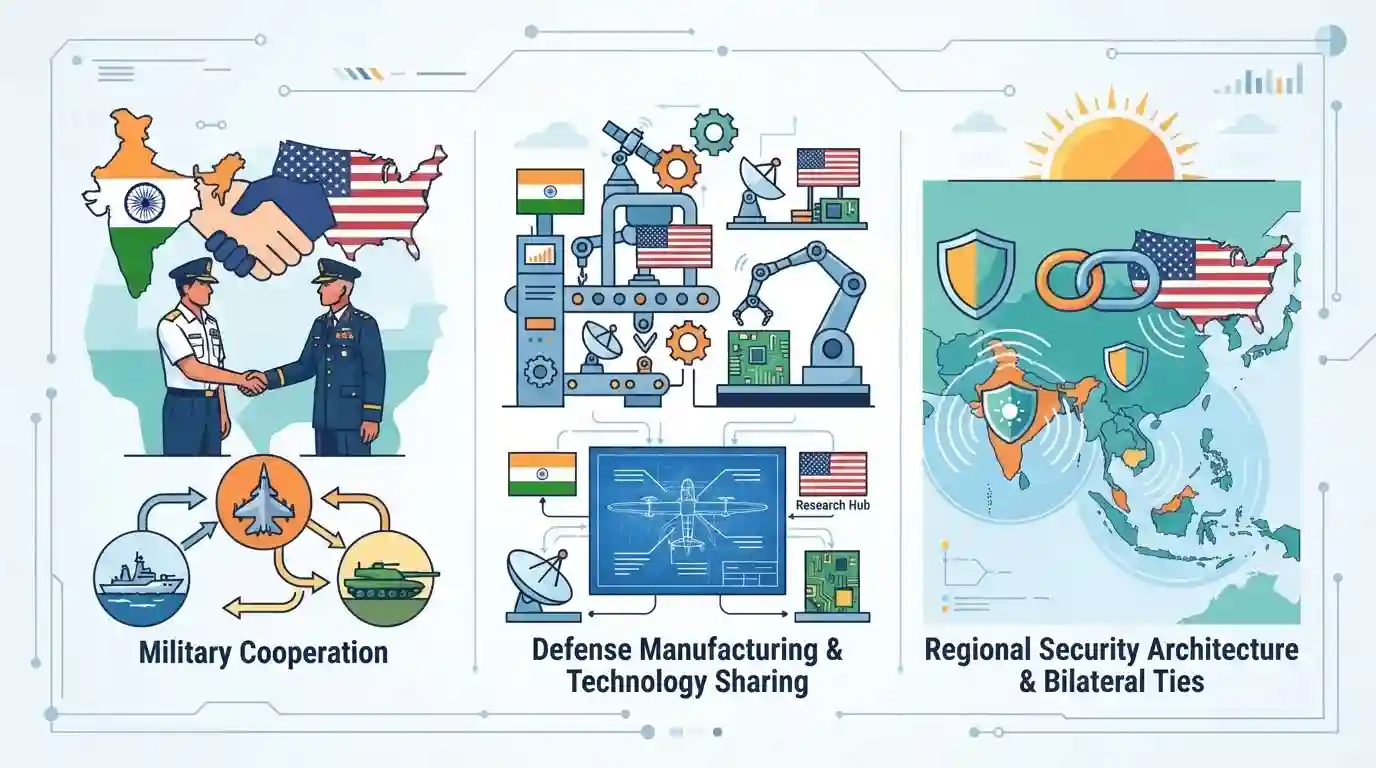
India and the United States have renewed their strategic partnership by signing a 10-year defence framework agreement designed to boost military cooperation, defence manufacturing, and technology sharing, further solidifying bilateral ties and regional security architecture.
Key Points
- India and the US signed a 10-year defence framework agreement to enhance strategic cooperation.
- The pact aims to deepen military-to-military engagement, defence trade, and technology transfer.
- It reflects the growing convergence of strategic interests between the two nations, particularly in the Indo-Pacific region.
Important Terms
10-year Defence Framework Agreement

A renewed decade-long strategic roadmap between India and the United States designed to deepen military coordination, enhance defence manufacturing, technology sharing, and regional security in the Indo-Pacific.
UPSC context
Important for GS Paper II (Bilateral Groupings & Agreements, Effect of Policies of Developed Countries on India's Interests).
India US Defence Framework
A comprehensive bilateral defence blueprint establishing long-term guidelines for strategic alignment, joint military exercises, and co-production of advanced military hardware between India and the US.
UPSC context
Crucial for GS Paper II under India-US bilateral relations and regional security architecture in the Indo-Pacific.
Prelims Trap
The 10-year defence framework agreement constitutes a formal military alliance binding India and the US into mutual treaty obligations.
Aspirants often confuse executive-level defence framework agreements with formal mutual defense treaties or military alliances, whereas India maintains a policy of non-alignment and strategic autonomy.
Static Concepts Connected
What are the four foundational defence communication and logistics agreements signed between India and the United States?
- LEMOA: Signed in 2016, it allows reciprocal logistics support, supplies, and services between the armed forces of both nations during authorized port visits, joint exercises, and humanitarian missions.
- COMCASA: Signed in 2018, it enables the transfer of encrypted communication equipment and secure data links between the US and Indian militaries to enhance interoperability.
- BECA: Signed in 2020, it facilitates the exchange of geospatial intelligence and sensitive satellite data between India and the US for navigational and targeting accuracy.
- GSOMIA: Signed in 2002, it permits the transfer of military hardware, software, and classified information while establishing security safeguards for defence technology.
Cross-Topic Patterns
Defence Pacts vs. Strategic Autonomy
Foundational military pacts (LEMOA, COMCASA, BECA) and technology transfer frameworks test India's traditional strategic autonomy against growing interoperability with Western security architectures.
Defence Manufacturing & Indo-Pacific Security
US framework agreements tie defence technology transfer directly to co-production, supporting India's Make in India initiative while balancing Indo-Pacific deterrence strategies.

Expect a match-the-following or statement-based question linking foundational US pacts (LEMOA, COMCASA, BECA) with their core operational domains.
Linked PYQs · 2
Linked PYQs · 2
- 2020MainsGS2
What is the significance of Indo-US defence deals over Indo-Russian defence deals? Discuss with reference to stability in the Indo-Pacific region.
- 2019MainsGS2
‘What introduces friction into the ties between India and the United States is that Washington is still unable to find for India a position in its global strategy, which would satisfy India's national self-esteem and ambitions.’ Explain with suitable examples.
