India-US Relations Transition Toward Transactional Diplomacy
Source:Indian Express ↗
Why It Matters
Understanding the transactional shift in India-US relations is crucial for UPSC aspirants, as it highlights the practical challenges in bilateral ties despite overarching strategic convergences. It provides critical insights for GS Paper 2 (International Relations) on how India must navigate protectionism and evolving global alignments.
Summary
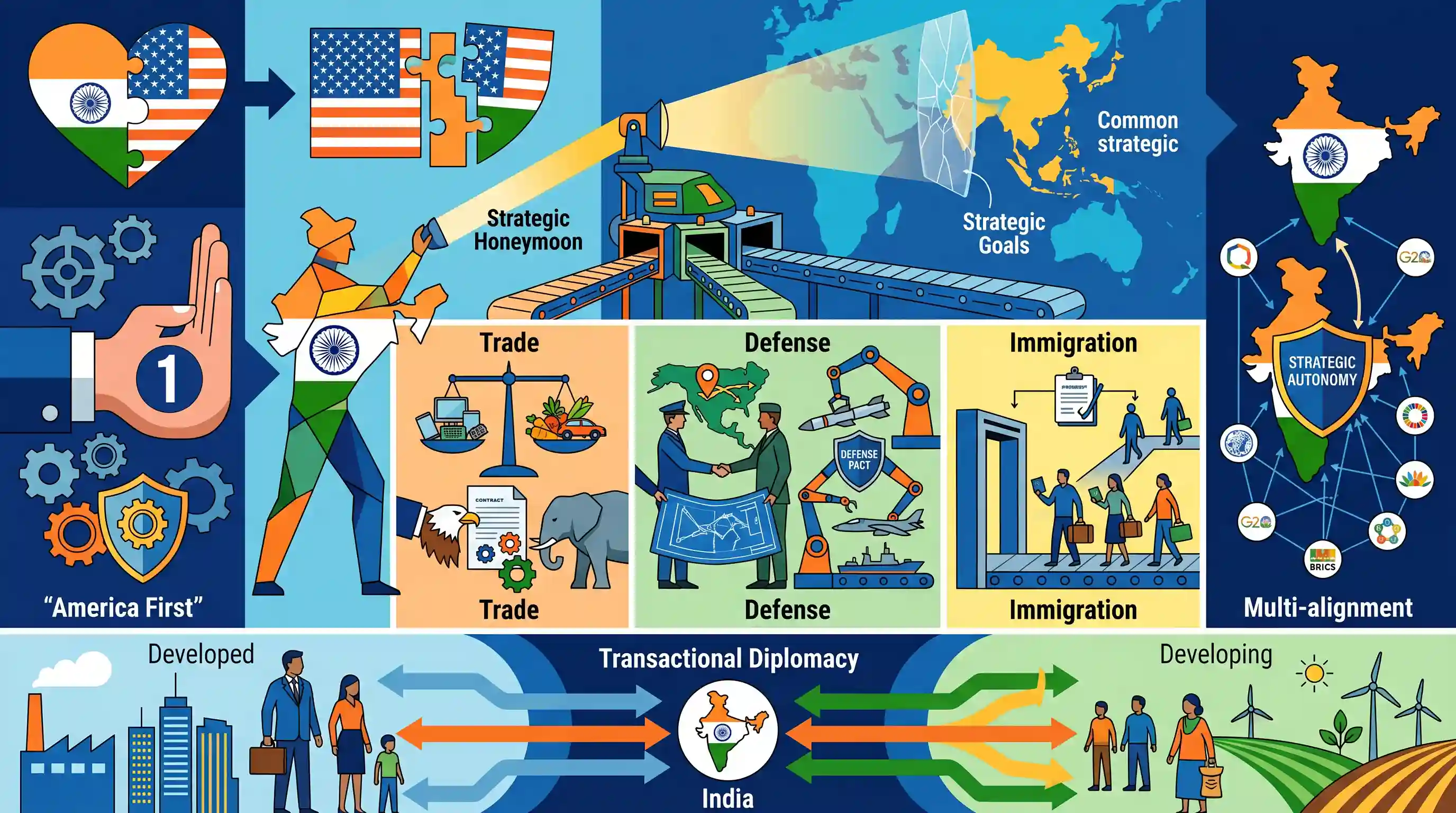
The evolving dynamics of India-US relations are witnessing a shift from a broad strategic 'honeymoon' phase to a more pragmatic and transactional diplomacy. Driven by the US's 'America First' posture, New Delhi is recalibrating its foreign policy strategy to navigate issue-based alignments rather than relying on assumed strategic altruism. This approach necessitates negotiating on specific trade, defense, and immigration matters independently, acknowledging that common strategic goals in the Indo-Pacific might not prevent friction in other bilateral domains. Consequently, India is required to maintain a highly adaptable, interest-driven diplomatic stance while upholding its strategic autonomy.
Key Points
- The India-US bilateral relationship is transitioning from an idealized strategic partnership into a phase of pragmatic, 'transactional diplomacy'.
- Driven by 'America First' policies in the US, Washington is increasingly prioritizing domestic interests, affecting areas like trade tariffs and immigration.
- Strategic convergences, such as countering China in the Indo-Pacific, are becoming decoupled from economic ties, meaning defense cooperation does not automatically translate to trade concessions.
- New Delhi is recalibrating its foreign policy strategy to handle bilateral frictions on an issue-by-issue basis, reinforcing its commitment to strategic autonomy and multi-alignment.
Important Terms
Transactional Diplomacy

A pragmatic foreign policy approach prioritizing immediate, cost-benefit outcomes and deal-specific negotiations over shared long-term ideologies or strategic altruism.
UPSC context
GS-II (International Relations); tests understanding of shifting diplomatic paradigms from strategic 'honeymoon' phases to interest-based pragmatism.
Strategic Autonomy
India’s principle of maintaining independent decision-making in foreign policy, avoiding formal military alliances while engaging with multiple global powers based on national interests.
UPSC context
GS-II (Indian Foreign Policy); foundational for evaluating India’s multi-alignment strategy in a multipolar world order.
America First
A US policy doctrine prioritizing national interests and economic protectionism over globalist frameworks. It emphasizes reducing trade deficits and unilateral action in international agreements.
UPSC context
GS-II (Effect of policies of developed countries); critical for analyzing trade frictions and US-India bilateral negotiations.
Indo-Pacific
A geostrategic maritime region spanning the Indian and Pacific Oceans. It serves as the primary theater for India-US convergence on maritime security and freedom of navigation.
UPSC context
GS-II (Regional Groupings); essential for discussing maritime strategy and India's role in regional security architectures.
Quad
A strategic forum of India, US, Japan, and Australia aimed at promoting a free, open, and inclusive Indo-Pacific through security and economic cooperation.
UPSC context
GS-II (Bilateral and Regional Groupings); tests knowledge of minilateralism and India’s regional diplomatic reach.
Comprehensive Global Strategic Partnership
The high-level institutionalized framework of India-US relations, signifying deep cooperation across defense, trade, and technology to shape a stable world order.
UPSC context
GS-II (Bilateral relations); tests the ability to analyze the evolution and current depth of India-US strategic ties.
Prelims Trap
"As Major Defense Partners, India and the US have eliminated bilateral tariffs through a Free Trade Agreement."
The US is India's largest trading partner, but they do NOT have an FTA. Under transactional diplomacy, strong defense ties do not guarantee trade concessions.
Static Concepts Connected
What are the 4 foundational defense agreements between India and the US?
- GSOMIA: Signed in 2002, allows for the safeguarding and sharing of classified military information.
- LEMOA: Signed in 2016, permits the military of either country to use the others' bases for logistics, resupply, and repairs.
- COMCASA: Signed in 2018, enables the sharing of highly encrypted, secure communications and data during joint military operations.
- BECA: Signed in 2020, allows the sharing of advanced geospatial intelligence and satellite data for pinpoint military accuracy.
How does 'Multi-alignment' conceptually differ from traditional 'Non-Alignment'?
- Non-Alignment: Historically meant maintaining distance from Cold War superpowers (US/USSR) to preserve political independence and avoid bloc politics.
- Multi-alignment: Involves actively building concurrent, issue-based partnerships with competing powers (e.g., Quad with US, SCO with Russia/China) to maximize national interest.
Cross-Topic Patterns
WTO disputes amid Quad synergy
India and the US frequently clash at the WTO over agricultural subsidies and steel tariffs, proving that strategic Indo-Pacific alignment (Quad) does not shield India from economic protectionism.
Immigration policies & Service exports
US 'America First' restrictions on H-1B visas directly impact India's IT service exports, linking GS2 bilateral relations with GS3 balance of payments and foreign exchange reserves.

India-US defense pacts + WTO trade frictions + H1B visa restrictions likely to form a single multi-statement prelims question in 2026.
Linked PYQs · 2
Linked PYQs · 2
- 2019MainsGS2
‘What introduces friction into the ties between India and the United States is that Washington is still unable to find for India a position in its global strategy, which would satisfy India's national self-esteem and ambitions.’ Explain with suitable examples.
- 2012MainsGS2
Discuss the likely negative impact of the protectionist measures proposed by the US on India's software industry.
