India US Strategic Relations and America First Policy Shift
Source:Indian Express ↗
Why It Matters
It provides a critical framework for understanding the realistic, transactional nature of modern global geopolitics, helping aspirants analyze how shifts in US domestic policy directly impact India's economic and strategic calculations.
Summary
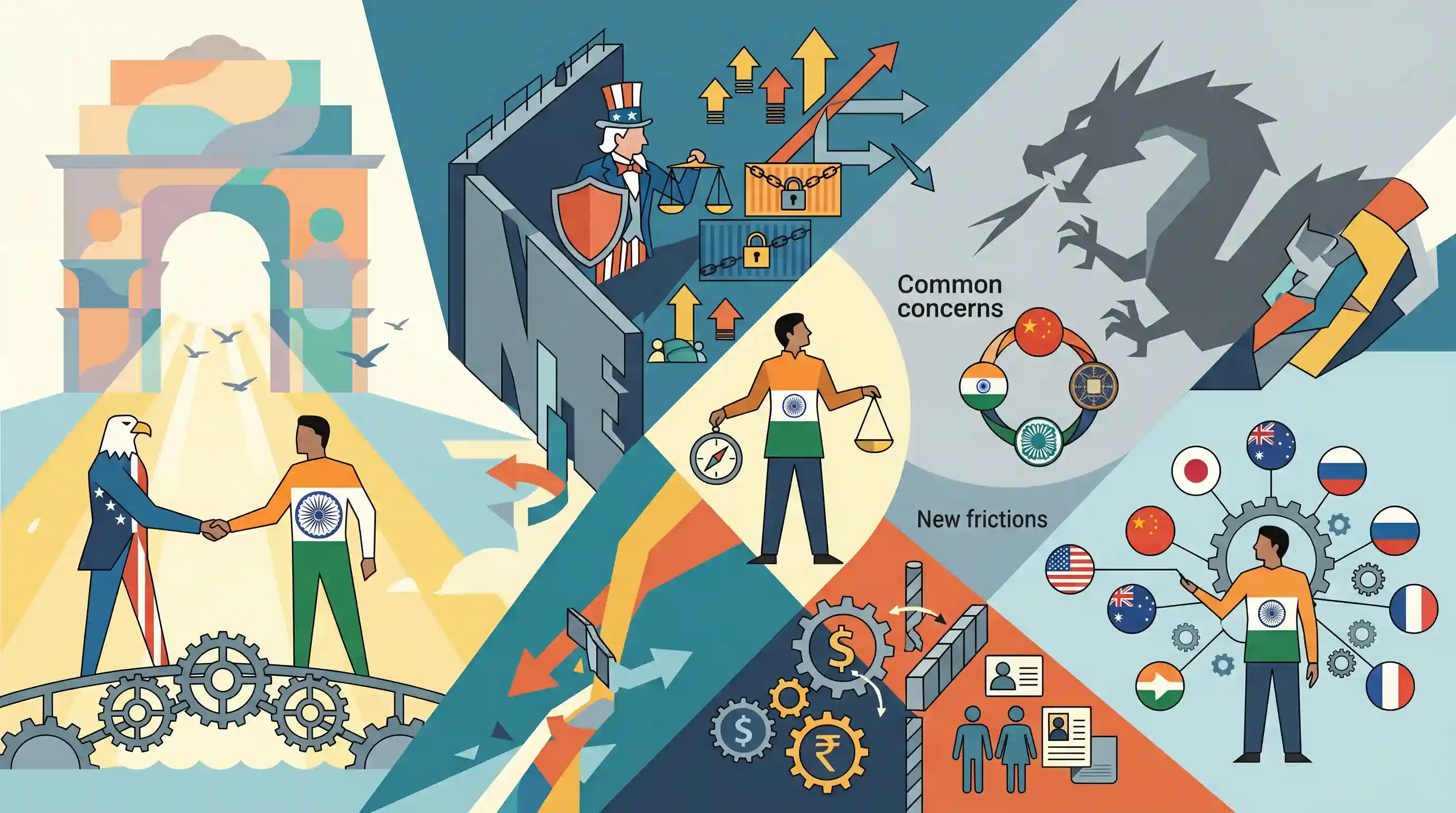
The article analyzes the evolving dynamics of India-US relations, arguing that the diplomatic "honeymoon" is being replaced by a pragmatic, transactional partnership. Driven by the "America First" doctrine, the US is increasingly prioritizing domestic interests, trade reciprocity, and protectionism over broad strategic altruism. For New Delhi, this structural shift necessitates a recalibration of its foreign policy. While mutual concerns regarding China and cooperation within the Quad sustain the strategic logic of the relationship, India must navigate emerging frictions over trade tariffs and immigration. Ultimately, the changing dynamic reinforces the importance of India maintaining its strategic autonomy, pursuing multi-alignment, and relying on hard-nosed diplomacy rather than shared democratic sentiments to secure its national interests.
Key Points
- The India-US strategic partnership is transitioning toward a more pragmatic and transactional phase driven by the 'America First' policy.
- Washington's focus on domestic economic interests, protectionism, and trade reciprocity poses challenges for Indian exports and IT professionals.
- New Delhi must adapt by reinforcing its strategic autonomy, avoiding over-reliance on a single partner, and negotiating hard on economic and defense interests.
- While shared geopolitical interests in the Indo-Pacific and concerns regarding China remain, the US is likely to demand more tangible, reciprocal contributions from India.
- The shift underscores that shared democratic values alone are insufficient, requiring India to employ hard-nosed diplomacy to navigate potential frictions in bilateral ties.
Important Terms
America First

A foreign policy doctrine prioritizing U.S. national interests, domestic manufacturing, and trade reciprocity. It often involves protectionist measures like tariffs and renegotiating bilateral agreements to reduce trade deficits.
UPSC context
GS-II: Effect of policies of developed countries on India's interests; tests understanding of transactional diplomacy and trade friction.
Quad (Quadrilateral Security Dialogue)
An informal strategic forum comprising India, the US, Japan, and Australia. It promotes a 'free, open, and inclusive' Indo-Pacific, focusing on maritime security, critical technologies, and regional stability.
UPSC context
GS-II: Regional and global groupings involving India; critical for Indo-Pacific strategy and balancing China's influence.
Strategic Autonomy
India's foreign policy principle of making independent sovereign choices without being dictated by external powers or becoming a 'junior partner' in a military alliance.
UPSC context
GS-II: Indian Foreign Policy; tests ability to analyze India's neutral stance in global conflicts (e.g., Russia-Ukraine).
Multi-alignment
A diplomatic strategy of engaging with multiple, often competing, global powers and blocs simultaneously (e.g., Quad and SCO) to maximize national interest and maintain balance.
UPSC context
GS-II: India's Foreign Policy; reflects the transition from Cold War-era Non-Alignment to modern, interest-based pragmatism.
Generalised System of Preferences (GSP)
A non-reciprocal trade preference program that allows duty-free entry for certain products from developing countries. India's status was revoked under 'America First' due to trade barriers.
UPSC context
GS-II/III: Bilateral trade relations and international trade bodies; tests knowledge of economic friction in India-US ties.
Prelims Trap
"Recent US trade actions against India are driven by the persistent US trade surplus with India."
India consistently runs a trade surplus with the US. Transactional US administrations use tariffs precisely to target this Indian surplus, not a US surplus.
Static Concepts Connected
How does 'Strategic Autonomy' differ from traditional 'Non-Alignment'?
- Traditional Non-Alignment: Focused on maintaining equal distance from Cold War power blocs and actively avoiding formal military or security alliances.
- Strategic Autonomy: Emphasizes active, issue-based multi-alignment (e.g., simultaneously engaging in the Quad and SCO) to maximize national interest without ideological rigidity.
- Economic integration: Rejects the autarkic import-substitution of early NAM in favor of aggressive global economic integration and transactional diplomatic leverage.
What are the structural economic frictions in the India-US bilateral relationship?
- Trade Tariffs: Frequent disputes over agricultural subsidies, steel/aluminum tariffs, and US complaints about India's high import duties on medical devices and ICT products.
- Visa Restrictions: Periodic tightening of H-1B and L-1 visa norms impacting the mobility of Indian IT professionals and service export revenues.
- Digital Taxation: US opposition to India's Equalisation Levy on tech giants and RBI's stringent data localization requirements for foreign payment networks.
Cross-Topic Patterns
Digital sovereignty vs Security convergence
Tensions over digital taxation (Equalisation Levy) and data localization frequently clash with US tech interests, demonstrating how economic friction persists alongside strategic security convergence.
Minilateralism as a pragmatic shift
Transactional 'America First' policies have accelerated India's shift toward outcome-driven minilaterals like the Quad and iCET over rigid, broad-based treaty alliances.

Expect a 2026 Mains question asking to critically analyze 'multi-alignment' as India's shield against US transactionalism and tariffs.
Linked PYQs · 2
Linked PYQs · 2
- 2019MainsGS2
‘What introduces friction into the ties between India and the United States is that Washington is still unable to find for India a position in its global strategy, which would satisfy India's national self-esteem and ambitions.’ Explain with suitable examples.
- 2012MainsGS2
Discuss the likely negative impact of the protectionist measures proposed by the US on India's software industry.
