USTR Proposes Tariffs on Indian Imports Over Capacity Concerns
Source:The Hindu ↗
Why It Matters
Highlights the increasing use of domestic legislation (Section 301) and human rights concerns (forced labour) as non-tariff barriers by developed nations. It underscores the dual nature of India-U.S. relations, where deep strategic partnerships coexist with persistent economic and trade frictions.
Summary
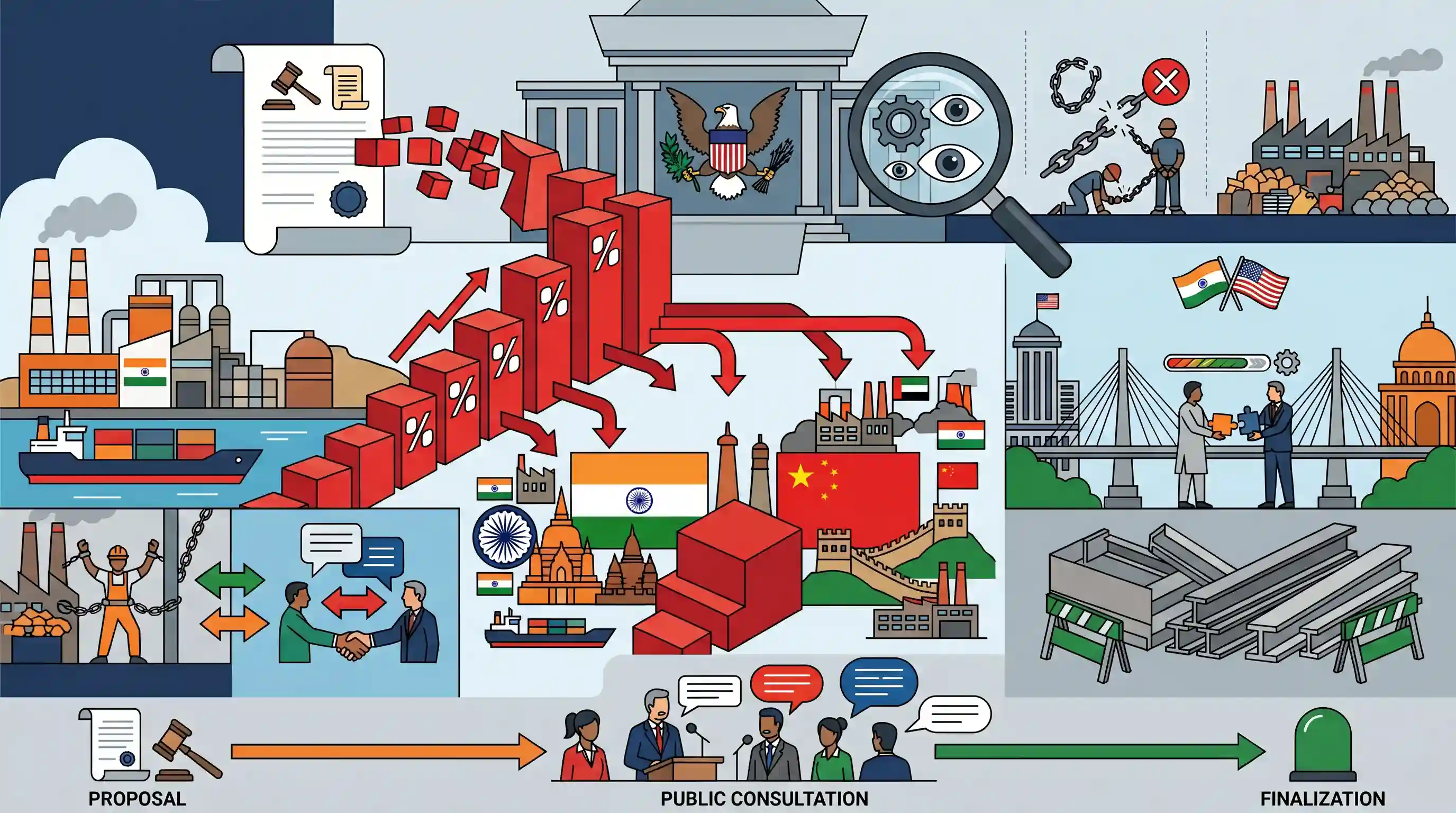
The U.S. Trade Representative (USTR) has proposed additional tariffs on imports from 60 economies, including a 12.5% tariff on India and China, citing concerns over forced labour and excess industrial capacity under a Section 301 investigation. While India faces these potential protectionist measures, it continues to engage with the U.S. to resolve the issue and concurrently negotiate an interim bilateral trade framework agreement. The proposed tariffs exclude products already covered under Section 232 sectoral tariffs and are open for public consultation before finalization.
Key Points
- The U.S. Trade Representative (USTR) has proposed a 12.5% tariff on imports from India, China, and 52 other economies under a Section 301 investigation regarding forced labour and excess industrial capacity.
- India's trade competitors like Pakistan and Indonesia face a slightly lower proposed tariff of 10%.
- Despite these trade frictions, India and the U.S. are concurrently negotiating to finalise a framework agreement for an interim trade deal.
- The USTR proposal includes a special mechanism for textiles and apparel, allowing limited import volumes to enter at lower tariff rates.
- The tariffs are not yet finalized, with public hearings and comment periods scheduled for July 2026.
Important Terms
Section 301 (U.S. Trade Act)

A provision of the U.S. Trade Act of 1974 authorizing the USTR to investigate and retaliate against foreign trade practices deemed unfair, unreasonable, or discriminatory to American commerce.
UPSC context
GS Paper 2 & 3: International Relations and Economic Development; tests understanding of unilateral trade measures and their impact on India's exports.
Section 232 (U.S. Trade Expansion Act)
A clause in the U.S. Trade Expansion Act of 1962 that empowers the President to impose trade restrictions on imports if they are found to threaten national security.
UPSC context
GS Paper 2: International Relations; relevant for analyzing trade barriers justified under 'national security' and their effects on global trade rules.
United States Trade Representative (USTR)
A cabinet-level U.S. government agency responsible for developing trade policy, conducting negotiations, and enforcing trade laws through investigations like Section 301.
UPSC context
GS Paper 2: International Relations; key institutional actor in India-U.S. bilateral trade relations and dispute resolution.
Excess Industrial Capacity
A situation where a country's production potential exceeds both domestic and global demand, often fueled by subsidies, leading to low-cost exports that distort international markets.
UPSC context
GS Paper 3: Effects of liberalization; critical for discussing global trade imbalances, anti-dumping duties, and industrial policy challenges.
Forced Labour in Supply Chains
Work performed under coercion or threat. In trade, it refers to products manufactured using such labor, often leading to import bans or sanctions as non-tariff barriers.
UPSC context
GS Paper 2: International Relations; examines human rights as non-tariff barriers and India's compliance with international labor standards.
Prelims Trap
"The imposition of Section 301 tariffs is a compliance mechanism mandated by the WTO to curb forced labour globally."
Section 301 is a domestic U.S. trade law allowing unilateral action by the USTR. It explicitly bypasses the multilateral WTO dispute settlement mechanism.
Static Concepts Connected
What is an Early Harvest Scheme (EHS) in free trade negotiations?
- Precursor to FTA: A framework where partners reduce or eliminate tariffs on a limited list of goods before concluding a broader, comprehensive trade agreement.
- Strategic purpose: Secures immediate market access and builds diplomatic trust while bypassing complex deadlocks over regulatory issues and non-tariff barriers.
- WTO compliance: Scrutinized under GATT Article XXIV, which mandates that trade agreements must ultimately cover "substantially all trade" rather than just selective sectors.
Which core ILO Conventions pertain to forced and child labour?
- Forced Labour: India has ratified Convention 29 (Forced Labour) and Convention 105 (Abolition of Forced Labour).
- Child Labour: India formally complies with Convention 138 (Minimum Age) and Convention 182 (Worst Forms of Child Labour).
- Trade defence: Ratification of these treaties is actively leveraged by developing nations to counter unilateral protectionist allegations of forced labour in supply chains.
Cross-Topic Patterns
EU CBAM & U.S. Section 301
Both represent a global shift where developed nations use domestic environmental or social laws as non-tariff barriers, effectively bypassing the multilateral WTO framework.
PLI Scheme & "Excess Capacity"
India's Production-Linked Incentives (PLI) meant to boost self-reliance are being framed by Western probes as state-subsidized "structural excess capacity," leading to retaliatory trade frictions.

Expect a 2026 prelims question pairing unilateral non-tariff barriers (Section 301, CBAM) against multilateral WTO and ILO frameworks.
Linked PYQs · 3
Linked PYQs · 3
- 2012MainsGS2
Discuss the likely negative impact of the protectionist measures proposed by the US on India's software industry.
- 2018PrelimsGS1
International Labour Organization's Conventions 138 and 182 are related to
- 2018MainsGS2
What are the key areas of reform if the WTO has to survive in the present context of "Trade War', especially keeping in mind the interest of India?
