US Foreign Policy Stance on India Pakistan and Energy Trade
Source:The Hindu ↗
Why It Matters
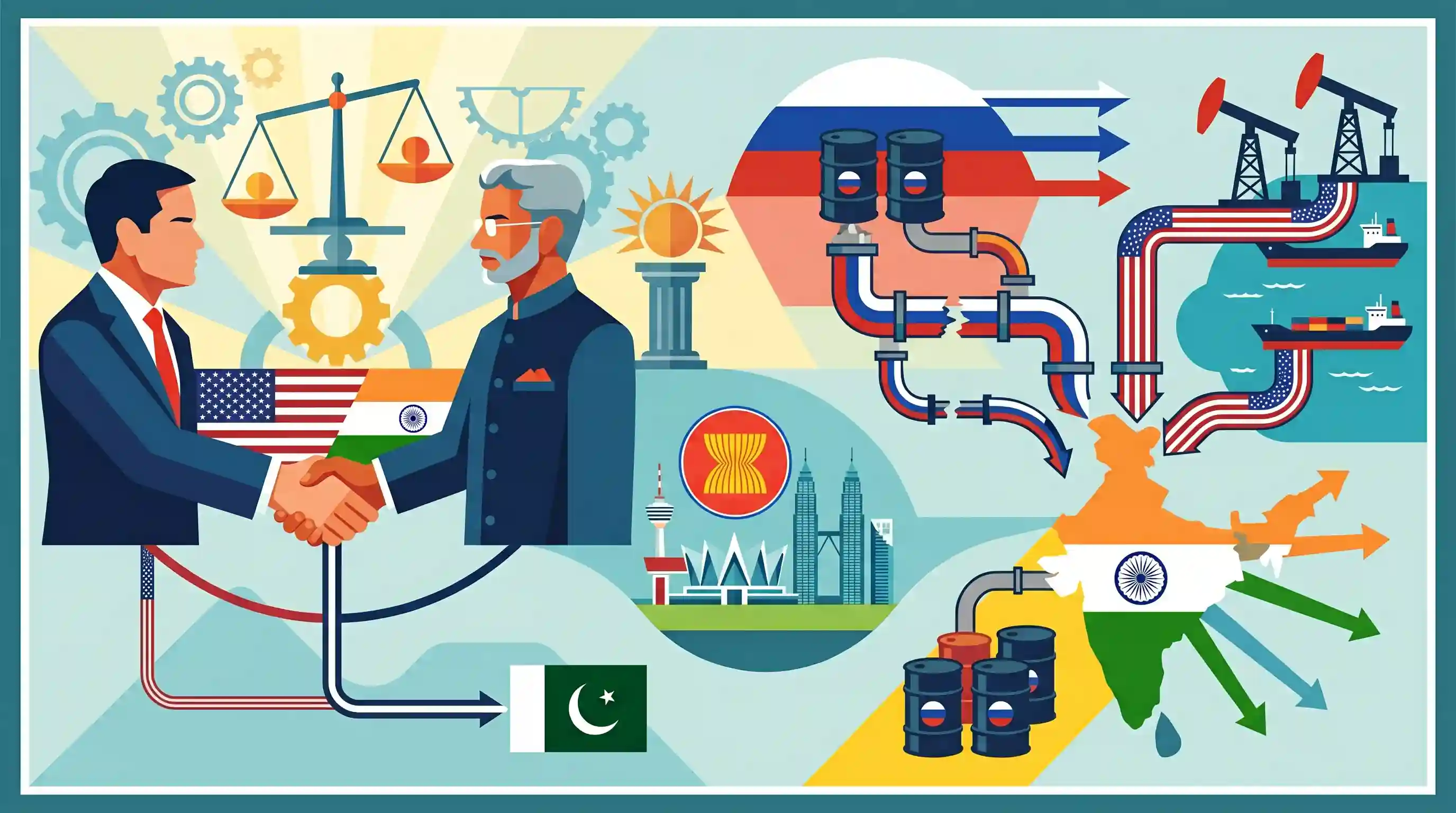
The article provides crucial insights into how the United States balances its strategic interests between India and Pakistan in a shifting geopolitical landscape. It also underscores the growing intersection of India's energy security strategy, crude oil diversification, and its broader foreign policy maneuvering amidst international sanctions on Russia.
Summary
U.S. Secretary of State Marco Rubio stated that Washington's efforts to strengthen strategic ties with Pakistan will not undermine its deep and historic relationship with India. Speaking ahead of the ASEAN summit in Malaysia, where he will meet External Affairs Minister S. Jaishankar, Rubio praised India's mature and pragmatic foreign policy. He also addressed India's energy trade with Russia, noting that New Delhi has shown an ongoing interest in diversifying its crude oil imports, which could foster broader energy cooperation and trade agreements with the United States.
Key Points
- U.S. Secretary of State Marco Rubio affirmed that Washington’s efforts to expand its strategic relationship with Pakistan will not come at the expense of its historic ties with India.
- Rubio's comments preceded his trip to Malaysia for the ASEAN summit, where he is scheduled to meet India's External Affairs Minister S. Jaishankar.
- The U.S. and Pakistan have seen an upswing in ties following a recent meeting between President Donald Trump and Pakistan Army Chief Asim Munir after a May military conflict between India and Pakistan.
- Regarding India's oil purchases from Russia, Rubio noted that New Delhi has already expressed an interest in diversifying its crude oil portfolio, potentially paving the way for increased U.S.-India energy trade.
Important Terms
ASEAN

A regional grouping of 10 Southeast Asian nations (plus observer Timor-Leste) promoting economic, security, and socio-cultural cooperation through consensus-based decision-making.
UPSC context
GS II: Bilateral/Regional Groupings. Central pillar of Act East Policy and key to Indo-Pacific maritime security.
Strategic Autonomy
A foreign policy doctrine where a nation maintains its independence in decision-making and avoids formal military alliances to safeguard its sovereign national interests.
UPSC context
GS II: Foreign Policy. Tests India’s ability to balance relations with competing powers like the US and Russia.
Energy Security
A nation's ability to ensure an uninterrupted, affordable, and diversified supply of energy resources to sustain economic growth and national defense.
UPSC context
GS III: Infrastructure/Economy. Vital for understanding India's oil import diversification and response to global supply shocks.
Act East Policy
India’s proactive engagement strategy with Southeast and East Asia, focusing on connectivity, trade, and strategic stability to enhance its regional influence.
UPSC context
GS II: International Relations. Successor to Look East; emphasizes 4C’s: Culture, Connectivity, Commerce, and Capacity Building.
Multi-alignment
A pragmatic diplomatic approach of engaging with several global powers simultaneously, often rivals, to secure diverse strategic and economic benefits.
UPSC context
GS II: Foreign Policy. Explains current Indian diplomacy of engaging with the Quad, BRICS, and SCO simultaneously.
Prelims Trap
De-hyphenation means the US maintains strictly equidistant and equal ties with India and Pakistan.
De-hyphenation means unlinking the two relationships to pursue them on independent merits. It does not mean equalizing them; it actually enables deeper US-India ties.
Static Concepts Connected
What is the "De-hyphenation" strategy in US foreign policy?
- Independent Tracks: Delinking US-India relations from US-Pakistan relations to engage each nation on its own distinct merits and strategic value.
- Zero-Sum Exit: Moves away from the Cold War-era framework where closer ties with New Delhi automatically alienated ties with Islamabad.
What is the US-India Strategic Energy Partnership (SEP)?
- Four Pillars: Organizes bilateral cooperation across four main pillars: Power/Energy Efficiency, Oil/Gas, Renewable Energy, and Sustainable Growth.
- Import Diversification: Acted as a catalyst for India to rapidly increase US crude oil and LNG imports, reducing historical over-reliance on OPEC.
- Clean Transition: Incorporates joint research initiatives like PACE-R to advance smart grids, energy storage, and transition technologies.
Cross-Topic Patterns
Energy security driving multi-alignment
India leverages discounted Russian oil to manage domestic inflation while simultaneously using crude diversification to negotiate broader trade agreements with the US.
ASEAN as a diplomatic multiplier
Multilateral forums like ASEAN are heavily utilized by India for critical sideline bilaterals (US, China), advancing 'Act East' while managing major-power dynamics.

Expect a multi-statement question on India's crude import basket shifts (Russia vs US/OPEC) linked to the 'Strategic Autonomy' doctrine.
Linked PYQs · 3
Linked PYQs · 3
- 2015MainsGS2
Terrorist activities and mutual distrust have clouded India-Pakistan relations. To what extent the use of soft power like sports and cultural exchanges could help generate goodwill between the two countries? Discuss with suitable examples.
- 2025MainsGS2
"Energy security constitutes the dominant kingpin of India's foreign policy, and is linked with India's overarching influence in Middle Eastern countries.” How would you integrate energy security with India's foreign policy trajectories in the coming years?
- 2023MainsGS2
‘The expansion and strengthening of NATO and a stronger US-Europe strategic partnership works well for India.’ What is your opinion about this statement ? Give reasons and examples to support your answer.
