India And US Negotiate New Ten Year Defence Partnership Framework
Source:The Hindu ↗
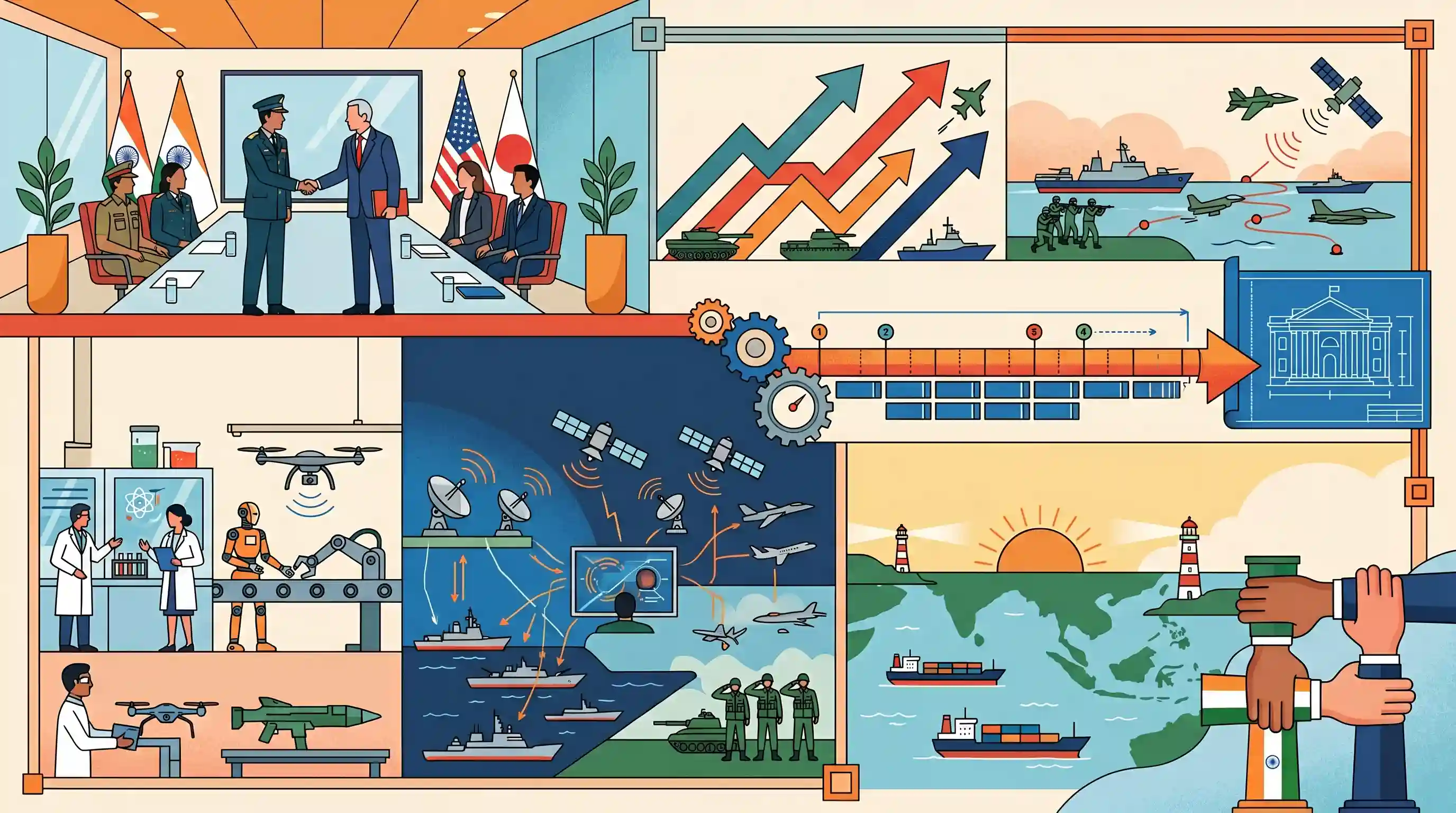
Why It Matters
The transition to a new 10-year Major Defence Partnership framework between India and the U.S. signifies a critical evolution in India's strategic alliances. It has direct implications for the balance of power in the Indo-Pacific region, India's defence modernization, and the broader geopolitical landscape involving China's rise.
Summary
India and the U.S. held a 2+2 Intersessional Dialogue, agreeing to expand their bilateral defence ties by negotiating a new 10-year framework for the India-U.S. Major Defence Partnership. The discussions emphasized advancing defence industrial and technological cooperation, improving operational coordination, and increasing information sharing. Both nations also reaffirmed their commitment to building upon the India-U.S. COMPACT initiative and maintaining a shared vision for a stable and prosperous Indo-Pacific region, highlighting the ongoing strategic importance of the Quad.
Key Points
- India and the U.S. held a 2+2 Intersessional Dialogue to review and expand their bilateral defence and strategic ties.
- Both nations agreed to negotiate a new 10-year framework for the India-U.S. Major Defence Partnership.
- The dialogue focused on advancing defence industrial, science, and technology cooperation, as well as operational coordination and information-sharing.
- The countries agreed to build upon the progress made under the India-U.S. COMPACT initiative.
- Both sides reaffirmed their shared vision for a safer, stronger, and more prosperous Indo-Pacific region through mechanisms like the Quad.
Important Terms
India-U.S. Major Defence Partnership

A unique designation granted to India by the U.S. in 2016 (renewed in 2025) allowing access to sensitive military technology and trade usually reserved for treaty allies without a formal alliance.
UPSC context
GS Paper-II (International Relations); tests understanding of strategic autonomy and India's shift from a 'buyer' to a 'co-producer' in defense.
India-U.S. COMPACT
Standing for 'Catalyzing Opportunities for Military Partnership, Accelerated Commerce & Technology,' this 10-year framework (launched 2025) streamlines technology transfers and co-production of advanced systems like missiles and drones.
UPSC context
GS Paper-II/III (Bilateral Agreements/Defence); relevant for questions on defense indigenization (Atmanirbhar Bharat) and high-tech supply chain resilience.
India-U.S. 2+2 Intersessional Dialogue
A mid-cycle review meeting between senior officials of India and the U.S. (Joint/Assistant Secretaries) to track progress on decisions made during the 2+2 Ministerial Dialogue.
UPSC context
GS Paper-II (Bilateral Groupings); demonstrates the institutionalized, 'whole-of-government' mechanism for managing strategic and security ties.
Quad
An informal strategic forum of India, USA, Japan, and Australia committed to a 'free, open, and inclusive' Indo-Pacific and a rules-based maritime order.
UPSC context
GS Paper-II (Global Groupings); central to analysis of maritime security, regional stability, and balancing Chinese assertiveness in Asia.
Bureau of South and Central Asian Affairs
A division within the U.S. State Department responsible for formulating and implementing policy towards South Asian countries, including India, and managing the 2+2 intersessional meetings.
UPSC context
GS Paper-II (Foreign Policy); useful for identifying the specific administrative actors involved in executing Indo-U.S. strategic policies.
Prelims Trap
India was designated as a Major Non-NATO Ally by the United States under the new defence framework.
India is a unique 'Major Defence Partner' (since 2016), not a Major Non-NATO Ally. This bespoke status elevates tech-sharing without invoking formal mutual treaty-ally obligations.
Static Concepts Connected
What are the four foundational defence agreements signed between India and the U.S.?
- GSOMIA: General Security of Military Information Agreement (2002) allows sharing of classified military intelligence between the two nations.
- LEMOA: Logistics Exchange Memorandum of Agreement (2016) permits reciprocal access to military facilities for logistics support and refueling.
- COMCASA: Communications Compatibility and Security Agreement (2018) provides a legal framework for transferring highly secure, encrypted communication equipment.
- BECA: Basic Exchange and Cooperation Agreement (2020) facilitates the sharing of precise geospatial and satellite data for navigation and targeting.
Which countries currently hold a 2+2 Ministerial Dialogue mechanism with India?
- Quad Partners: The U.S., Japan, and Australia hold regular 2+2 dialogues (Foreign & Defence Ministers) with India.
- Russia: A prominent non-Quad country maintaining this format, highlighting India's strategic autonomy and multi-aligned foreign policy.
- UK & Brazil: Added recently to the 2+2 roster (alongside Brazil), reflecting expanding defense cooperation beyond traditional spheres.
Cross-Topic Patterns
Defence co-production & iCET
The 10-year defence framework aligns with the Initiative on Critical and Emerging Technology (iCET), integrating AI, space, and jet engine co-production into bilateral military interoperability.
Strategic hedging & import diversification
Initiatives like COMPACT signal a shift from pure buyer-seller dynamics to co-development, accelerating India's pivot away from legacy Russian military hardware and supporting Atmanirbhar Bharat.

Expect a 2026 prelims question mapping foundational agreements (LEMOA, BECA) to new co-production frameworks (COMPACT, iCET, INDUS-X).
Linked PYQs · 1
Linked PYQs · 1
- 2020MainsGS2
What is the significance of Indo-US defence deals over Indo-Russian defence deals? Discuss with reference to stability in the Indo-Pacific region.
