India US bilateral trade agreement interim negotiations
Source:The Hindu ↗
Why It Matters
This highlights the geopolitical fragmentation of global trade. With the decline of WTO-led multilateralism, countries are resorting to unilateral tariffs (like Section 301) and ad-hoc bilateral pacts. Aspirants should understand how India navigates protectionist measures by leveraging geoeconomic commitments (like purchasing U.S. energy and tech) to protect its export interests.
Summary
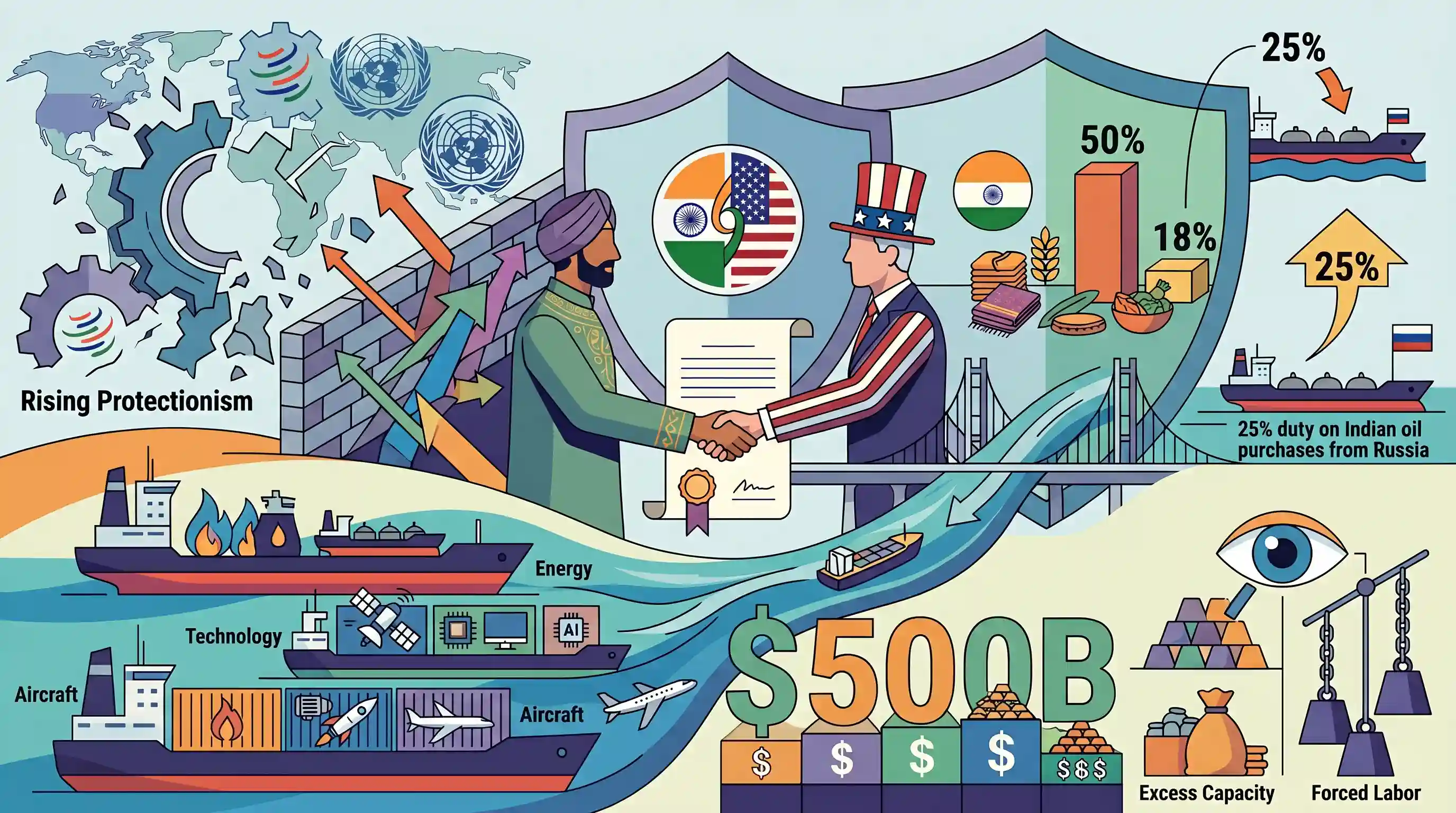
India and the United States are on track to execute the first phase of a bilateral trade agreement by mid-July, aimed at shielding bilateral commerce from rising protectionism. The negotiations were necessitated after the U.S. proposed a universal 10% tariff on all imports following a Supreme Court ruling that struck down reciprocal tariffs under the 1977 IEEPA. The pact secures key concessions, including the U.S. lowering certain tariffs on Indian goods from 50% to 18% and lifting 25% duties previously imposed over India's purchases of Russian oil. Against the backdrop of unilateral USTR Section 301 actions citing forced labor and excess capacity, India is attempting to balance the bilateral trade surplus by committing to buy $500 billion worth of U.S. energy, technology, and aircraft over five years. This development highlights the broader global economic shift from multilateralism to protectionist bilateral agreements.
Key Points
- India and the U.S. are finalizing the first phase of a bilateral trade pact, expected to be executed by mid-July, following intensive negotiations to resolve tariff friction.
- The trade recalibration comes after the U.S. Supreme Court struck down reciprocal tariffs imposed under the 1977 IEEPA, leading the U.S. to announce a universal 10% tariff on all countries.
- Under the interim agreement, the U.S. agreed to reduce specific tariffs on Indian goods from 50% to 18% and remove a 25% penalty tariff linked to India buying Russian oil.
- The USTR has launched unilateral Section 301 investigations targeting multiple nations, proposing 12.5% tariffs over concerns like excess capacity and forced labor.
- To offset concerns and balance its $34.4 billion trade surplus, India committed to purchasing $500 billion in U.S. energy products, aircraft, and technology over five years.
Important Terms
International Emergency Economic Powers Act (IEEPA)

A 1977 US law empowering the President to regulate international commerce after declaring a national emergency to deal with unusual and extraordinary threats.
UPSC context
GS-II: International Relations. Relevant for understanding US executive trade authority and its impact on Indian export stability.
Section 301 (Trade Act of 1974)
A provision of the US Trade Act of 1974 used to investigate and retaliate against foreign trade practices deemed unfair, unreasonable, or discriminatory to US commerce.
UPSC context
GS-III: Indian Economy. Key to analyzing non-tariff barriers and trade disputes affecting Indian sectors like textiles and tech.
United States Trade Representative (USTR)
The US federal agency responsible for developing trade policy and conducting bilateral and multilateral trade negotiations with other nations and the WTO.
UPSC context
GS-II: India-US Bilateral Relations. The primary counterpart for India\'s Ministry of Commerce in trade diplomacy.
Protectionism
Economic policy of restricting imports through tariffs, quotas, or regulations to protect domestic industries from foreign competition.
UPSC context
GS-III: Global Economy. Evaluates the shift from multilateralism (WTO) to bilateral trade blocs in the 21st century.
Section 122 (Trade Act of 1974)
A US law allowing the President to impose temporary tariffs (up to 15%) for 150 days to address a large balance-of-payments deficit.
UPSC context
GS-III: External Sector. Understanding legal mechanisms behind "universal tariffs" and their implications for India\'s trade surplus with the US.
Bilateral Trade Agreement (BTA)
A treaty between two nations to reduce trade barriers, eliminate tariffs, and increase market access for goods and services.
UPSC context
GS-II: Bilateral Groupings. Focuses on India\'s strategy of using interim mini-deals to secure market access.
Prelims Trap
"India maintains a structural bilateral trade deficit with the United States."
Unlike its trade relationship with China or Russia, India maintains a persistent and significant trade surplus with the United States.
Static Concepts Connected
What is Section 301 of the U.S. Trade Act and why is it controversial?
- Domestic statute: It authorizes the U.S. to unilaterally impose tariffs or sanctions on foreign countries for perceived unfair trade practices, such as forced labor or excess capacity.
- WTO bypass: It is controversial because it undermines multilateralism, bypassing the World Trade Organization's (WTO) formal Dispute Settlement Mechanism in favor of unilateral punishment.
How do tariff and non-tariff barriers (NTBs) differ in international trade protectionism?
- Tariff barriers: Direct financial charges or duties imposed on imported goods, such as the proposed universal 10% U.S. tariff, designed to make imports more expensive.
- Non-tariff barriers: Regulations, quotas, or quality standards (like citing "forced labor") used to restrict foreign imports without directly applying a standard tax.
Cross-Topic Patterns
Energy procurement as trade diplomacy
India's commitment to buy U.S. energy offsets its trade surplus, showcasing how strategic energy imports are now utilized as diplomatic leverage to prevent protectionist tariffs.
Bilateralism in the post-WTO era
As the WTO's dispute settlement body remains paralyzed, major economies are aggressively reverting to transactional bilateral agreements and unilateral domestic laws to manage trade imbalances.

Expect a 2026 prelims question contrasting India's trade surplus with the US against China, paired with unilateral Section 301 tariffs.
Linked PYQs · 3
Linked PYQs · 3
- 2025MainsGS3
What are the challenges before the Indian economy when the world is moving away from free trade and multilateralism to protectionism and bilateralism? How can these challenges be met?
- 2019MainsGS2
‘What introduces friction into the ties between India and the United States is that Washington is still unable to find for India a position in its global strategy, which would satisfy India's national self-esteem and ambitions.’ Explain with suitable examples.
- 2012MainsGS2
Discuss the likely negative impact of the protectionist measures proposed by the US on India's software industry.
