India-US Trade Deal and Critical Minerals Supply Chain Security
Source:The Hindu ↗
Why It Matters
The formulation of an India-US trade deal is highly significant amid rising global protectionism and the Trump administration's focus on recalibrating trade. It directly impacts India's export growth, economic diplomacy, and strategic efforts to secure critical supply chains while reducing dependence on China.
Summary
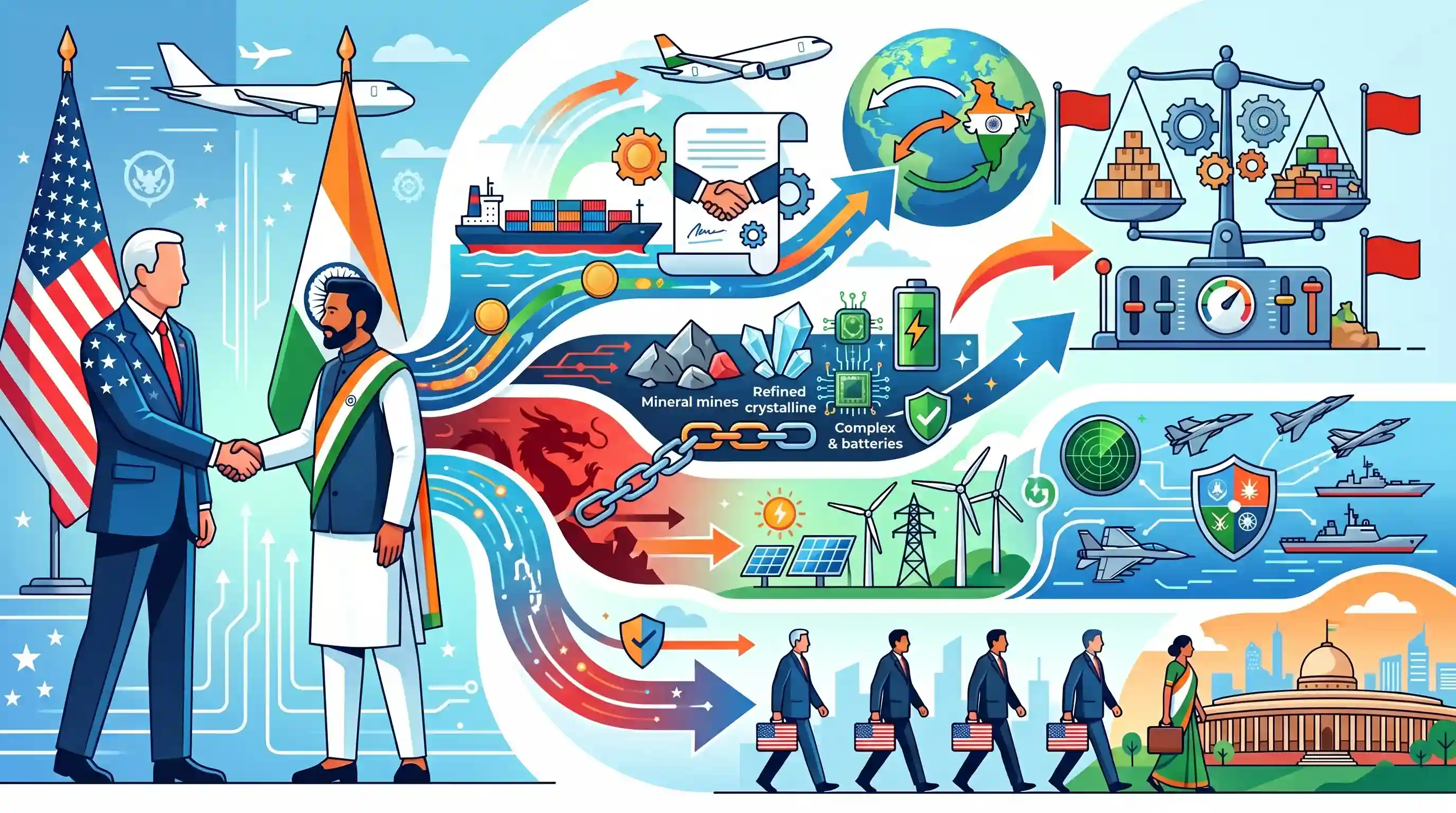
India and the US are looking forward to finalizing a bilateral trade agreement soon, following high-level discussions between External Affairs Minister S. Jaishankar and US Secretary of State Marco Rubio. During Rubio's four-day visit to India, the leaders focused on broadening cooperation across trade, critical minerals, energy, and defense. Rubio emphasized that the Trump administration’s intent to recalibrate global trade is a structural adjustment aimed at massive trade imbalances, rather than a policy directed against India. Furthermore, establishing secure supply chains independent of China, especially for critical minerals, was highlighted as a shared strategic priority. A US trade delegation will visit India soon to advance these negotiations.
Key Points
- External Affairs Minister S. Jaishankar and US Secretary of State Marco Rubio discussed expanding cooperation across trade, critical minerals, energy, and defense during Rubio's visit to India.
- The two nations are actively working towards an 'enduring, beneficial, and sustainable' bilateral trade agreement, with a US trade delegation slated to visit India shortly.
- Rubio clarified that the Trump administration's recalibration of global trade is aimed at addressing structural imbalances worldwide, rather than targeting specific nations like India.
- Strengthening resilient supply chains and reducing dependence on China, particularly concerning critical minerals, remains a core strategic objective of the evolving India-US partnership.
Important Terms
India-US Bilateral Trade Agreement (BTA)

A proposed pact to reduce tariffs and non-tariff barriers, enhancing market access for Indian exports like textiles and pharmaceuticals and US products like agriculture and energy.
UPSC context
GS Paper 2: Bilateral agreements involving India; tests understanding of trade diplomacy and economic impact of bilateral deals.
iCET (Initiative on Critical and Emerging Technology)
A 2022 framework to elevate strategic technology and defense industrial cooperation in areas such as AI, semiconductors, space, and next-generation telecommunications.
UPSC context
GS Paper 2 & 3: Strategic partnerships and Science & Tech; focuses on technology transfer and defense indigenization.
Minerals Security Partnership (MSP)
A US-led multilateral initiative aimed at securing resilient and sustainable global supply chains for critical minerals; India became the 14th member in 2023.
UPSC context
GS Paper 2: International groupings; tests knowledge of energy security and global supply chain diversification.
Critical Minerals
Minerals like lithium, cobalt, and rare earth elements essential for high-tech manufacturing, clean energy, and defense, currently vulnerable to geopolitical supply disruptions.
UPSC context
GS Paper 1 (Geography/Resources) & Paper 3 (Security/Environment); critical for the green energy transition and self-reliance.
Trade Imbalance
A situation where the value of a country's imports exceeds exports (deficit) or vice-versa (surplus); the US seeks to address its trade gap through 'rebalancing.'
UPSC context
GS Paper 3: Indian Economy and issues of trade deficit; tests ability to analyze bilateral economic friction points.
Major Defense Partner
A unique strategic designation granted to India by the US in 2016, facilitating advanced defense technology sharing at levels similar to US treaty allies.
UPSC context
GS Paper 2: Bilateral Relations; essential for understanding the shift in India-US defense and security ties.
Prelims Trap
India suffers a chronic bilateral trade deficit with the United States.
While India runs a massive overall global trade deficit, it consistently maintains a significant trade SURPLUS with the US, which makes it a target for US tariff recalibrations.
Static Concepts Connected
What classifies a mineral as "critical" for a nation?
- Economic and Strategic Importance: They are indispensable for modern advanced technologies, clean energy transitions (EVs, solar), and defense manufacturing.
- High Supply Risk: Extraction and processing are highly concentrated in a few geographies (e.g., China), making global supply chains highly vulnerable to geopolitical disruptions.
- Lack of Substitutes: There are currently no viable or commercially scalable alternatives for these minerals in their specific industrial applications.
How do standard FTAs differ from CECA/CEPA agreements?
- Traditional FTAs: Focus primarily on reducing or eliminating customs duties (tariffs) on a specified list of traded goods.
- CEPA / CECA: Comprehensive agreements that go beyond goods to include services, investment, intellectual property, government procurement, and regulatory cooperation.
- Preferential Trade Agreements (PTA): The most basic form where partners reduce tariffs on a 'positive list' of items, rather than aiming for zero duty across the board.
Cross-Topic Patterns
Critical Minerals Security Partnership (MSP)
India's push for an independent critical mineral supply chain links directly to its 2023 entry into the US-led Minerals Security Partnership (MSP) and the broader "China+1" global de-risking strategy.
Bilateralism bypassing the WTO
The US shift toward structural tariff adjustments and bilateral deals reflects the ongoing paralysis of the WTO's dispute settlement mechanism, forcing India to secure its market access bilaterally.

Expect a 2026 multi-statement question merging India-US trade surplus dynamics with the US-led Minerals Security Partnership.
Linked PYQs · 2
Linked PYQs · 2
- 2025MainsGS3
What are the challenges before the Indian economy when the world is moving away from free trade and multilateralism to protectionism and bilateralism? How can these challenges be met?
- 2020MainsGS2
What is the significance of Indo-US defence deals over Indo-Russian defence deals? Discuss with reference to stability in the Indo-Pacific region.
