India and US finalize interim trade deal focusing on technology
Source:The Hindu ↗
Why It Matters
The growing tech-trade nexus between India and the U.S. is crucial for India's strategic self-reliance in emerging technologies. Understanding the intersections of IP, AI infrastructure (like the India AI Mission), and foreign investment is important for answering questions on technology policy and international trade.
Summary
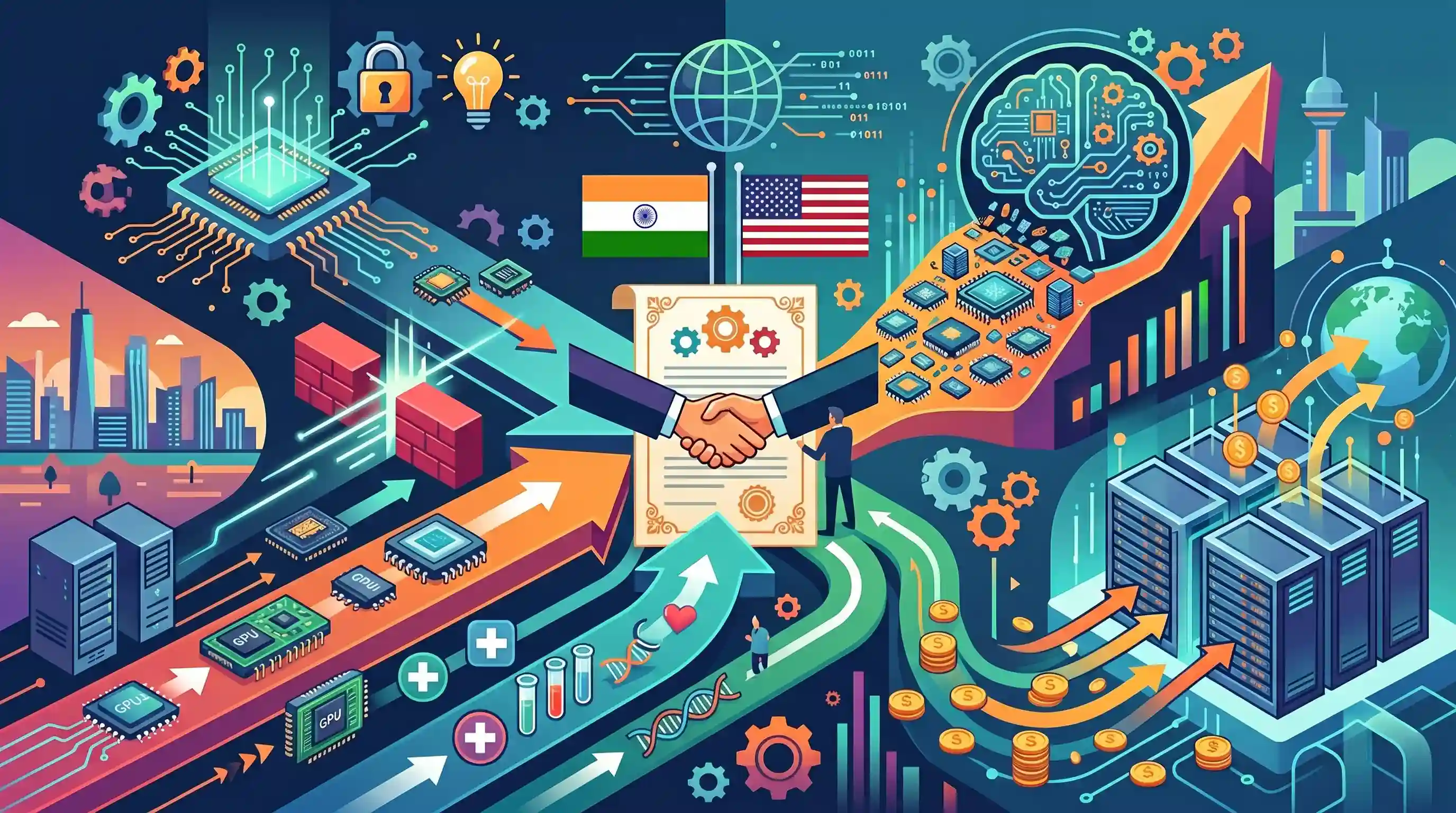
India and the United States have formulated an interim trade deal to address non-tariff barriers and enhance trade in technology and medical goods. The agreement reflects deepening bilateral cooperation on electronics and Intellectual Property (IP) co-development. The deal is set to expand trade in critical tech hardware like GPUs and data center components. Concurrently, the India AI Mission is advancing the domestic tech ecosystem by procuring over 34,000 GPUs, bolstered by massive investments from global tech giants into Indian data centers.
Key Points
- India and the U.S. have finalized an interim trade deal aimed at resolving non-tariff barriers for U.S. exports, particularly medical devices and ICT goods.
- Union Minister Ashwini Vaishnaw highlighted the close bilateral cooperation on electronics and Intellectual Property (IP), focusing on co-development and respecting IP rights.
- The agreement is expected to significantly boost trade in technology infrastructure, including Graphics Processing Units (GPUs) and data center equipment.
- Under the India AI Mission, over 34,000 GPUs have been procured to build a common compute facility, driving domestic AI innovation.
- Global tech giants have committed over $90 billion in data center investments in India, strengthening the country's multi-layered AI and tech ecosystem.
Important Terms
India-U.S. Interim Trade Deal

A 2026 bilateral framework aiming to reduce tariffs to a reciprocal 18%, resolve non-tariff barriers, and enhance trade in high-tech goods like GPUs and medical devices.
UPSC context
GS Paper II & III: International Relations and Indian Economy; tests bilateral trade diplomacy and tariff/non-tariff strategies.
IndiaAI Mission
A national initiative focused on establishing a sovereign AI ecosystem, featuring a common compute facility with 34,000+ GPUs and support for indigenous foundation models.
UPSC context
GS Paper III: Science & Technology; tests awareness of digital sovereignty and government-led tech infrastructure.
Non-Tariff Barriers (NTBs)
Trade restrictions other than tariffs, such as import licensing procedures, technical standards, and testing requirements, which often limit market access for medical and ICT products.
UPSC context
GS Paper III: Economy; essential for understanding trade hurdles and regulatory alignment in global commerce.
Digital Connexion
A joint venture between Reliance, Brookfield, and Digital Realty, investing $11 billion in AI-native 1GW data center campuses in Visakhapatnam to support hyperscale workloads.
UPSC context
GS Paper III: Infrastructure/Economy; highlights the role of FDI and private investment in India's digital backbone.
GPUs (Graphics Processing Units)
Specialized hardware essential for processing AI workloads; a primary focus of the India-US tech trade to bolster India's computational power and data center capacity.
UPSC context
GS Paper III: Science & Technology; relevant for questions on critical emerging technologies and supply chain security.
iCET (Initiative on Critical and Emerging Technology)
A strategic partnership between India and the U.S. designed to elevate and expand bilateral technology cooperation in areas like AI, space, and semiconductors.
UPSC context
GS Paper II: International Relations; crucial for understanding high-level strategic and technological ties with the U.S.
Prelims Trap
The India-US Interim Trade Deal is a Comprehensive Free Trade Agreement (FTA) eliminating all bilateral tariffs.
An interim deal is limited in scope, focusing here on Non-Tariff Barriers (NTBs) and specific sectors (ICT/medical), unlike a full FTA/CEPA which entails sweeping tariff elimination.
Static Concepts Connected
What are the main types of Non-Tariff Barriers (NTBs) recognized by the WTO?
- SPS Measures: Sanitary and Phytosanitary measures enacted by countries to ensure food safety and protect animal or plant health.
- TBT Measures: Technical Barriers to Trade covering specific product standards, testing protocols, and mandatory certification rules.
- Quantitative Restrictions: Direct volume limits such as import quotas, strict licensing requirements, and voluntary export restraints.
What are the benefits of granting "Infrastructure Status" to Data Centers?
- Cheaper Credit: Allows developers to access long-term, low-cost financing from banks and specialized infrastructure lenders.
- ECB & FDI: Eases regulatory norms for raising External Commercial Borrowings (ECBs) and attracts sustained foreign direct investment.
- Policy Support: Enables inclusion in the Harmonized Master List, reducing administrative bottlenecks for land and power procurement.
Cross-Topic Patterns
IPR + Strategic Tech Transfers
The shift to IP co-development in this deal mirrors India’s broader push under iCET for indigenous deep-tech and defense self-reliance, moving beyond purely transactional imports.
AI Mission + Digital Public Goods
Procuring 34,000 GPUs extends India's Digital Public Infrastructure (DPI) model—creating a 'sovereign compute' grid to democratize AI access for startups, much like UPI did for payments.

Expect a 2026 Prelims question linking 'Infrastructure Status' for data centers with India AI Mission goals and WTO NTB classifications.
Linked PYQs · 3
Linked PYQs · 3
- 2025MainsGS3
India aims to become a semiconductor manufacturing hub. What are the challenges faced by the semiconductor industry in India? Mention the salient features of the India Semiconductor Mission.
- 2014MainsGS3
In a globalized world, Intellectual Property Rights assume significance and are a source of litigation. Broadly distinguish between the terms-Copyrights, Patents and Trade Secrets.
- 2023MainsGS3
Introduce the concept of Artificial Intelligence (AI). How does Al help clinical diagnosis? Do you perceive any threat to privacy of the individual in the use of Al in healthcare?
